








|
Getting your Trinity Audio player ready...
|
Table of Contents
Few decisions shape an online store more than the platform it’s built on. And when the conversation turns to Shopify vs WooCommerce, the debate quickly becomes intense. These two platforms dominate the eCommerce landscape, yet they approach online selling from completely different angles.
On the one hand, you have Shopify, a fully managed, subscription-based platform designed for simplicity and speed. On the other hand, WooCommerce is a flexible WordPress plugin that enables deep customization with no upfront licensing cost.
Naturally, the question follows: is the “free” model truly more economical, or does a paid ecosystem deliver stronger long-term value? More importantly, which option actually fits your business goals?
This article answers all your questions, including a detailed comparison of Shopify vs WooCommerce. Let’s first understand each of these platforms individually.
Overview: Shopify vs WooCommerce For Beginners
If you’re new to eCommerce, understanding the fundamentals behind Shopify vs WooCommerce is the smartest place to begin. Both platforms are powerful, widely adopted, and designed to help businesses sell online, yet they operate in very different ways. Before you compare Shopify vs WooCommerce, it’s essential to grasp what each solution actually offers and where each one fits best.
The WooCommerce vs Shopify comparison ultimately reflects two different philosophies. WooCommerce offers freedom and granular control but demands greater involvement. Shopify prioritizes ease and stability while trading off some customization depth.
What is WooCommerce?
WooCommerce is an open source eCommerce plugin designed for WordPress. Rather than operating as a separate platform, it converts a WordPress website into a fully functional Shopify online store. This architecture gives users extensive control over design, features, and behavior. Because WordPress itself powers a large portion of the web, WooCommerce naturally benefits from a massive ecosystem of themes, developers, and extensions.
For beginners, WooCommerce is often attractive due to its flexibility and low initial cost. You can modify nearly anything, extend functionality endlessly, and tailor the store to precise business needs.
Key advantages:
- Deep integration with the WordPress content management system
- Complete customization thanks to its open-source nature
- Wide selection of themes and design options
- High flexibility for complex requirements
- Broad support for payment gateways
- Core platform available at no cost
Challenges to consider:
- Requires time and technical comfort to master
- WordPress familiarity is almost mandatory
- Essential tools like SSL certificates are not bundled
- Heavy plugin usage can impact performance
- Many advanced extensions involve additional costs
WooCommerce is often attractive due to its flexibility and low initial cost. You can modify nearly anything, extend functionality endlessly, and tailor the store to precise business needs. Businesses that require deeper customization often explore professional WooCommerce Development Services to unlock the platform’s full potential.

What is Shopify?
Shopify, in contrast, is a fully hosted eCommerce platform designed for simplicity and speed. Everything, such as hosting, security, maintenance, and infrastructure,e is managed for you. This dramatically lowers the technical barrier for beginners and allows store owners to focus on products, marketing, and sales rather than setup and configuration.
When merchants compare Shopify vs WooCommerce, Shopify often stands out for its ease of use and polished user experience. The platform provides structured workflows, attractive storefront templates, and a large marketplace of apps that expand functionality.
Key advantages:
- Beginner-friendly interface requiring minimal technical skills
- Professionally designed storefront themes
- Automation through apps and integrations
- Reliable 24/7 customer support
- Built-in hosting and security management
- Strong support for omnichannel selling, including in-person sales
Challenges to consider:
- Customization is more restricted than WooCommerce
- Advanced users may find flexibility constraints
- Limited selection of free themes
- Many third-party apps introduce recurring costs
Shopify’s fully hosted architecture removes much of the technical burden, making it especially appealing for growing brands. Businesses aiming for rapid deployment and scalability often consider specialized Shopify Development Services to accelerate store setup and optimization.
WooCommerce vs Shopify: A Practical Side-by-Side Breakdown
When businesses compare Shopify vs WooCommerce, the goal is to understand how each platform behaves in real-world use. Both solutions can power successful stores. Both have loyal advocates. Yet the experience, costs, and long-term management responsibilities differ in ways that directly impact day-to-day operations.
Let’s break down the comparison in a clear, beginner-friendly way.
Cost and Fees
Pricing is often the first filter in the WooCommerce vs Shopify decision.
WooCommerce
WooCommerce itself is free, which makes the entry point extremely appealing. However, running a live store involves supporting services. Store owners typically invest in web hosting, domain registration, premium themes, and specialized extensions for shipping or advanced functionality. Costs vary widely depending on hosting quality, design preferences, and scaling needs. While many merchants find WooCommerce economical at the start, expenses grow as complexity increases.
Shopify
Shopify follows a subscription model with tiered plans designed for different business sizes. The structure offers predictability in which you know your baseline monthly cost. That said, certain features, premium themes, and third-party apps introduce additional charges. Although Shopify may appear more expensive upfront, the bundled infrastructure often reduces unexpected technical expenses.
Ease of Use
For beginners evaluating whether Shopify or WooCommerce, usability plays a decisive role.
WooCommerce
WooCommerce demands more involvement. Users must manage WordPress installation, plugin setup, updates, backups, and security configurations. The guided setup helps, but the interface assumes some WordPress familiarity. Without prior experience, the learning curve can feel steep.
Shopify
Shopify’s fully hosted model simplifies everything. No manual installations. No update management. No server maintenance. You create an account, choose a theme, and begin configuring your store. This streamlined workflow is one reason many first-time merchants prefer Shopify.
Design and Themes
Visual presentation matters, and it’s a noticeable contrast in the WooCommerce vs Shopify comparison.
WooCommerce
WooCommerce provides access to thousands of themes and nearly unlimited design flexibility. Because it’s open-source, developers can modify virtually any visual or structural element. The trade-off? Achieving polished results may require more customization effort.
Shopify
Shopify themes are widely recognized for their clean, modern aesthetics. Templates are optimized for conversions and mobile responsiveness. While customization is possible, theme variety is smaller compared to WooCommerce.
Features and Flexibility
Both platforms extend functionality through integrations, yet they differ in philosophy.
WooCommerce
Built on WordPress, WooCommerce benefits from a vast plugin ecosystem. Whether you need SEO enhancements, advanced checkout logic, or marketing automation, there’s typically an extension available. Flexibility is a defining strength.
Shopify
Shopify’s app marketplace delivers similar extensibility with a more controlled environment. Apps are easy to install and generally integrate smoothly. The platform’s API also enables deeper custom solutions when needed.
Payment Methods and Transaction Fees
Payments are essential in any comparison of Shopify vs WooCommerce analysis.
WooCommerce
WooCommerce supports its native payment solution along with numerous third-party gateways. Merchants can integrate options like Stripe, PayPal, Square, and others. Transaction fees largely depend on the selected gateway rather than WooCommerce itself.
Shopify
Shopify offers its own payment system while also supporting a wide array of external providers. Setup is typically faster, particularly for beginners. As with WooCommerce, processing fees are mostly tied to payment providers.
SEO Capabilities
Search visibility influences long-term growth, making this a critical comparison point.
WooCommerce
WooCommerce shines in SEO flexibility. Powerful plugins enable granular control over metadata, sitemaps, indexing rules, and technical optimizations. However, effective configuration often requires some expertise.
Shopify
Shopify includes built-in SEO essentials such as sitemap generation and canonical tags. The system is structured and beginner-friendly. For deeper optimization, merchants rely on specialized apps.
Security and Maintenance
Security considerations frequently shape the WooCommerce or Shopify choice, and this is where differences become structural. A proper Shopify vs WooCommerce security comparison highlights responsibility allocation.
WooCommerce
Security depends heavily on hosting providers, SSL certificates, updates, and plugins selected by the user. This grants control but requires active management. Neglecting maintenance can introduce vulnerabilities.
Shopify
Shopify manages infrastructure-level security automatically. Hosting, updates, and core protections are handled by the platform. This reduces technical overhead and maintenance demands.
Shipping and Fulfillment
Efficient logistics are crucial for scaling stores.
WooCommerce
WooCommerce enables extensive shipping customization through extensions. Users can configure carriers, live rates, and label printing. Flexibility is high, but setup complexity may increase.
Shopify
Shopify includes built-in shipping tools that simplify rate comparisons, label generation, and notifications. Inventory tracking features are also tightly integrated, making store management smoother for beginners.
Shopify vs WooCommerce: Comparing Essential eCommerce Capabilities
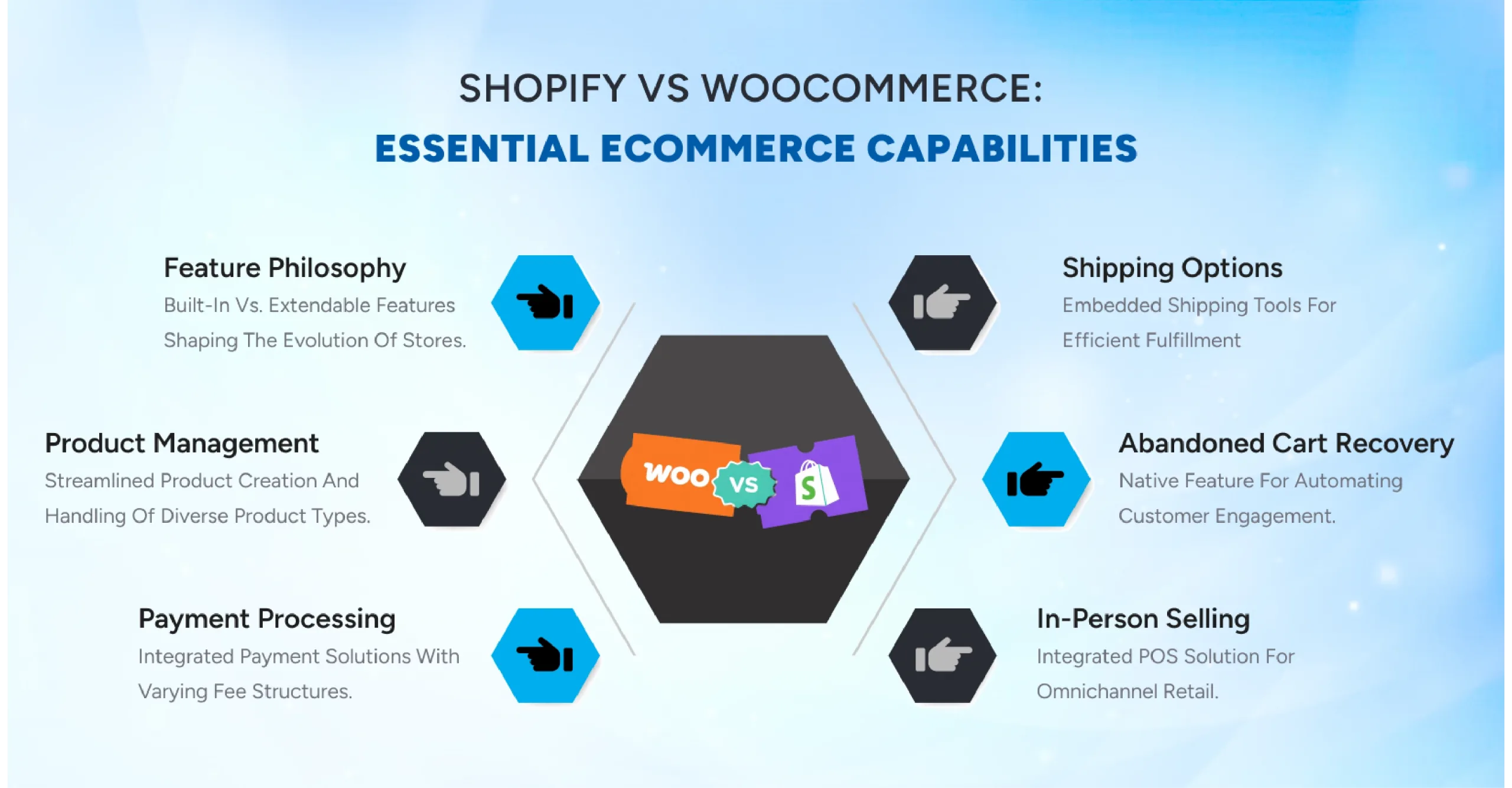
At first glance, both platforms appear to deliver similar outcomes, helping you build and operate an online store. But when you examine how features are delivered and managed, the differences become much clearer. The Shopify vs WooCommerce comparison is about how easily you can access them, how much configuration is required, and how those decisions affect scalability.
Let’s look at how these both platform plays out across key store operations.
Product Management
Shopify streamlines product creation with a clean, structured interface. Adding products, defining variants like size or color, setting pricing, and managing inventory are straightforward tasks. For businesses selling standard physical or digital products, the workflow feels intuitive and fast.
WooCommerce allows unlimited products and variations without platform restrictions. Its real strength, however, lies in handling non-standard product models. Through official extensions, merchants can support bookings, subscriptions, memberships, and other complex product types. This flexibility is powerful, though it often requires additional configuration.
WooCommerce supports a wide range of product configurations, including digital goods and memberships. This flexibility makes it ideal for niche solutions such as an Ecommerce Web Platform for Audio and eBooks, where content delivery and user access control are critical.
Payment Processing & Fees
Payments are tightly integrated through Shopify Payments. When merchants use this gateway, they avoid additional platform-level transaction fees. However, choosing external processors such as Stripe or PayPal introduces extra charges imposed by Shopify alongside the provider’s own fees. This structure rewards merchants who remain inside Shopify’s ecosystem.
WooCommerce does not apply platform transaction fees, regardless of the payment gateway selected. Store owners only pay the fees charged by their chosen processor. This model provides financial predictability and greater freedom in payment provider selection, a factor many merchants weigh carefully when deciding between Shopify and WooCommerce.
Shipping Options
Shipping tools are embedded into Shopify’s core experience. Users can access carrier integrations, view discounted rates, and print shipping labels directly from the dashboard. The built-in approach reduces reliance on third-party tools and simplifies fulfillment workflows.
WooCommerce includes basic shipping settings, such as flat rates and local pickup. Advanced capabilities, including live carrier rates or label printing, require dedicated extensions. While this modular system supports customization, it also introduces extra setup steps.
Abandoned Cart Recovery
Abandoned cart recovery is available as a native feature. Merchants can automate reminder emails without installing additional tools, making conversion optimization easier for beginners and growing stores alike.
WooCommerce does not provide abandoned cart functionality within its core plugin. To enable similar automation, merchants must integrate third-party extensions, many of which involve recurring costs. This distinction often becomes significant for stores focused on maximizing revenue from existing traffic.
In-Person Selling (Point of Sale)
Shopify offers a fully integrated POS solution that synchronizes online and offline sales, inventory, and customer data. This unified system is particularly valuable for retailers operating both physical and digital channels.
WooCommerce lacks an official native POS infrastructure. In-person selling is possible through external integrations, but implementation typically demands more technical coordination. For merchants prioritizing omnichannel retail, this difference can influence the broader Shopify vs WooCommerce decision.
Feature Philosophy: Built-In vs Extendable
The contrast between Shopify vs WooCommerce ultimately reflects two distinct design strategies. Shopify reduces complexity by embedding features directly into the platform, creating a controlled yet simplified environment. WooCommerce emphasizes extensibility, allowing merchants to assemble highly tailored stores through plugins.
Neither approach is inherently superior. The better option depends on operational priorities. Businesses seeking convenience, speed, and minimal technical management often lean toward Shopify. Those valuing deep customization and infrastructure control frequently prefer WooCommerce.
Understanding this difference is essential when choosing Shopify or WooCommerce, because the platform’s feature philosophy will shape your store’s evolution long after launch.

Making the Right Choice: Shopify or WooCommerce?
The Shopify vs WooCommerce debate often creates the impression that one solution must clearly outperform the other. In reality, both platforms are highly capable, but they serve different business needs, technical preferences, and growth strategies.
Your ideal platform depends on how you plan to run your store, how much control you need, and how involved you want to be in the technical side of operations. Let’s simplify the decision framework.
Choose Shopify if:
- You’re new to eCommerce and prefer a system that minimizes technical setup
- Ease of use matters more than deep customization flexibility
- Access to 24/7 customer support is a priority
- You want most features available without managing numerous plugins
- Scaling to higher sales volumes is part of your growth plan
- You operate both online and in-person sales channels
Shopify is typically the stronger fit for merchants who value speed, convenience, and a managed infrastructure. The platform reduces operational complexity, allowing business owners to focus on marketing, product strategy, and customer experience rather than maintenance.
Choose WooCommerce if:
- Full customization and design control are critical to your business
- You want extensive flexibility through WordPress’s ecosystem
- Advanced SEO configurations are central to your strategy
- You run a small to medium-sized business with specific functional needs
- Your website already operates on WordPress
- Budget sensitivity is a major factor (while recognizing variable costs)
WooCommerce is often ideal for merchants who prioritize ownership, adaptability, and granular control. Its open-source nature enables virtually unlimited modifications, making it attractive for businesses with unique workflows or highly tailored user experiences.
Conclusion
Choosing between platforms is rarely just a technical decision. It’s a business commitment that shapes how your store evolves, how efficiently your team operates, and how easily you adapt to change. The real challenge isn’t simply which is better, Shopify or WooCommerce, but which ecosystem best supports your long-term growth, operational comfort, and customer experience strategy. Trends shift, tools improve, and business models expand, making flexibility and scalability more important than ever.
Ace Infoway helps businesses move beyond surface-level comparisons like WooCommerce vs Shopify, aligning platform decisions with measurable business outcomes. From strategy and development to optimization and integrations, our team ensures your store is built for performance, security, and sustainable growth.
If you’re planning your next move, contact us to explore the right approach for your eCommerce journey.
FAQ
Does platform choice affect website speed and performance?
Yes, but not always in obvious ways. Shopify’s hosted infrastructure is optimized by default, while WooCommerce’s performance depends heavily on hosting quality, theme efficiency, and plugin usage. Poor optimization on either platform can slow stores. The key is proper configuration, caching, and lightweight design choices.
Is Shopify safer than WooCommerce from a security standpoint?
Security works differently across both platforms. In a typical Shopify vs WooCommerce security comparison, Shopify manages core protections and updates automatically, reducing user responsibility. WooCommerce security depends on hosting, updates, and plugins. Properly maintained WooCommerce stores can be highly secure, but require active oversight.
How does scalability differ in WooCommerce vs Shopify?
Shopify simplifies scaling by handling server resources and infrastructure automatically. WooCommerce can scale extensively as well, but typically requires hosting upgrades and performance tuning. Businesses expecting rapid traffic growth often compare Shopify vs WooCommerce from a resource management perspective rather than features alone.
Which platform offers better control over customer data?
WooCommerce provides deeper data ownership since you control hosting and databases. Shopify offers strong data tools but operates within a hosted ecosystem. Businesses with strict compliance or data governance concerns often weigh this factor when debating whether to use Shopify or WooCommerce.
Which platform is better for international selling?
Both platforms support global commerce, but via different mechanisms. Shopify offers structured multi-currency and localization features, while WooCommerce relies on plugins for advanced configurations. The best choice depends on payment gateways, tax rules, and logistics complexity rather than the WooCommerce vs Shopify debate alone.