









|
Getting your Trinity Audio player ready...
|
Table of Contents
Imagine waiting six months to launch a simple promotional campaign because your eCommerce platform requires a full system-wide deployment. Meanwhile, your competitor ships the same update in 48 hours.
This growing execution gap isn’t about talent or ambition. It’s about architecture. Businesses locked into monolithic commerce platforms struggle to move fast, while those adopting composable commerce platforms release features independently, scale selectively, and respond to market changes in real time.
According to Gartner, organizations using composable commerce can outpace competitors by up to 80% in implementation speed. McKinsey reinforces this shift, noting that traditional all-in-one platforms often force costly re-platforming every decade. In contrast, MACH-based architectures evolve continuously by changing just 10% of the platform each year.
This guide breaks down composable commerce architecture in practical terms from MACH principles and microservices to API-first development and headless frontends. You’ll learn how loose coupling enables independent scaling, how composable commerce systems reduce vendor lock-in, and what fundamentally separates modern commerce architectures from legacy platforms.
What is Composable Commerce?
Composable commerce is a modular digital architecture for eCommerce that lets businesses handpick, assemble, and combine software components to build a custom platform.
Instead of forcing your entire operation into a single, rigid platform, composable commerce treats core capabilities as independent, interchangeable building blocks called Packaged Business Capabilities (PBCs).
These core capabilities are search, shopping carts, checkout, content management, and payments. All the components communicate through APIs, so you can swap, upgrade, or scale individual functions without breaking the entire system.
What are the Benefits of Composable Commerce?
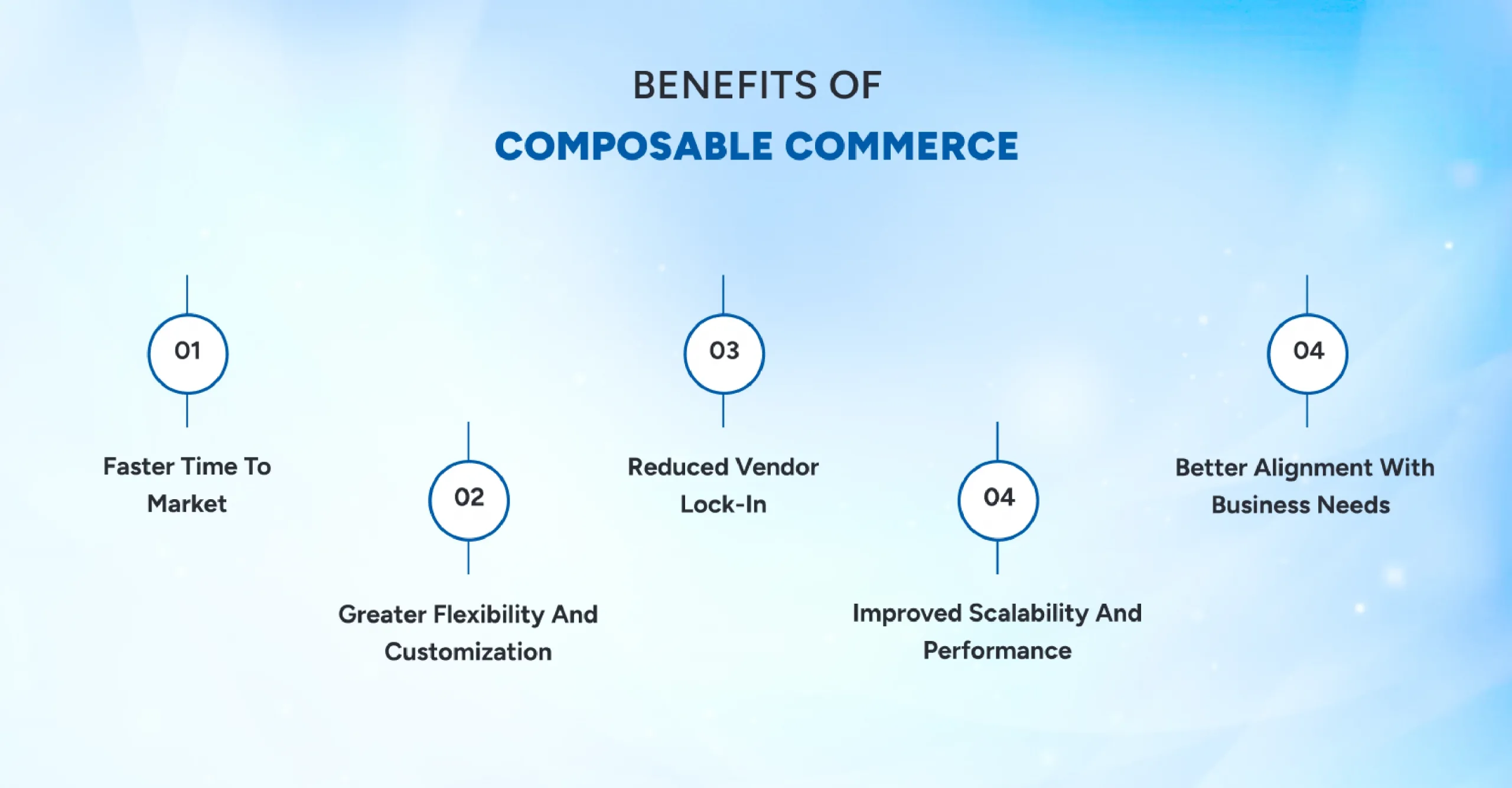
Adopting composable commerce allows organizations to transition from rigid, one-size-fits-all legacy systems to agile, modular architectures. This shift addresses specific ecommerce challenges by leveraging key benefits that transform how businesses innovate and compete.
1. Faster Time to Market
In traditional monolithic systems, innovation is often bottlenecked by tight coupling between the frontend and backend. A change in the user interface might risk breaking the database, requiring extensive regression testing and unified deployment cycles.
Composable commerce accelerates this process by allowing independent teams to develop, test, and deploy specific components simultaneously.
Take an example of a retailer that needs to launch a new seasonal promotion or landing page immediately. In a monolith, this might wait weeks for the next scheduled system-wide release.
In a composable environment, the marketing team can deploy new content instantly via the CMS without engineering dependency, while developers simultaneously update backend pricing logic.
What makes this particularly powerful?
Your marketing campaigns no longer wait in engineering queues. Launch when the market opportunity exists, not when the deployment schedule permits.
2. Greater Flexibility and Customization
Composable commerce empowers businesses to select the best eCommerce solutions for every function, including search, cart, and personalization, rather than settling for generic features bundled into a suite.
This architectural freedom supports unlimited customization, enabling brands to craft unique experiences across web, mobile, IoT, and physical channels.
Take an example of a brand that wants to implement an AI-driven visual search tool that the current monolithic vendor does not support. Instead of waiting for the vendor’s roadmap, the brand can simply plug in a specialized third-party search engine via an API to instantly upgrade the customer experience.
Beyond immediate access to features, this flexibility prevents competitive disadvantage. When your competitors innovate faster because their composable commerce platform lets them integrate cutting-edge capabilities, you can match or exceed their moves without platform migrations.
3. Reduced Vendor Lock-In
Monolithic platforms often trap businesses in long-term contracts, leaving them beholden to a single vendor’s upgrade cycle, feature set, and pricing model. Composable architecture eliminates this dependency by treating software components as interchangeable parts.
If a specific module, such as a payment gateway or review engine, no longer meets business requirements or becomes too expensive, it can be swapped out without replatforming the entire system.
For example, an enterprise is dissatisfied with its platform’s native inventory management system but cannot leave because replatforming is too costly. With a composable commerce solution, they can replace only the inventory module with a superior third-party solution while keeping the rest of their stack intact.
Here’s what this means for your technology strategy: you negotiate from a position of strength. Vendors know you can switch components, which fundamentally changes pricing conversations and feature prioritization.
4. Improved Scalability and Performance
Legacy systems often suffer from scalability bottlenecks, where high traffic to one part of the site requires scaling the entire application, which is inefficient and costly. Composable commerce leverages cloud native infrastructure to scale individual components independently based on demand.
This granular scalability ensures high availability and performance even during peak traffic events.
Take an example of an eCommerce brand having issues with the checkout process. During a Black Friday flash sale, a checkout service crashes due to atraffic spike, taking the entire browsing experience offline.
In a composable setup, the checkout service scales automatically to handle the load or fails in isolation, allowing customers to continue browsing product pages without interruption.
Moreover, this targeted scaling optimizes infrastructure costs. You pay for the exact capacity you need when you need it, rather than maintaining worst-case-scenario infrastructure year-round to handle occasional spikes.
5. Better Alignment with Business Needs
Composable commerce creates a business-centric technology stack where software is assembled to fit specific operational requirements, rather than forcing the business to adapt its processes to rigid software constraints.
This approach enables the creation of capabilities precisely aligned with unique business models, such as complex B2B workflows, subscription models, or multi-vendor marketplaces.
For example, a B2B manufacturer requires complex, customer-specific pricing tiers that a standard B2C-focused monolith cannot handle out of the box.
A composable approach allows them to integrate a specialized pricing engine, PBC, that handles complex logic while maintaining a standard frontend for users.
As your business model evolves, launching new markets, adding distribution channels, or acquiring companies with different workflows, your composable commerce architecture evolves with you. Add components that support new requirements without disrupting existing operations.

MACH Foundation Behind Composable Commerce Technology
A composable commerce solution empowers businesses to leverage an open ecosystem of accelerators, third-party tools, and prebuilt solutions rather than contorting workflows to fit a vendor’s limitations.
Technically, composable commerce architecture is grounded in MACH principles, which ensure modularity and adaptability:
- Microservices: The application splits into small, self-contained services handling specific functions like inventory or pricing, each developed and deployed independently
- API-first: All functionalities are exposed through APIs, acting as connective tissue between services and external systems
- Cloud-native: The software runs natively in the cloud (SaaS), leveraging elastic scaling and automatic updates for high availability.
- Headless: The front-end presentation layer decouples completely from back-end logic, enabling unique interfaces across web, mobile, and IoT touchpoints.
How Composable Commerce Differs from Legacy Systems
Monolithic platforms bundle front-end, back-end, and database into a single, tightly coupled codebase. The limitations become obvious quickly:
- Rigidity vs. flexibility: Modifying a single component in a monolith, such as the checkout flow, often requires rebuilding and testing the entire application. A composable commerce platform lets teams swap a search engine or CMS without touching the rest of the stack.
- Scaling inefficiency: Monoliths force you to scale the entire application to handle traffic spikes for a single feature, wasting resources. Composable systems scale high-demand components independently.
- Vendor lock-in: Monoliths trap businesses with a single vendor’s roadmap and feature set. Composable commerce eliminates this by letting you mix solutions from different providers.
Composable vs. Traditional Headless Commerce
While often confused, headless and composable commerce are distinct concepts, headless is a stepping stone toward full composability.
- Scope: Headless commerce decouples the front-end from the back-end commerce engine to enable omnichannel delivery. Composable commerce goes further by breaking the entire back end into modular components.
- Architecture: A traditional headless setup might still use a monolithic back end for catalog, cart, and orders, connected to a custom front end via an API.
The benefits of composable commerce emerge when you decompose the monolithic back end into distinct microservices, giving you freedom across the entire ecosystem, not just the user interface.
This architectural evolution explains why composable commerce represents the next stage of digital commerce maturity, moving beyond simple decoupling to full operational modularity.
Composable Commerce Architecture Explained
A typical composable commerce architecture is designed as a modular ecosystem where independent components interact through APIs to deliver commerce experiences. This structure allows businesses to select best-of-breed solutions for specific functions rather than forcing their entire operation into a single monolithic suite.
And why does this matter?
If your checkout flow becomes outdated or your search functionality can’t keep pace with customer expectations, you can swap that specific component without rebuilding your entire commerce infrastructure.
Frontend Experience Layer: Where Customers Meet Your Brand
The frontend is the presentation layer where customers interact with the brand. In a composable setup, this layer is completely decoupled from the backend logic, allowing distinct user interfaces for websites, mobile apps, IoT devices, smartwatches, and physical kiosks.
This layer often uses modern frameworks such as React, Vue.js, or Next.js and may leverage Frontend as a Service (FEaaS) solutions for faster deployment.
What makes this powerful?
Your design team can rebuild the entire customer-facing experience without waiting for backend engineers to refactor business logic.
Commerce Services: The Transactional Engine
This layer consists of the core transactional engines, shopping cart, checkout flows, pricing logic, tax calculations, and order management delivered as independent microservices or Packaged Business Capabilities (PBCs).
Because these services are modular, businesses can swap out a pricing engine or upgrade a checkout flow without disrupting the rest of the system.
Apart from technical flexibility, this modularity accelerates experimentation.
Want to test a new promotional engine with dynamic pricing? Deploy it alongside your existing system, run A/B tests, and roll back instantly if performance disappoints.
Supporting Services: Enhancing the Customer Journey
To enhance the customer journey, composable architectures integrate specialized third-party services. A headless CMS handles content distribution across all channels without being tied to a specific display format. Specialized search engines like Algolia provide fast, AI-driven product discovery. Personalization engines tailor content and recommendations in real time.
What makes these critical to the benefits of composable commerce?
They transform basic transactional capabilities into differentiated customer experiences. Your CMS can push content to your website, mobile app, in-store kiosks, and voice assistants simultaneously, each optimized for its channel without creating separate content workflows.
Integration and Orchestration Layer: The Connective Tissue
This layer acts as middleware, ensuring that all independent components communicate effectively. It typically includes an API gateway to route requests, manage security, and enforce rate limits.
Orchestration platforms and event buses, such as Kafka, manage data synchronization and asynchronous workflows, such as updating inventory across systems after a purchase.
Here’s the reality: loose coupling only works when you have sophisticated orchestration. Without proper middleware, your modular components become isolated islands. The integration layer transforms independent services into a cohesive system.
Data and Analytics Layer: Preventing Silos
This layer unifies customer and product data from various sources to prevent silos. It often integrates Customer Data Platforms (CDPs) and analytics tools to provide a unified view of customer behavior and enable data-driven decision-making.
What compounds the challenge in modular architectures? When your cart service, CMS, personalization engine, and analytics platform all maintain separate customer profiles, you end up with fragmented data that undermines the very flexibility you built the system to achieve.
How Loose Coupling Improves Scalability and Resilience?
The defining characteristic of a composable architecture is loose coupling, in which components operate independently and communicate only through API contracts. This offers significant advantages over tightly coupled monolithic systems.
Scalability: Precision Resource Allocation
In a monolithic system, high traffic to a single feature, such as product search, requires scaling the entire application. In a composable commerce solution, components scale independently based on demand.
For example, a retailer can vertically scale their checkout service during a flash sale or allocate more resources to their search engine during the holidays without paying for unnecessary capacity elsewhere.
What makes this cost-effective?
Cloud infrastructure pricing rewards precision. When you scale only what needs scaling, your infrastructure costs align directly with business demand.
Resilience: Fault Isolation That Protects Revenue
Loose coupling ensures fault isolation. If the ratings and reviews service goes down, it does not crash the entire site. The rest of the application, such as product browsing and checkout, continues to function normally, protecting revenue.
Here’s what this means in practical terms:
- When your reviews service experiences an outage, customers see a “Reviews temporarily unavailable” message but can still browse products and complete purchases.
In a monolithic architecture, a single database connection timeout could cascade into a full-site failure. - Beyond handling failures, composable systems accelerate diagnosis and recovery. When an issue occurs, engineering teams immediately know which service is affected, rather than having to debug a massive codebase. Deploy the fix to that single service and restore full operations.
Core Technologies Behind Composable Commerce
The composable commerce technology stack is built on MACH architecture principles (Microservices, API-first, Cloud-native, Headless), which collectively enable a modular, flexible, and future-proof digital ecosystem.
And why does this architecture matter?
These technologies directly deliver the benefits of composable commerce, transforming how businesses innovate and scale.
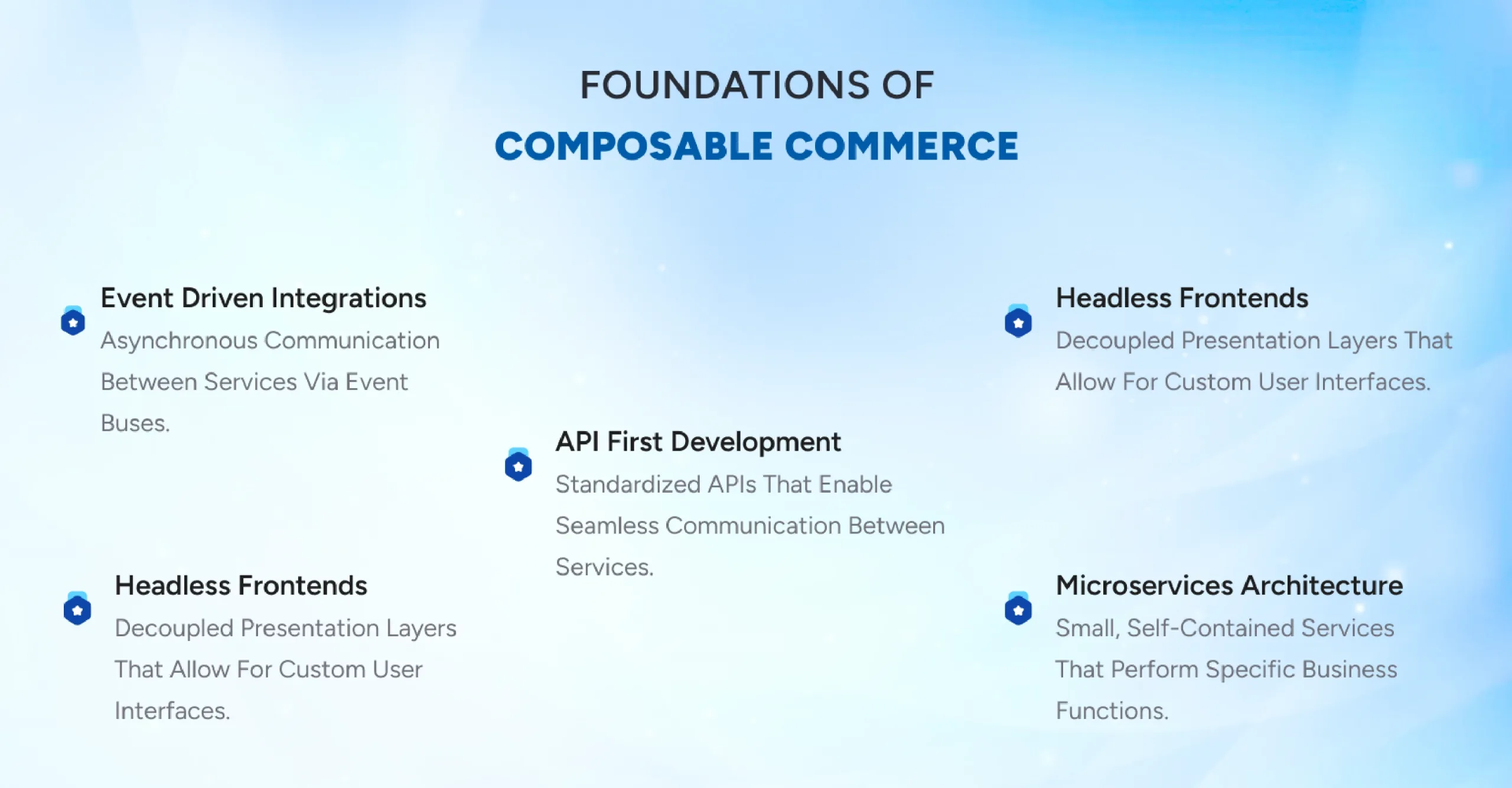
Microservices Architecture
Microservices are the fundamental building blocks of composable commerce. Instead of a single, monolithic application with all functions tightly coupled, the composable commerce architecture breaks the system into small, self-contained services that perform specific business functions, such as cart management, pricing, inventory, and checkout.
These services operate independently, meaning they have their own data storage and can be developed, deployed, and scaled without impacting other parts of the system.
This granular approach allows organizations to select best-of-breed solutions for each function rather than relying on a single vendor’s suite.
API First Development
In a composable environment, APIs act as the connective tissue binding disparate microservices together. An API-first approach means that all functionality and data are exposed through standardized APIs by design, not as an afterthought.
This ensures that every component, whether a search engine, payment gateway, or CMS, can communicate seamlessly with others, regardless of the underlying programming language or vendor.
What makes this critical?
This architecture facilitates plug-and-play capabilities, allowing businesses to easily swap out or add new components without rewriting the entire codebase.
Headless Frontends
Headless commerce decouples the frontend presentation layer from the backend commerce logic. The backend delivers content and functionality via APIs, giving developers the freedom to build custom user interfaces using modern frameworks such as React, Vue.js, or Next.js.
This separation allows brands to deliver consistent content and commerce experiences across multiple touchpoints, websites, mobile apps, smartwatches, and IoT devices without being constrained by the backend system’s templates.
Technologies like Frontend as a Service (FEaaS) provide pre-built, customizable UI components and cloud infrastructure to accelerate development of these headless frontends.
Cloud Native Infrastructure
Composable commerce solutions are designed to run natively in the cloud (SaaS), leveraging the full capabilities of cloud computing such as elastic scaling and automatic updates. Unlike legacy systems hosted on-premises, cloud-native infrastructure uses containers (e.g., Docker) and orchestration tools ( Kubernetes) to manage deployments.
This model supports high availability and resilience, allowing the infrastructure to scale resources up or down automatically based on demand. What does this mean for your composable commerce platform? Improved cost efficiency and elimination of manual server management.
Event-Driven Integrations
To maintain performance and agility, composable architectures often utilize event-driven integrations. Instead of relying solely on synchronous API calls, where one service must wait for another to respond, services communicate asynchronously via event buses such as Kafka.
For example, when a purchase is made, an “order created” event is published, triggering simultaneous updates to the inventory, shipping, and email marketing systems. This loose coupling ensures that a delay or failure in one service does not bottleneck the entire transaction flow, significantly enhancing system resilience and responsiveness.

Enabling Independent Scaling and Faster Innovation
These core technologies collectively drive business agility and operational efficiency, the primary benefits of composable commerce that distinguish it from traditional platforms.
Independent Scaling
Because microservices and cloud native infrastructure allow components to operate autonomously, businesses can scale specific functions based on demand without scaling the entire platform.
For instance, a retailer can increase resources for their checkout service during a flash sale or scale their search engine during holiday browsing, without paying for unnecessary capacity in other areas, such as the CMS.
This targeted scaling optimizes infrastructure costs and ensures consistent performance during traffic spikes. Apart from cost savings, independent scaling prevents the resource waste inherent in monolithic systems, where scaling one feature means scaling everything else.
Faster Innovation
The modular nature of the stack allows development teams to work in parallel on different components without risk of conflict. A frontend team can redesign the customer experience while a backend team simultaneously integrates a new payment provider.
This decoupling reduces the risk associated with deployments, enabling organizations to release updates frequently, sometimes multiple times a day,y and significantly reducing time to market for new features.
The ability to swap out individual components (PBCs) allows businesses to experiment with new technologies, such as AI search engines, without undergoing a risk-free full-platform migration.
How Ace Infoway can Help you Leverage Composable Commerce?
The composable commerce shift isn’t a future consideration but a competitive reality separating market leaders from businesses stuck explaining why they can’t ship features fast enough.
Every week you delay composable adoption, your competitors deploy new capabilities, test personalization engines, and optimize checkout flows without risking full-platform outages. They’re not smarter or better funded; they built systems where innovation doesn’t require permission from a monolithic codebase.
Ace Infoway specializes in transforming legacy eCommerce platforms into modular, MACH-based architectures that accelerate time-to-market and eliminate vendor dependency.
We don’t just talk about microservices and API-first development; we architect composable ecosystems tailored to your specific business model.
Our approach delivers:
- Phased migration strategies that minimize operational disruption while systematically decomposing monolithic systems into independent PBCs
- Seamless integrations across headless CMS, personalization engines, search providers, and payment gateways without forcing your business into a single vendor’s roadmap
- Cloud-native infrastructure leveraging Docker and Kubernetes for elastic scaling that aligns costs directly with demand, not worst-case-scenario provisioning
- Continuous deployment pipelines enable multiple releases per day instead of quarterly deployment windows that bottleneck innovation.
Schedule a consultation on a composable commerce strategy to assess your current architecture, identify the highest-impact components to modularize first, and build a migration roadmap that accelerates rather than disrupts your operations.
FAQ
How long does it take to migrate from a monolithic platform to composable commerce?
Most migrations take 4-9 months for full deployment, but phased “strangler pattern” approaches deliver initial capabilities in 3-4 months while keeping existing systems running.
Can we migrate to composable commerce without disrupting current operations?
Yes, incremental migration strategies let you decompose monolithic components gradually while your existing platform continues to serve customers, prioritizing high-impact areas like checkout or search.
What skills and resources do we need to manage a composable commerce platform?
You need capabilities in API integration, microservices architecture, cloud infrastructure (Docker/Kubernetes), and DevOps practices, either built internally or through specialized partners.
When is the right time to migrate to composable commerce?
When deployment cycles miss market opportunities, scaling costs misalign with demand, or vendor limitations prevent competitive parity, delays only widen the execution gap.