









|
Getting your Trinity Audio player ready...
|
Table of Contents
70% of shopping carts get abandoned before checkout, costing retailers $18 billion annually. That’s a systematic failure in how eCommerce platforms meet customer expectations.
If you are an eCommerce business, you may be facing three compounding challenges right now. Cart abandonment bleeds revenue every hour. Return rates spike because customers can’t accurately visualize products. Competitors who cracked personalization first are capturing lifetime value while you’re still optimizing generic product pages.
The gap between what customers demand and what your platform delivers isn’t just costing sales. The 2026 eCommerce market demands the strategic implementation of technologies that eliminate friction in the buyer journey, maximize customer lifetime value, and build operational resilience that scales.
Take an example of the eCommerce trend, like agentic commerce, which automates product comparison and purchasing decisions that used to take customers 20 minutes. Similarly, there are many other key trends in eCommerce development that you can’t miss out on in 2026.
Understanding these trends means you architect solutions before problems compound. Let’s get to the list straightaway.
Top 9 eCommerce Trends To Watch Out For 2026
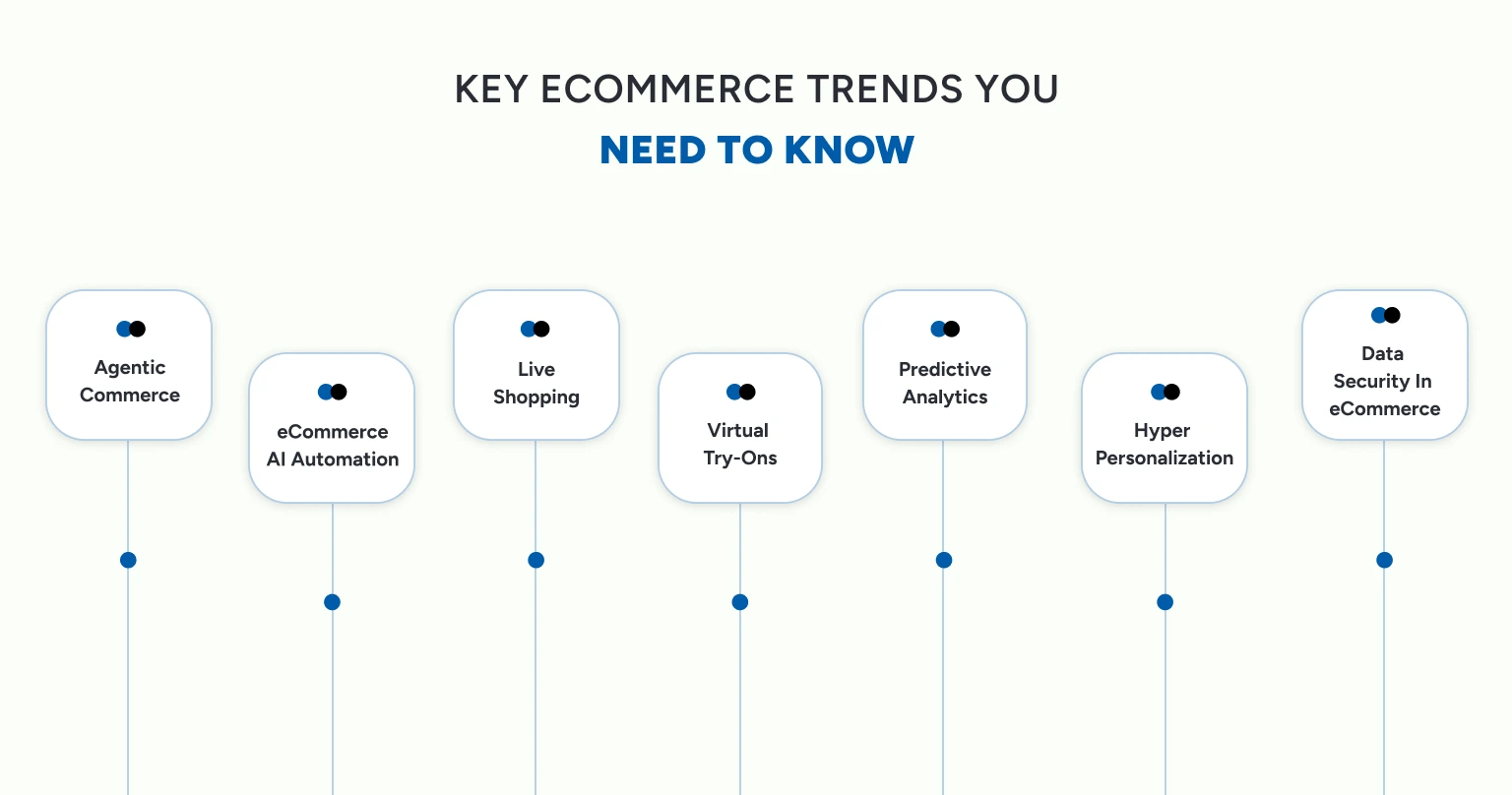
Here are some of the trends in eCommerce you must follow to ensure a frictionless, seamless, and improved shopping experience.
1. Agentic Commerce
Agentic commerce is an eCommerce trend that will redefine online shopping in 2026. With the introduction of autonomous AI agents, users can now automate product comparisons, negotiations, and purchases. It will not only transform how eCommerce businesses operate but also force them to reinvent their monetization strategies and business models.
By 2030, the US B2C retail market will generate up to $1 trillion in revenue from agentic commerce. This eCommerce trend will impact not just web but also mobile commerce.
Why Does This eCommerce Trend Matter?
Agentic commerce will transform how users shop and compare products. It is an eCommerce trend that will convert the reactive processes of an eCommerce business into proactive ones. Consumers will have unprecedented convenience, hyper-personalization, and an efficient method to purchase products.
For consumers, Agentic Commerce will help reduce the time required for price comparisons, deal-finding, subscription management, and supply reordering. For businesses, this eCommerce trend will help them:
- Improve customer interaction
- Begin to hire engagement and loyalty.
- Streamline the process
- Build trust among customers.
Businesses can leverage agentic commerce to provide strategic product recommendations. They can also gain a deeper understanding of customer intent, preferences, and buying patterns across SKUs.
What Should Be Your Action Plan?
- Implement API-first architecture across catalog, pricing, inventory, and checkout.
- Make sure to enable real-time data synchronizations across stocks, pricing, and promotions for your eCommerce platform.
- Make sure you structure the product data in machine-readable formats such as Schema or JSON-LD.
- Create semantic product catalogs with attributes, variants, and context.
- You can also optimize your eCommerce content using LLM-based discovery, leveraging AU and GEO services.

2. eCommerce AI Automation
AI automation is a trend in eCommerce that is transforming how retail tasks are automated. It uses artificial intelligence, machine learning, and NLP to automate key tasks, including inventory management, marketing, hyper-personalization, pricing, and customer service.
On the operational automation aspect, AI is transforming how eCommerce businesses manage real-time inventory, forecast demand, optimize supply chains, and streamline order processing. It also helps automate in-wheel campaigns and generate SEO-optimized content for eCommerce businesses. Plus, it helps them predict customer behavior and set dynamic pricing based on peak demand and market competition.
More than 50% of US consumers are already using ChatGPT or Gemini to browse or buy online. This is what eCommerce businesses should capitalize on by leveraging AI automation. While if you consider 95% of eCommerce brands are already using AI technology in some form, this trend will only grow bigger in 2026.
Why Does This eCommerce Trend Matter?
The use of AI in commerce is transforming how businesses operate, providing real impact across every area of operations, from marketing to logistics to customer service.
This includes:
1. Data mining, where businesses can analyze current and historical data to uncover specific customer buying patterns and predict outcomes
2. Natural Language Processing(NLP) enables computers to interpret and respond to human language, and it helps eCommerce businesses to create customized chatbots and voice search capabilities.
3. Machine learning algorithms and fast data analysis help eCommerce brands to make quicker decisions.
4. Deep learning capabilities help eCommerce brands to extract more profound insights into complex customer data.
What Should Be Your Action Plan?
- Automate demand forecasting and inventory in real-time to eliminate stock-outs and overstocking
- Deploy AI-driven dynamic pricing mechanisms to maximize your margins during peak demand.
- Leverage predictive personalization engines based on machine learning algorithms to deliver excellent shopping experiences at scale.
- Automate your customer support system with NLP-powered chatbots for faster resolution times and better customer satisfaction.
- Integrate AI into your supply chain operations to accelerate fulfillment and reduce logistics costs.
3. Live Shopping
Live stream shopping, or live shopping, is an eCommerce trend that is already very popular in 2025 and will remain in demand in 2026. This is a strategy where customers can buy products through live streams by influencers or during product launches.
Most of this live streaming is done on social media platforms or on YouTube. Live shopping enables eCommerce brands to interact with customers and target audiences on social media platforms. Some eCommerce brands even live-stream their product launches and let users purchase on their websites. Some famous examples of live-stream shopping are Amazon Live and Instagram Live Shopping.
Why Does This eCommerce Trend Matter?
What makes this eCommerce trend most important is that customers can ask questions and buy products directly during the same live session as influencers or brands launch their products or showcase their services.
This causes urgency and immediate gratification. Plus, eCommerce brands can leverage AI to automate chat responses, scripts, and data analysis.
They can also stream their product launches, services, and influencer videos across multiple platforms like TikTok, Instagram, YouTube, and their own site. This means that they can reach their customers where they are.
Livestream shopping is a form of experiential shopping because customers can watch their products live during the stream, which also emphasizes user-generated content. And builds more trust among the customers.
What Should Be Your Action Plan?
- Transform every product launch into a live, shoppable event across platforms like TikTok, Instagram, YouTube, and your website.
- Partner with influencers to boost your sales in real time across channels. Make sure to integrate one-click checkout directly inside the live stream.
- Use AI-powered chat boards to automate and handle every question and doubt around your products during the live stream.
- Create urgency among customers by leveraging limited-time drops, live-only pricing, and countdown offers.
4. Virtual Try-Ons
Virtual trance is an eCommerce trend that leverages augmented reality and artificial intelligence to let online shoppers visualize how a product would look on them in real-time.
It simulates the in-store experience for users while directly addressing critical online retail challenges, such as high return rates and low customer confidence.
Plus, it helps eCommerce plans meet specific customer demands, such as an interactive shopping experience and hyper-personalization. Virtual triumphs use multiple technologies to create a realistic simulation of how a product would look to a customer.
This includes:
- The capture of customers’ images through their smartphones, tablets, or computer cameras
- Advanced algorithms, customized to eCommerce business needs, are then used to map customers’ facial or body features and identify specific measurements and proportions.
- Digital 3D models are created from data processed by algorithms and overlaid on users’ images.
- Augmented reality also offers real-time, interactive capabilities, allowing users to move around, change angles, or switch between product variations (such as colors, styles, and sizes) during their experience.
This provides a more seamless, immersive experience for customers.
Why Does This eCommerce Trend Matter?
This is one of the most critical trends in the ecommerce business because it can reduce the return rates. Most product returns are due to fit and appearance issues. Virtual try-ons can provide a more accurate preview of the product and allow customers to make informed decisions.
It also boosts buyer confidence and transforms the discovery and consideration of a product into an interactive experience.
This, in turn, helps ecommerce brands to improve their conversion rates. Retailers have reported up to a 30% increase in sales conversion rates by leveraging virtual try-ons.
Plus, virtual try-ons offer a gamified experience that enhances engagement and fosters stronger brand loyalty. When you integrate AI into virtual try-ons, you can transform the entire interactive experience by providing personalized product recommendations and curated style suggestions in real time.
Lastly, virtual try-ons give ecommerce brands an edge and help them position themselves as market leaders.
What Should Be Your Action Plan?
- Use AR-powered virtual try-ons on product pages to eliminate size, speed, and appearance issues.
- Leverage AI-driven body and face mapping to deliver hyper-accurate personalized product previews.
- Integrate a real-time inventory management system with virtual try-ons.
- Ensure variants are updated, and dynamic pricing is integrated.
- Create interactive 3D product pages and reduce return rates by validating pitch, scale, and styling before checkout.
- Create AI-style assistance to improve product recommendations.
5. Predictive Analytics
Protesting analytics is one of the key ecommerce trends in 2026, which will transform not just customer interactions but also business operational efficiency. It will help eCommerce brands to predict user intent by analyzing complex data points, including customer interactions, browsing history, and even mouse movements.
This allows them to spot specific patterns that humans may overlook. It helps eCommerce businesses generate dynamic intent scores for each customer, which they can use to personalize their products and services. Using AI for power can improve their conversion rates, and predictive analytics can help them do so.
Why Does This eCommerce Trend Matter?
Predictive analytics enables hyper-personalization, which has become the new reality for customer interactions.
Using AI and ML systems, e-commerce brands can analyze customer data, especially:
- How much do they spend while browsing products on their website?
- What are their preferences?
- What is the real-time session activity?
This type of data is used to predict user intent and create specific patterns. Using data from these patterns and reference-based personalizations, eCommerce brands can build customer loyalty. It helps them improve the customer lifetime value and ensure a frictionless shopping experience. Plus, they can add AI-based search functionality to ensure faster checkouts and product discovery.
Predictive analytics helps eCommerce brands change route management, fundamentally improving delivery efficiency. They can algorithmically read out parcels based on real-time data, such as traffic or weather, to avoid delays before they occur.
What Should Be Your Action Plan?
- For this ticketed FPI, standards and algorithmic pricing engines capable of agent-to-agent association.
- Ensure end-to-end visibility across your supply chain operations by tightly integrating last-mile operations with core organizational systems, including enterprise resource planning, warehouse management systems, and customer relationship management.
- Integrate autonomous mobile robots into your warehouses to optimize drop placement and delivery.
- Implement innovative warehousing and fulfillment intelligence to optimize internal processes and improve demand forecasting.
- Use machine learning models to forecast product value shifts accurately, then enable automatic placement of fast-moving products closer to dispatch zones.
6. Hyper Personalization
Hyper-personalization is one of the biggest ecommerce trends today. It uses artificial intelligence to tailor every step of the shopping journey. This approach has already produced ten to thirty percent higher conversions and increased customer spending by almost forty percent.
The trend also affects delivery operations. Major brands like Amazon and Walmart use forward-deployed centers to offer faster delivery.
Why Does This eCommerce Trend Matter?
Forward-deployed fulfillment addresses the biggest customer concern: delivery speed. Keeping inventory closer to customers cuts delivery time, reduces costs by up to forty percent, and lowers return rates.
It also gives brands clearer inventory visibility and improves forecasting accuracy. This applies to both retail and b2b ecommerce trends.
What Should Be Your Action Plan?
- Use forecasting tools to select the best micro-fulfillment locations.
- Add robotic picking and sorting to improve throughput.
- Sync inventory across all fulfillment centers.
- Use dynamic routing that assigns orders to the nearest center.
- Study customer locations to update hub placement.
- Partner with regional shipping providers to improve coverage and consistency.
7. Data Security in eCommerce
Data security has become a significant trust factor in the latest trends in the commerce industry. As brands rely on customer data for personalization and AI use, strong security becomes essential.
Recent studies show that 63% of eCommerce brands have experienced data breaches in the past 2 years. Yet fewer than thirty percent use zero-trust security models.
Modern ecommerce security now includes API protection, vendor oversight, AI model protection, and real-time threat monitoring.
Why Does This eCommerce Trend Matter?
Customer data drives personalization and predictive analytics. A single breach can damage brand reputation and reduce lifetime value. Many customers leave a site if they doubt its security.
Rules like GDPR and CCPA impose significant penalties for mishandling data. Third-party vendors create new risks, and attackers often target supply chain partners to reach larger brands. These challenges impact both retail and b2b ecommerce trends.
What Should Be Your Action Plan?
- Encrypt all customer data during transfer and storage.
- Use zero-trust models that validate every user and system.
- Audit third-party partners regularly.
- Add real-time threat detection using behavioral analytics.
- Train AI models in isolated environments to prevent data exposure.
- Use role-based access control and automatically monitor compliance.
8. Voice Commerce
Voice commerce is becoming one of the fastest-growing ecommerce trends. As people use smart speakers and voice assistants more often, they are now browsing, comparing, and buying products with voice commands.
By 2026, voice shopping may reach $40 billion, and voice queries may account for half of all online searches. This creates new opportunities across both retail and B2B ecommerce.
Why Does This eCommerce Trend Matter?
Voice commerce reduces friction by removing the need for screens. It helps multitaskers, busy professionals, and people with visual impairments.
Voice assistants offer personalized recommendations and make reordering simple. In the b2b space, procurement teams can use voice to check inventory or place bulk orders.
What Should Be Your Action Plan?
- Write product descriptions that match natural speech patterns.
- Use Schema and JSON-LD to support voice search systems such as Alexa and the Google Assistant.
- Create conversational shopping flows with AI chat tools.
- Build voice-friendly content that answers common customer questions.
- Add voice-enabled checkout experiences.
- Create loyalty programs that work with voice assistants.
9. Subscription ecommerce Models
Subscription commerce is one of the strongest ecommerce trends today. It shifts revenue from one-time transactions to recurring purchases. This model increases lifetime value, improves retention, and creates predictable monthly and yearly revenue.
The subscription market is expected to reach $500 billion by 2028. This trend influences both retail and B2B ecommerce, where businesses now buy software, inventory, and services on recurring plans.
Why Does This eCommerce Trend Matter?
Subscribers spend more than one-time buyers. Predictable revenue improves business planning and makes companies more attractive to investors.
Long-term subscribers also share more behavioral data, which improves personalization. Subscribers also require fewer marketing efforts because they already trust the brand.
What Should Be Your Action Plan?
- Build tiered subscription plans: Basic, Pro, and Enterprise.
- Offer flexible billing with rewards for long-term commitments.
- Create a customer success program to improve retention.
- Use dynamic pricing that adjusts based on usage and lifetime value.
- Set up automated tools to recover failed payments.
- Offer transparent pricing and rewards for loyal subscribers.
How Ace Infoway Can Help You Implement the Best eCommerce Trends?
The 2026 eCommerce landscape demands agentic commerce infrastructure, AI-powered automation, live shopping capabilities, AR try-ons, and predictive analytics, all while maintaining zero-trust security and voice-ready platforms. These aren’t isolated features. They’re interconnected systems that either compound your revenue or expose operational gaps.
Ace Infoway architects the infrastructure that converts key eCommerce trends into measurable growth. Our team engineers API-first platforms, real-time personalization engines, and subscription billing systems that scale.
Ready to architect your competitive advantage? Connect with us for a clear roadmap to 2026-ready infrastructure.
FAQ
How will agentic commerce change the way people shop in 2026?
Agentic commerce will automate the entire shopping journey, from product research and price comparison to autonomous purchasing decisions. AI agents will proactively anticipate customer needs and execute transactions on their behalf, eliminating the need for manual browsing and comparison shopping.
Which eCommerce tasks should be automated with AI to increase revenue?
Automate demand forecasting, dynamic pricing, personalized product recommendations, and customer support chatbots to drive conversions and improve customer lifetime value. AI-powered inventory management and predictive analytics help reduce stockouts, lower operational costs, and maximize revenue per visitor.
Do AR virtual try-ons actually reduce return rates for fashion and beauty brands?
Yes. Brands using AR virtual try-ons see meaningful reductions in return rates because customers make more confident purchase decisions with accurate product previews. AR-enabled experiences also drive higher conversion rates by removing fit and appearance uncertainty before checkout.
What is hyper-personalization in eCommerce, and how does it increase conversions?
Hyper-personalization uses AI to analyze real-time behavioral data such as browsing patterns, purchase history, and preferences to deliver tailored experiences at every touchpoint. This approach significantly improves conversion rates, increases revenue, and reduces cart abandonment compared to traditional personalization.
What are the most significant eCommerce security risks in 2026, and how can brands protect customer data?
Payment manipulation, SQL injection attacks, account takeovers, and cross-site scripting are among the biggest threats as eCommerce platforms become prime cyberattack targets. Brands must adopt zero-trust security models, encrypt all data transfers, enable real-time threat detection, and secure third-party payment systems to maintain customer trust.