








|
Getting your Trinity Audio player ready...
|
Table of Contents
If you are an enterprise, the most significant challenge your organization faces in the current era of fast-moving markets is data. With the massive cost of data management, your organization, like many other enterprises, needs to reassess its approach to data integration. Especially with the estimated investment in data centers reaching $6.7 trillion by 2030, computing costs are expected to increase.
A data integration tool helps you automate and streamline the extraction of information. It enables you to consolidate data from various sources into a single, centralized repository. Such customer data integration tools are essential if you are an eCommerce, retail, or business from a highly regulated domain. However, like most enterprises, your organization too will have some queries before deciding to use such a tool, like,
- Which tool to choose?
- What is the cost of a data integration tool?
- What kind of features does it offer?
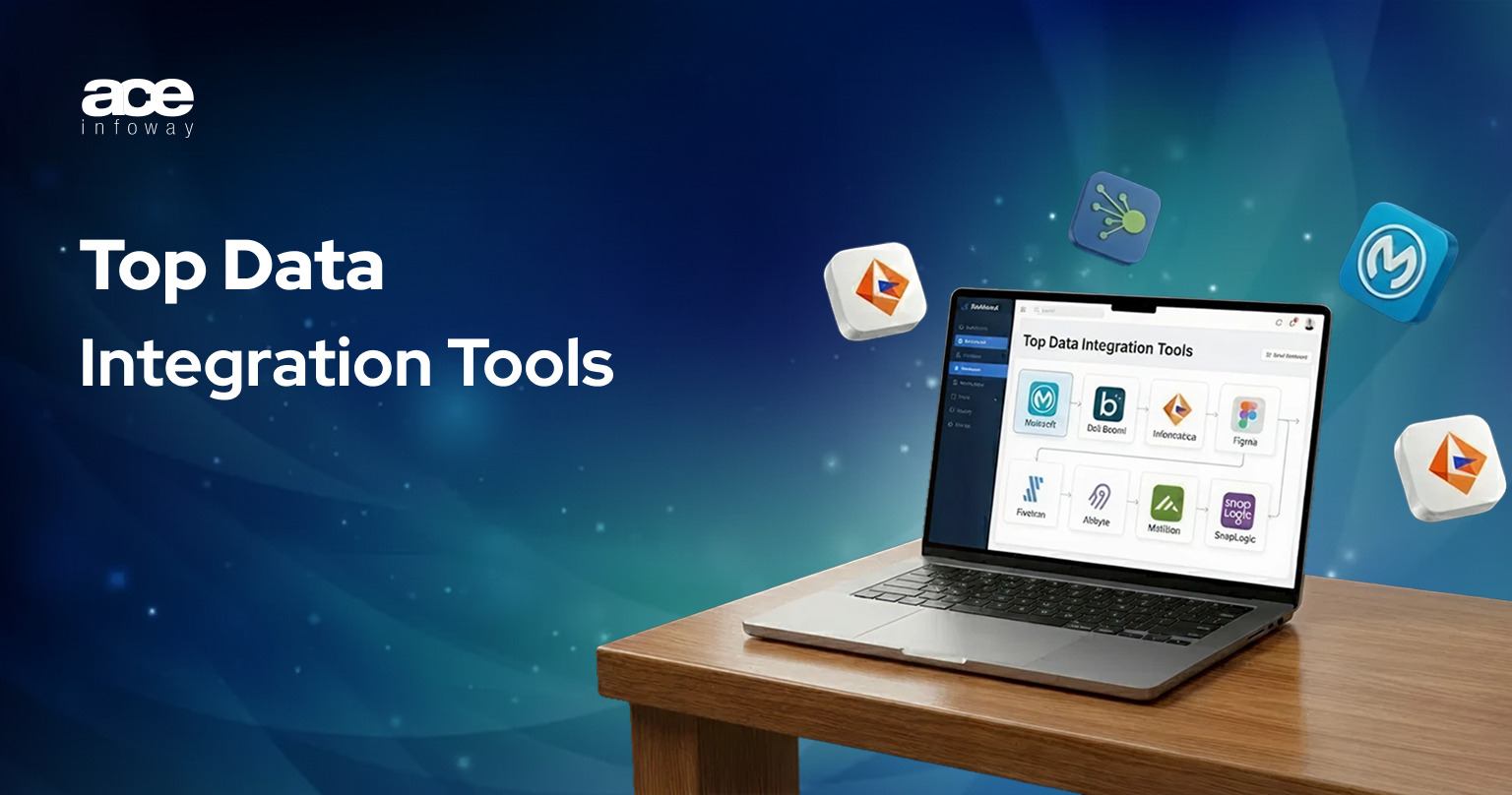
To make your decision-making more efficient, our experts, with over two decades of experience, have compiled a list. This list of the 10 best data integration tools will help you make a better decision. So, let’s get started.
10 Must-Have Data Integration Tools for Your Projects
Finding the perfect tool for your project can be overwhelming with the numerous data integration platforms available on the market. The best choice often comes down to your unique needs, budget, and the systems you already use.
To help you decide, we’ve compiled a list of 10 must-have tools for 2025. This selection encompasses a range of solutions, from those featuring hundreds of pre-built data connectors for various sources to open-source options that offer exceptional flexibility and customization. Following best practices, this list will guide you toward the right tool.
1. Talend

Talend is one of the best data integration tools with powerful ETL capabilities. Owned by Qlik, it offers a low-code solution that simplifies the process of connecting and deploying data sources. Talend offers Open Studio, which allows you to create data pipelines quickly.
It focuses on built-in data quality tools that ensure information flows through your data pipeline is accurate and reliable. This makes it a strong contender if you need a platform that covers the entire data lifecycle.
Best For
- Enterprise data warehousing and centralized BI projects
- Advanced data scheduling, monitoring, and governance
- Complex ETL transformations with multi-step workflow orchestration
- Hybrid cloud environments require both on-premises and cloud integration
- Data governance projects needing metadata management and lineage tracking
Features
- Built-in data quality tools with profiling, cleansing, and data masking
- Real-time and batch processing capabilities
- End-to-end column-level lineage tracking and impact analysis
- AI and GenAI integration with LLM extensibility for data enrichment
- Comes with an easy-to-use drag-and-drop interface.
- Java-based deep customization nd optimization for data processes
Pricing
Free for the first 14 days of usage
After 14 days, this data integration tool is paid based on your needs
2. Informatica PowerCenter
Informatica PowerCenter is an enterprise data integration tool owned by Informatica Corporation. This industry-leading ETL solution excels at extracting, transforming, and loading massive data volumes while maintaining stringent data quality and governance standards.
Its visual development interface and extensive connectivity options make it the go-to choice for complex enterprise data environments that require both reliability and scalability.
Best For
- Large enterprises managing petabyte-scale data integration projects
- Organizations are building and maintaining enterprise data warehouses.
- Complex multi-source environments with diverse legacy and modern systems
- High-performance ETL operations needing advanced transformation capabilities
- Businesses prioritizing metadata management and end-to-end data lineage tracking
Features
- Extracts data from diverse sources, applies complex business logic, and transforms.
- Advanced data quality tools with profiling, cleansing, and validation capabilities
- Grid computing architecture with parallel processing and dynamic partitioning
- Comprehensive metadata management with version control and impact analysis
- Supports both on-premises and cloud-based data sources.
Pricing
- Paid tool with pricing starting from $2,000/month.
3. Microsoft SQL Server Integration Services (SSIS)
Microsoft SSIS is another data integration tool that uses Azure Data Factory. As part of the Microsoft SQL Server suite, SSIS offers seamless integration within Microsoft environments and provides hybrid cloud capabilities through Azure.
SSIS is a data integration cloud computing tool that enables faster data extraction from various sources, transforms it, and loads it into the designated storage or system. It offers a visual development environment within SQL Server Data Tools (SSDT) for Visual Studio.
Best For
- Organizations heavily invested in the Microsoft ecosystem technologies
- Hybrid cloud environments requiring seamless on-premises to Azure integration
- Teams needing user-friendly visual pipeline design tools
- Data warehouse and data lake population projects
- Businesses requiring cost-effective ETL solutions with Microsoft licensing synergies
Features
- Native integration with the entire Microsoft technology stack
- Hybrid data movement between on-premises and Azure cloud platforms
- Parallel processing with automatic scaling capabilities
- Built-in features for real-time synchronization
- Integrated monitoring and alerting through Azure Monitor
Pricing
- Paid tool that offers customizable pricing plans based on your SQL server core license.
4. IBM InfoSphere DataStage
IBM InfoSphere DataStage is an enterprise-grade ETL excellence, specifically engineered for high-performance data integration at massive scale. Built on IBM’s parallel processing architecture, this cloud-based data integration tool delivers exceptional performance for big data environments that require the efficient movement of enormous data volumes.
DataStage’s enterprise-grade capabilities come with corresponding complexity, making it ideal for organizations with dedicated data engineering resources and large-scale integration requirements.
Best For
- Large enterprises managing massive data volumes and complex transformations
- High-performance environments requiring parallel processing optimization
- Organizations with dedicated data engineering and technical resources
- Businesses needing robust, battle-tested enterprise data platforms
Features
- Advanced parallel processing architecture for maximum performance
- DataStage Designer Client offers a visual interface to design data integration jobs
- Support both ELT and ETL patterns for data integration
- Real-time and batch processing with load balancing
- Extensive connectivity to mainframe and legacy systems
Pricing
- Paid tool with pricing range starting from $1.75 per Capacity Unit-Hour (CUH)
5. Oracle Data Integrator (ODI)
Oracle Data Integrator is one of the leading data integration tools that uses ELT architecture to move and transform Big Data. Unlike conventional ETL tools, ODI leverages the target database’s processing power to perform transformations, significantly improving performance and reducing resource overhead.
This Oracle-native platform provides seamless integration with the entire Oracle technology stack while supporting heterogeneous environments through extensive connectivity options.
Best For
- Organizations with significant Oracle database and application investments
- High-performance data environments requiring ELT architecture optimization
- Large-scale data warehousing projects within Oracle ecosystems
- Businesses needing advanced data replication and synchronization capabilities
- Enterprises requiring seamless Oracle Cloud integration
Features
- Revolutionary ELT architecture leveraging target database processing power
- Native integration with Oracle databases and cloud services
- Advanced data replication and real-time synchronization capabilities
- Support for both Oracle and non-Oracle source systems
- Comprehensive data lineage and impact analysis tools
- Built-in data quality and governance features
Pricing
- Paid tool starting with the pricing range of $900 per Named User Plus (NUP)
6. SAP Data Services
SAP Data Services delivers comprehensive data integration excellence specifically designed for SAP-centric business environments. As part of the SAP BusinessObjects suite, this enterprise-grade data integration tool provides unified data integration, quality management, and governance capabilities.
SAP Data Services offers organizations a comprehensive solution for transforming raw data into trusted and actionable information. It comes with the ability to pull information from a wide variety of sources, like SAP systems, databases, third-party apps, and web services.
Best For
- Organizations with extensive SAP application portfolios and investments
- Enterprise data warehousing projects requiring SAP-native integration
- Businesses that need unified data quality and governance frameworks
- Complex SAP migrations and system consolidation projects
- Companies requiring compliance with SAP-specific data standards and formats
Features
- Native integration with the entire SAP application ecosystem
- Pre-built SAP business content and transformation templates
- Advanced data quality management with profiling and cleansing
- Real-time and batch processing with SAP-optimized performance
- Comprehensive data governance and lineage tracking capabilities
- Built-in support for SAP HANA in-memory processing
Pricing
Paid tool that can cost you $10,000 annually based on your custom requirements.
7. Fivetran
Fivetran has revolutionized cloud data integration through its fully automated, zero-maintenance approach to data pipeline creation. This SaaS-native platform eliminates the complexity traditionally associated with ETL development by providing pre-built connectors that automatically detect schema changes and maintain data synchronization.
This data integration tool enables data teams to focus on analysis rather than pipeline maintenance, making it the preferred choice for organizations that prioritize speed and operational efficiency.
Best For
- Modern data teams prioritize speed and automation over customization
- Organizations with limited data engineering resources
- Cloud-first businesses using popular SaaS applications and cloud databases
- Analytics-focused teams needing reliable, hands-off data replication
- Companies requiring rapid time-to-value for data integration projects
Features
- Fully automated schema detection and change management
- Zero-maintenance data pipeline operations with automatic updates
- Built-in data transformation capabilities with dbt integration
- Enterprise-grade security with SOC 2 Type II compliance
- Usage-based pricing with transparent cost predictability
Pricing
A free tool that allows you to use up to 500,000 Monthly Active Rows (MAR) and 5,000 model runs per month.
Beyond 500,000 MAR, you will incur a per-use charge.
8. Matillion
Matillion is a leading data integration tool engineered explicitly for modern cloud data warehouses, including Snowflake, Amazon Redshift, and Google BigQuery. It combines intuitive visual design with powerful transformation capabilities, enabling both technical and non-technical users to build sophisticated data pipelines.
Matillion’s AI-powered features and plain-language query capabilities democratize data transformation while maintaining enterprise-grade performance and scalability.
Best For
- Teams needing both no-code and low-code transformation capabilities
- Businesses requiring AI-powered data pipeline development
- Companies modernizing from legacy ETL to cloud-native ELT architecture
- Data teams seeking visual, collaborative pipeline design tools
Features
- Native integration with Snowflake, Redshift, BigQuery, and Azure Synapse
- Visual drag-and-drop pipeline designer with collaborative capabilities
- AI-powered transformation suggestions and plain-language query processing
- Auto-scaling architecture that matches cloud warehouse performance
- Git-based version control with CI/CD pipeline integration
- Comprehensive data lineage and impact analysis tools
Pricing
- Free to use up to 250 task hours
9. Stitch Data

Stitch Data simplifies cloud data integration through its developer-centric approach and streamlined pipeline creation process. This data integration tool focuses on rapid deployment and automated maintenance. It makes enterprise-grade data replication accessible to organizations without extensive data engineering resources.
Stitch’s automated approach reduces typical data pipeline setup time from weeks to hours while maintaining enterprise-grade reliability and security standards.
Best For
- Developer-focused teams needing rapid data pipeline deployment
- Organizations with straightforward replication requirements
- Businesses prioritizing cost-effective, transparent pricing models
- Teams requiring automated schema management and change detection
- Companies needing reliable data movement without complex transformations
Features
- 140+ pre-built connectors for popular data sources and destinations
- Automated schema detection and change management capabilities
- Built-in data monitoring and alerting with detailed logs
- Enterprise security with encryption in transit and at rest
- Simple usage-based pricing with no hidden fees
Pricing
- Free tool that offers a 14-day trial and beyond that costs $100–$1,250/month
10. Airbyte
Airbyte is one of the best open-source data integration tools. It offers unparalleled flexibility and customization capabilities for organizations that require complete control over their data pipelines. With strong community support and rapid connector development, Airbyte enables data engineers to build tailored solutions for unique integration requirements.
Airbyte’s open-source model has driven the creation of over 350 connectors in just four years, surpassing many commercial platforms in terms of breadth of connectivity.
Best For
- Organizations requiring maximum flexibility and customization capabilities
- Data engineering teams that are comfortable with open-source tool management
- Budget-conscious companies needing enterprise-grade functionality
- Businesses with unique data sources requiring custom connector development
- Teams prioritizing community-driven innovation and rapid feature development
Features
- 350+ open-source connectors with rapid community development
- Fully customizable and extensible architecture
- Self-hosted and cloud deployment options available
- Built-in transformation capabilities with dbt integration
- Comprehensive API for custom integrations and automation
- Active community support with transparent roadmap development
Pricing
- Offers a 14-day free trial with 400 trial credits.
- Beyond the free trial, pricing starts at $10/month, with four credits included.
- Additional credits cost US $2.50 each.
How Ace Infoway can Help you With A Custom Data Integration Solution?
Data is the ultimate currency in the current digital era, and enterprises must prioritize the correct customer information. If not prioritized, it can lead to higher storage, management, and computing costs. A data integration tool can help streamline the extraction, transformation, and loading of information. It also enables enterprises to gain real-time insights, thereby improving operational efficiency.
However, selecting the proper data integration tool is crucial. While these tools offer capabilities that can transform data management, a customized solution is necessary. Especially if your enterprise deals with sensitive data, leveraging a customized data integration solution makes sense.
Ace Infoway experts can help you with custom solutions that ensure better data management capabilities. Contact our experts now to build your customized data integration tool.
FAQs
1. How do cloud data integration tools differ from traditional ones?
Cloud data integration tools offer scalability, flexibility, and real-time processing capabilities that traditional tools may lack. They enable seamless connections across various platforms and services, allowing businesses to manage diverse data sources efficiently while reducing infrastructure costs.
2. Which features should I prioritize when choosing a data integration tool?
When selecting a data integration tool, prioritize features like real-time processing, data quality management, ease of use, scalability, and robust security measures. Also, consider compatibility with existing systems and the ability to handle various data formats for seamless integration.
3. What are some popular cloud data integration tools for 2025?
In 2025, popular cloud data integration tools include Apache NiFi for real-time data flows, Informatica for comprehensive ETL processes, Talend for open-source flexibility, and Microsoft Azure Data Factory for seamless cloud integration.