








|
Getting your Trinity Audio player ready...
|
Table of Contents
Legacy applications helped businesses establish reliable digital operations, but many now struggle to meet modern performance, security, and scalability expectations. As technology evolves rapidly, outdated systems often become barriers instead of business enablers.
This growing challenge has made application modernization services a strategic priority for organizations pursuing long-term digital transformation.
Research by Gartner predicts that worldwide end-user spending on public cloud services will reach $723.4 billion, highlighting why organizations are modernizing applications to support cloud-native operations.
Success depends on choosing the right application modernization strategy and adopting scalable application modernization technology that supports future business goals. Every modernization decision influences how quickly organizations respond to market changes, customer expectations, and emerging innovations.
Organizations investing in modernization are not simply upgrading software. They are creating adaptable digital foundations capable of supporting continuous innovation, seamless integrations, and sustainable business growth.
What Are Application Modernization Services?
Application modernization services help organizations transform legacy applications into scalable, secure, and cloud-ready solutions. Instead of replacing every system, modernization improves existing applications while preserving valuable business logic and operational continuity.
Modernization initiatives typically include:
- Cloud migration to improve scalability and infrastructure flexibility.
- Application refactoring to enhance maintainability and performance.
- API integration for seamless communication across systems.
- Infrastructure optimization to improve resource utilization and reliability.
- Architectural modernization using cloud-native and microservices principles.
Many organizations begin their modernization journey with legacy application modernization to improve performance while preserving critical business functionality.
What Are the Benefits of Application Modernization Services?
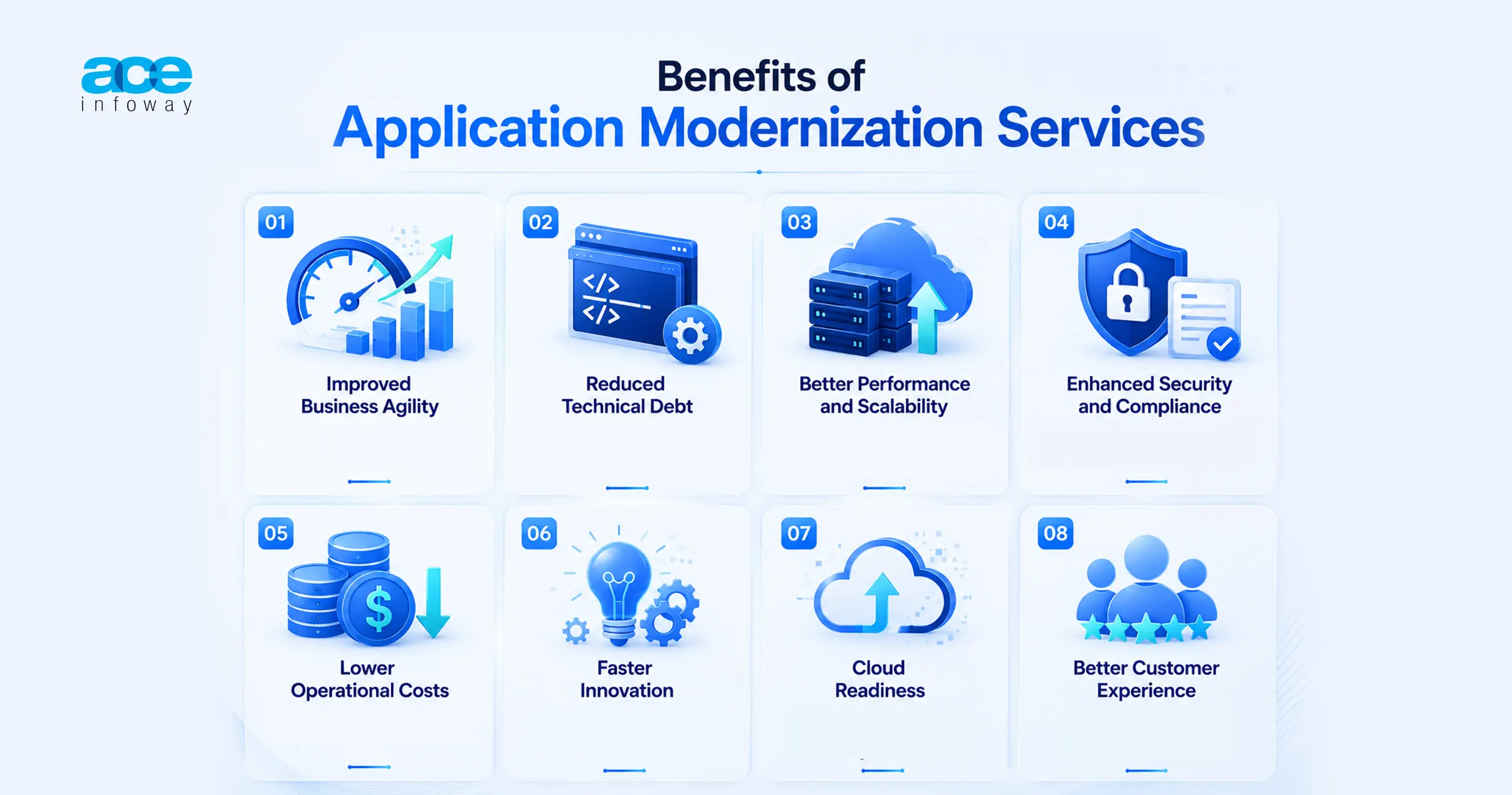
Modern businesses compete through speed, customer experience, and continuous innovation rather than technology ownership alone. The IBM Transformation Index found that 74% of executives believe modernizing applications is essential for achieving successful digital transformation initiatives.
Key benefits include:
Improved Business Agility
Legacy systems often delay feature releases because every update affects interconnected components. Modernized applications enable development teams to introduce improvements faster while responding quickly to changing customer expectations and business opportunities.
Business Impact
Organizations reduce release cycles, respond faster to market opportunities, and improve collaboration across development and business teams.
Reduced Technical Debt
Years of accumulated code, outdated frameworks, and unsupported technologies increase maintenance complexity. Modernization simplifies application architecture, making future enhancements easier while reducing long-term operational risks and development effort.
Business Impact
Development teams spend less time maintaining legacy code and more time delivering new business capabilities.
Better Performance and Scalability
Modern application architectures distribute workloads more efficiently across cloud environments. Businesses maintain consistent performance during traffic spikes while scaling infrastructure according to actual business demand instead of fixed capacity limitations.
Business Impact
Applications remain responsive during peak usage while infrastructure costs stay aligned with actual business requirements.
Enhanced Security and Compliance
Older applications frequently depend on unsupported software components that increase security exposure. Modernization strengthens application security through updated frameworks, stronger authentication, automated monitoring, and compliance with evolving industry regulations.
Business Impact
Organizations reduce cybersecurity risks while meeting regulatory standards more efficiently.
Lower Operational Costs
Maintaining aging infrastructure consumes valuable IT resources while limiting innovation. Modernized applications reduce infrastructure overhead, improve resource utilization, and optimize technology investments through scalable cloud-based environments.
Business Impact
IT budgets shift from routine maintenance toward innovation and strategic digital initiatives.
Faster Innovation
Modern architectures allow organizations to integrate artificial intelligence, automation, analytics, and emerging technologies without redesigning complete applications.
Business Impact
Teams can launch new features faster and adapt quickly to changing customer expectations.
Cloud Readiness
Cloud adoption becomes significantly easier when applications are optimized for distributed environments. Modernization prepares workloads for cloud-native infrastructure, improving resilience, availability, disaster recovery, and operational efficiency across business-critical systems.
Business Impact
Businesses improve application availability while building a scalable foundation for future growth.
Better Customer Experience
Application performance directly influences customer satisfaction and business outcomes. One of the most valuable application modernization benefits is delivering faster response times, reliable services, and seamless digital experiences across web, mobile, and enterprise platforms.
Business Impact
Customers experience faster interactions, improving engagement, satisfaction, and long-term retention.
Traditional Applications vs Modernized Applications
Many organizations assume modernization means replacing legacy systems with entirely new applications. In reality, modernization focuses on improving architecture, performance, and scalability while preserving valuable business capabilities wherever possible.
A modern application adapts quickly to evolving business needs, whereas traditional systems often require extensive effort to introduce even minor changes.
|
Difference Between Traditional and Modernized Applications |
||
| Aspect | Traditional Applications | Modernized Applications |
| Architecture | Monolithic architecture with tightly coupled components. | Modular, cloud-ready architecture built for flexibility and scalability. |
| Deployment | Manual deployments requiring longer release cycles. | Automated CI/CD pipelines enabling faster and more reliable deployments. |
| Scalability | Limited scalability that often requires additional hardware investments. | Elastic scaling through cloud infrastructure based on real-time demand. |
| Integration | Difficult to integrate with modern APIs and third-party platforms. | API-first design enabling seamless integration across business systems. |
| Security | Relies on legacy security models and outdated frameworks. | Built with modern security practices, continuous monitoring, and compliance controls. |
| Maintenance | High maintenance effort due to aging technologies and technical debt. | Simplified maintenance through modular services and automated management. |
| Performance | Performance degrades as workloads and user demands increase. | Optimized for high availability, responsiveness, and distributed workloads. |
| Innovation | Slow adoption of emerging technologies due to architectural limitations. | Rapid adoption of AI, automation, analytics, and cloud-native capabilities. |
How Should One Plan an Application Modernization Process?
A structured application modernization process reduces implementation risks while ensuring every modernization phase supports business continuity. Following a defined process also improves collaboration between technical teams and business stakeholders throughout the transformation journey.
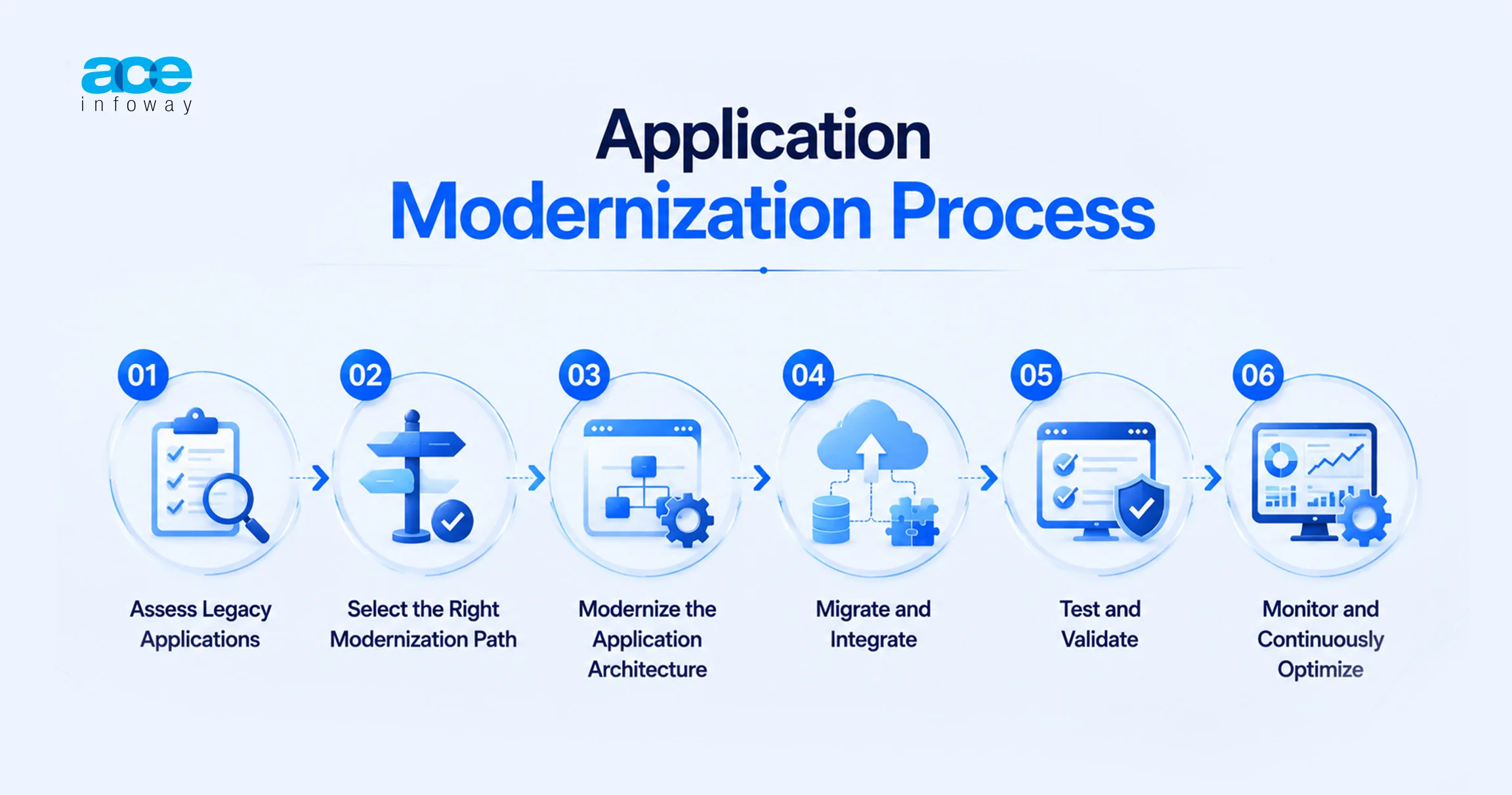
Assess Legacy Applications
Evaluate application performance, infrastructure dependencies, security posture, integration complexity, and maintenance requirements. A comprehensive assessment establishes the technical foundation for successful modernization planning.
Select the Right Modernization Path
Determine whether each application should be rehosted, replatformed, refactored, rearchitected, rebuilt, or replaced. The selected path depends on business objectives, technical complexity, and long-term digital transformation goals.
Modernize the Application Architecture
Update application components using cloud-native principles, APIs, containers, microservices, and modern development frameworks. Architectural improvements increase flexibility while preparing applications for future technology adoption.
Migrate and Integrate
Move applications, workloads, and data into modern infrastructure while integrating them with cloud services, enterprise platforms, and third-party systems. Careful planning minimizes operational disruptions throughout the migration process.
Test and Validate
Comprehensive testing verifies application functionality, performance, security, integrations, and user experience before production deployment. Continuous validation ensures modernization objectives are achieved without introducing unexpected operational risks.
Monitor and Continuously Optimize
Application modernization does not end after deployment. Continuous monitoring, performance optimization, security updates, and ongoing improvements help applications remain reliable, scalable, and aligned with changing business requirements.
Application modernization delivers stronger outcomes when supported by comprehensive digital transformation services.
Common Application Modernization Approaches
Every organization follows a different modernization journey because no two legacy environments are identical. Choosing the right application modernization approach depends on business objectives, application complexity, technical debt, budget, and long-term digital transformation priorities.
- Rehost: Often called the “lift and shift” approach, rehosting moves applications to modern cloud infrastructure without making significant code changes. It delivers faster cloud adoption while minimizing implementation effort and operational disruption.
- Replatform: Replatforming introduces selected infrastructure and platform improvements without redesigning the complete application. Businesses improve performance, reliability, and scalability while preserving the application’s core functionality and business logic.
- Refactor: Refactoring restructures existing application code to improve maintainability, performance, and cloud compatibility without changing business functionality.
- Rearchitect: Rearchitecting redesigns the application’s underlying architecture to support cloud-native services, microservices, containers, and API-driven integrations. It enables greater scalability, flexibility, and resilience for future business growth.
- Rebuild: Some legacy applications have architectural limitations that cannot support modern business requirements. Rebuilding involves developing a new application using modern technologies while retaining existing business processes, workflows, and operational knowledge.
- Replace: When modernization is no longer cost-effective, organizations replace legacy applications with commercial SaaS platforms or modern enterprise solutions. This approach simplifies maintenance while accelerating access to new features and continuous vendor updates.
Technologies Powering Application Modernization
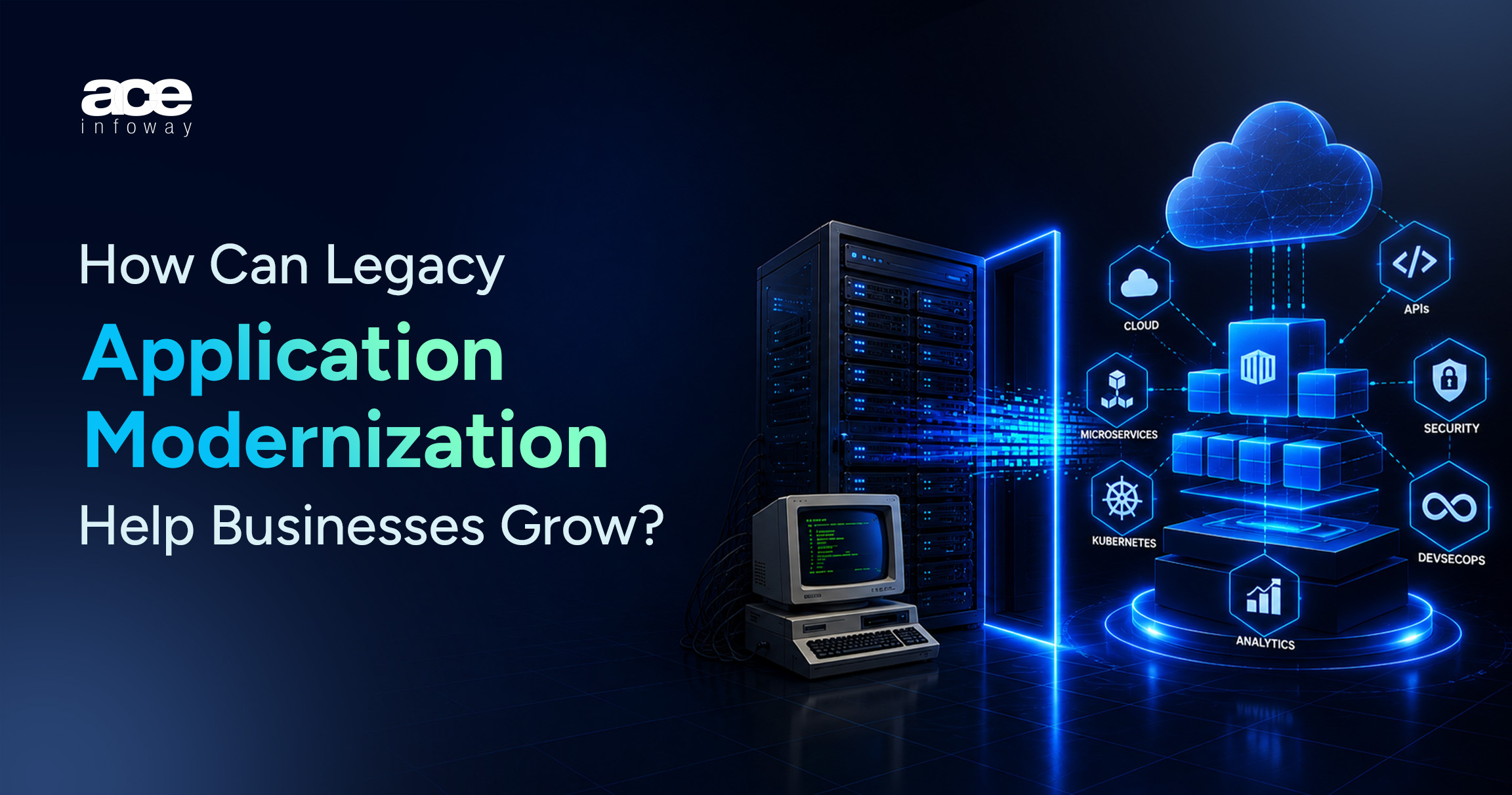
Modern application modernization services rely on multiple technologies working together to improve scalability, security, performance, and operational agility. These capabilities create the technical foundation required to support continuous innovation across modern enterprise applications.
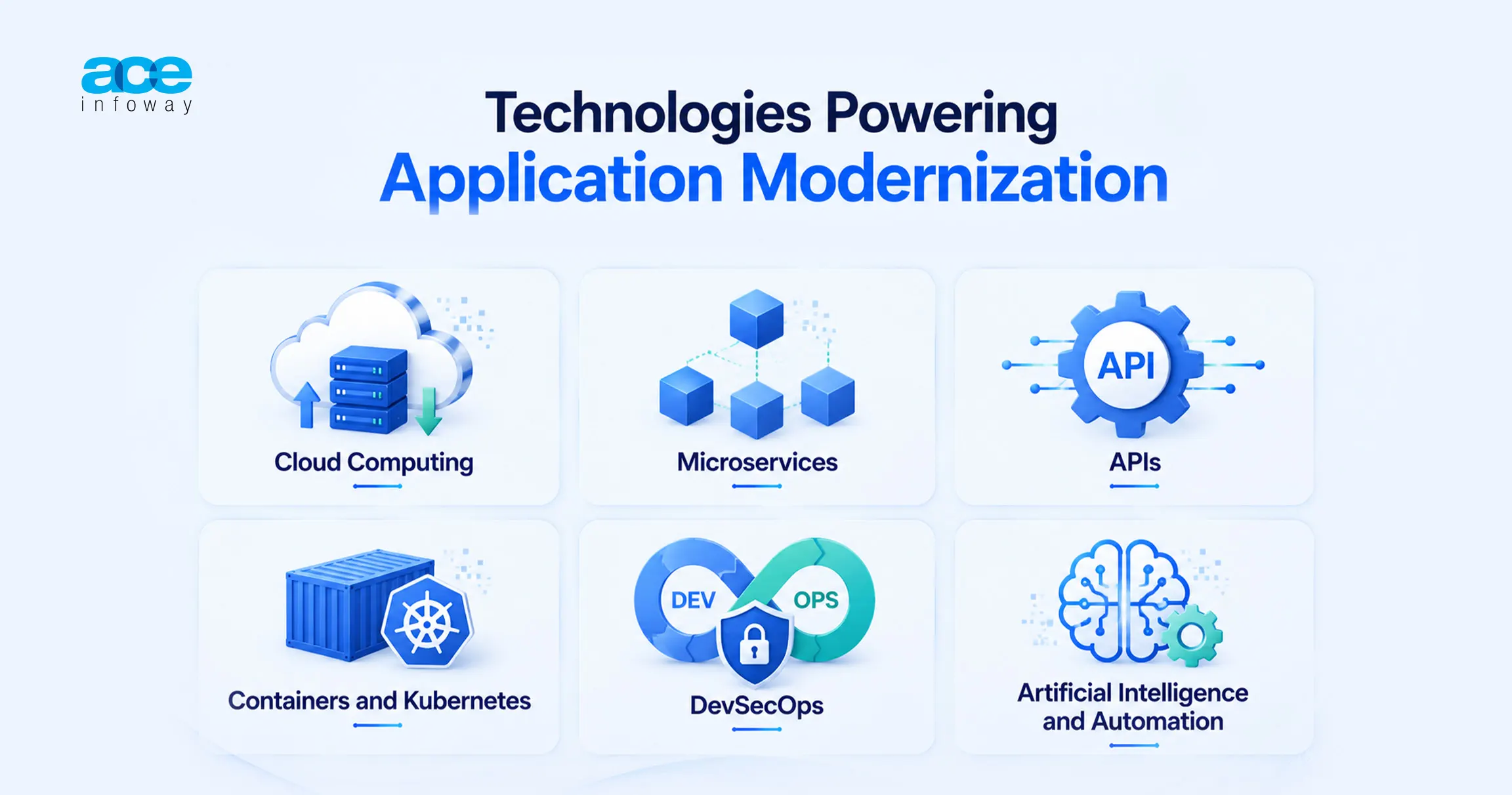
- Cloud Computing: Cloud platforms provide elastic infrastructure that automatically scales according to business demand. Organizations improve application availability, optimize infrastructure costs, and accelerate deployment without investing in additional physical resources.
- Microservices: Microservices divide large applications into smaller, independent services that can be developed, deployed, and scaled individually. This modular architecture improves flexibility while reducing the impact of future application updates.
- APIs: API-first development connects applications, enterprise systems, cloud platforms, and third-party services through standardized communication. Strong API integration improves interoperability while enabling organizations to expand their digital ecosystems more efficiently.
- Containers and Kubernetes: Containers package applications with their required dependencies, ensuring consistent deployment across different environments. Kubernetes automates container orchestration, workload scaling, resource allocation, and application availability at enterprise scale.
- DevSecOps: DevSecOps integrates development, security, and operations into one continuous delivery pipeline. Automated testing, security validation, and deployment processes improve software quality while reducing operational risks throughout the development lifecycle.
- Artificial Intelligence and Automation: Artificial intelligence and intelligent automation simplify application monitoring, performance optimization, predictive maintenance, and operational decision-making. These technologies enable organizations to improve system reliability while reducing manual administrative effort.
Conclusion
Organizations that treat modernization as an ongoing capability, rather than a one-time project, are better equipped to respond to changing market demands and future technology shifts.
At Ace Infoway, we help businesses modernize legacy applications through scalable architectures, cloud-native development, and tailored digital transformation strategies. Our focus is on building future-ready solutions that align technology investments with measurable business outcomes and sustainable growth.
Contact us to explore how our application modernization services can support your modernization journey.
Frequently Asked Questions
How do I know if my business needs application modernization services?
Applications that experience frequent downtime, high maintenance costs, poor performance, or limited integration capabilities are strong candidates for application modernization services. A technical assessment helps identify modernization opportunities before these issues affect business growth.
What factors influence a successful application modernization strategy?
A successful application modernization strategy depends on clear business objectives, application assessment, technology selection, risk planning, and phased implementation. Aligning modernization efforts with long-term business goals delivers greater value than focusing only on technology upgrades.
Which application modernization technology is commonly used today?
Modern organizations rely on cloud computing, microservices, APIs, containers, Kubernetes, DevSecOps, and artificial intelligence as core application modernization technologies. These technologies improve scalability, resilience, and application performance while supporting continuous innovation.
Can the application modernization process be completed without business disruption?
Yes. A phased application modernization process allows organizations to modernize applications incrementally while maintaining business continuity. Careful planning, automated testing, and staged deployments help minimize downtime and operational risks.
How do I choose the right application modernization approach?
The ideal application modernization approach depends on your application’s architecture, business criticality, technical debt, budget, and future scalability requirements. Evaluating these factors helps determine whether rehosting, refactoring, rearchitecting, rebuilding, or replacing is the most suitable option.