








|
Getting your Trinity Audio player ready...
|
Table of Contents
Java has stood the test of time, not by chance, but by consistently adapting to how modern software is built. From powering mission-critical enterprise platforms to enabling sleek web applications and even intuitive desktop interfaces, Java continues to be a dependable choice for developers who value performance, portability, and long-term stability. As per the report by Verified Market Research, the global Java web development market is expected to reach a value of USD 9,034.10 million by 2030.
What truly amplifies Java’s power, however, is its rich ecosystem of frameworks. The best Java frameworks shape how applications are designed, tested, secured, and scaled. The right framework can accelerate development, improve code quality, and make complex architectures easier to manage. Your framework choice directly impacts speed, flexibility, and maintainability, no matter if you are building APIs, microservices, or a responsive Java GUI framework for desktop applications.
In this blog, we explore the 10 best Java frameworks that stand out for their features, developer friendliness, and real-world relevance. Each framework listed has earned its place by simplifying development while meeting modern performance and scalability demands.
What Are Java Frameworks?
Java frameworks are structured sets of libraries, tools, and design patterns that act as a backbone for application development. Instead of starting from scratch every time, developers rely on Java frameworks to handle repetitive and complex tasks such as request handling, database communication, security enforcement, and application configuration. This approach reduces manual coding effort while bringing consistency and reliability to the development process.
At their core, frameworks provide a clear architectural flow. A Java web application framework, for example, manages how user requests move through the system, how data is processed, and how responses are delivered, allowing developers to focus on business logic rather than infrastructure concerns. With features like dependency injection, modular components, and built-in support for APIs and testing, frameworks make applications easier to scale and simpler to maintain over time.
The right Java framework and Java Development approach streamlines workflows, improves code quality, and ensures your application is built to evolve with changing business needs.
Why Use Java Frameworks?
Java frameworks play a critical role in application development by providing structure, efficiency, and long-term stability. They help teams build applications faster while maintaining high code quality and scalability. By relying on proven tools and design patterns, businesses can reduce development risks, improve collaboration, and ensure their applications are ready to evolve with changing technology demands.
1. Accelerated Development
Java frameworks provide pre-built components, libraries, and tools that significantly reduce development time. Features like auto-configuration, scaffolding, and dependency injection help eliminate repetitive coding tasks. As a result, developers can focus more on business logic instead of application setup, which is one of the key benefits of Java frameworks.
2. Scalability and Flexibility
Modern Java backend frameworks are designed to support scalable architectures such as microservices and distributed systems. Whether you’re building a simple REST API or a complex enterprise platform, frameworks allow applications to scale smoothly as user demands grow, including platforms that pull live data from Sports API sources.
3. Enhanced Code Quality and Maintainability
Java frameworks encourage clean architecture through modular design and separation of concerns. By following proven patterns like MVC, applications become easier to manage, test, and extend. This structured approach ensures long-term maintainability as projects evolve and teams expand.
4. Community and Ecosystem Support
Popular Java frameworks come with extensive documentation, active developer communities, and a wide range of plugins and integrations. This strong ecosystem helps teams resolve issues faster, adopt best practices, and stay aligned with the latest development standards.
5. Security and Compliance
Most frameworks include built-in security mechanisms such as authentication, authorization, and input validation. These features help developers enforce secure coding practices from the start, reducing vulnerabilities and supporting compliance requirements.
6. DevOps and CI/CD Integration
Java frameworks integrate seamlessly with modern DevOps workflows and CI/CD pipelines. Automated testing, continuous integration, and faster deployments become easier to implement, leading to more reliable and efficient release cycles.
7. Cross-Platform and Cloud-Native Readiness
Many Java frontend frameworks and backend frameworks are optimized for cloud environments, supporting containerization, Kubernetes, and serverless deployments. This cross-platform compatibility enables businesses to deploy applications across multiple environments with minimal rework.

Best Java Frameworks For Advanced Web and Mobile Application Development
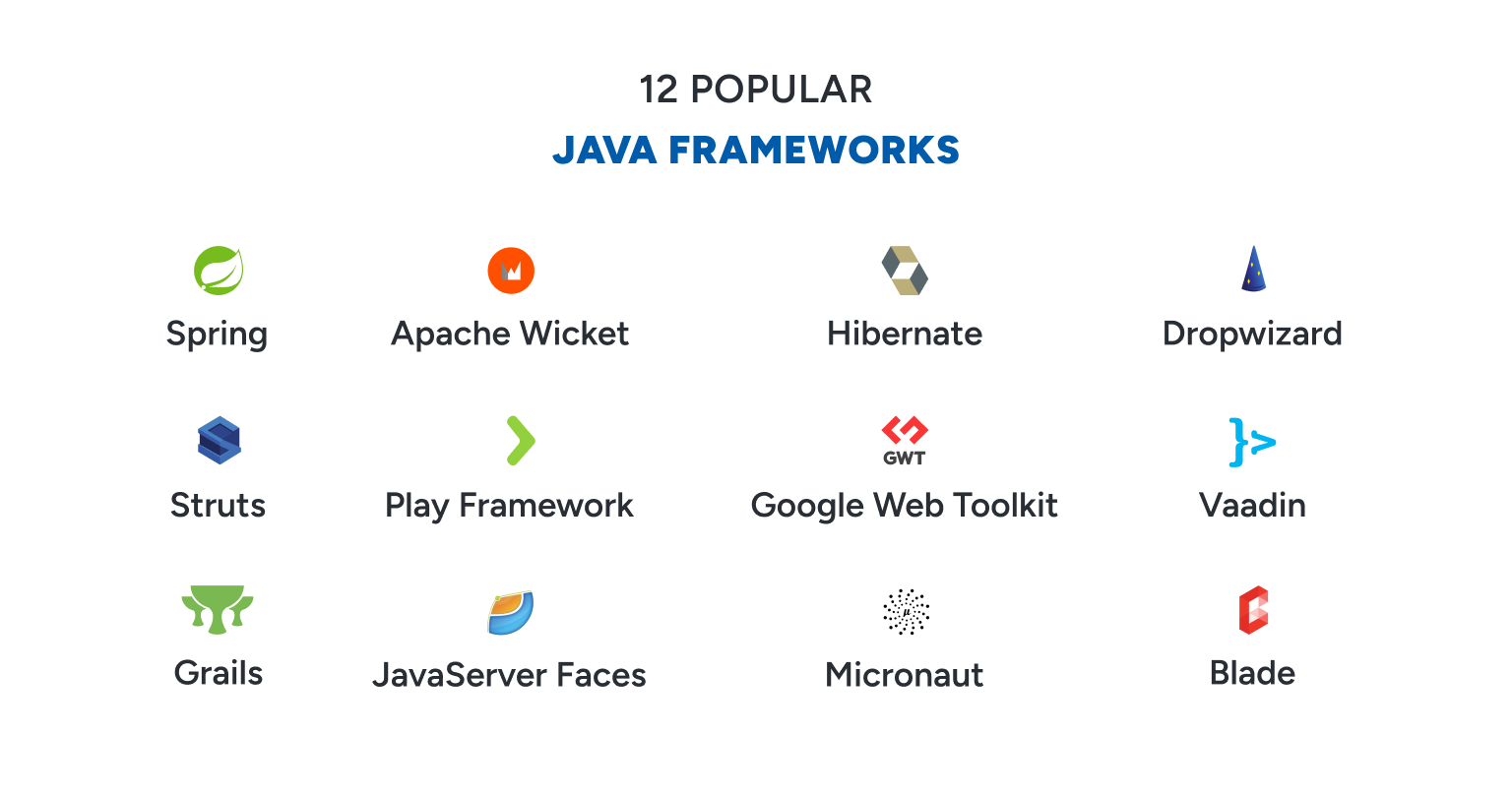
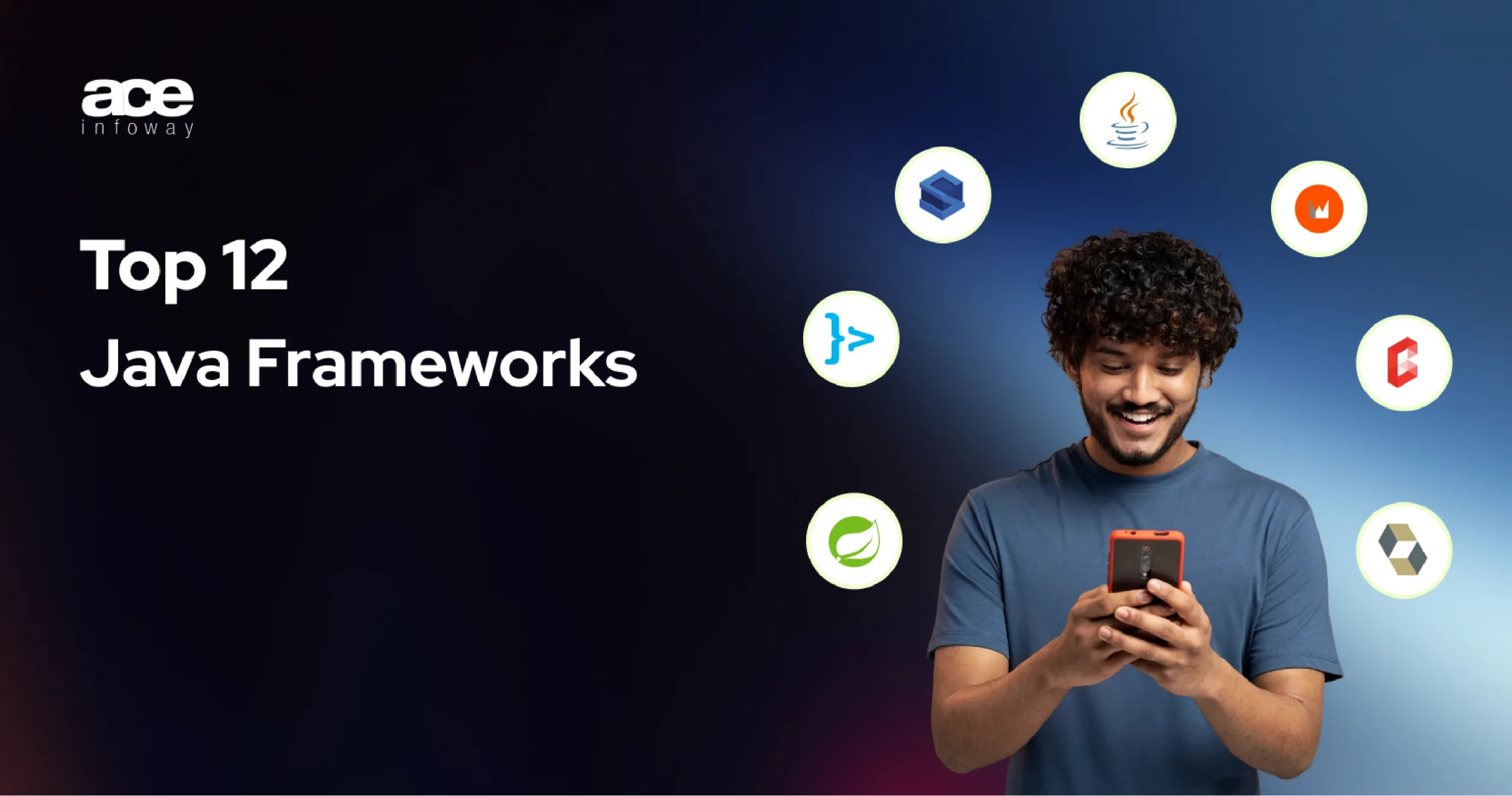
When it comes to building high-performance, scalable, and future-ready applications, choosing from the best Java frameworks can make all the difference. Modern development demands flexibility across layers, which is why today’s Java backend frameworks, Java frontend frameworks, and even a robust Java GUI framework play a critical role in delivering seamless web and mobile experiences.
1. Spring
Spring continues to lead the ecosystem as one of the best Java frameworks for enterprise-grade development. It simplifies complex application architecture by offering comprehensive infrastructure support, enabling developers to build secure, testable, and highly maintainable systems. As a dominant choice among Java backend frameworks, Spring excels in powering scalable web and mobile backends while integrating smoothly with frontend layers.
Key Highlights:
- Dependency injection for clean, modular code
- Aspect-oriented programming to manage cross-cutting concerns
- Spring MVC for structured web application development
- Advanced transaction management for complex operations
- Strong, customizable security features for enterprise use
Use Case:
Spring is ideal for building scalable enterprise systems, APIs, and cloud-native platforms where reliability and security matter most. Developers rely on it as a powerful Java backend framework, while businesses benefit from faster development cycles, long-term maintainability, and enterprise-grade performance.
2. Apache Wicket
Apache Wicket is a component-driven Java web application framework that focuses on simplicity and clarity. By allowing developers to build interactive web interfaces using pure Java and HTML, it bridges backend logic and frontend presentation effectively. Wicket is often favored when Java frontend frameworks need tight control over UI behavior without heavy configuration overhead.
Key Highlights:
- Reusable, component-based architecture
- Event-driven model for handling user interactions
- Bookmarkable pages for better navigation
- High customization for UI components
- Built-in Ajax support for responsive interfaces
Use Case:
Apache Wicket works best for interactive, component-driven web applications that demand clean separation between UI and logic. It’s a strong Java web application framework for teams that want precise control over user experience without complicating the backend.
3. Hibernate
Hibernate is a cornerstone among Java backend frameworks, designed to simplify database interactions through Object-Relational Mapping (ORM). It eliminates boilerplate SQL while maintaining performance and flexibility, making it a critical part of many modern Java stacks.
Key Highlights:
- Automatic mapping between Java objects and database tables
- Database independence across multiple RDBMS platforms
- Built-in caching for improved performance
- Lazy loading for optimized data access
- Flexible querying with HQL and criteria APIs
Use Case:
Hibernate is best suited for applications that require efficient and flexible data persistence across complex databases. As a core part of many Java backend frameworks, it helps businesses reduce database overhead while ensuring faster data access and consistency.
4. Dropwizard
Dropwizard is a minimalist yet powerful Java web application framework built for speed and performance. It bundles best-in-class Java libraries into a lightweight package, enabling developers to launch production-ready services quickly. For teams focused on APIs and microservices, it stands out among the best Java frameworks.
Key Highlights:
- Embedded Jetty server for fast HTTP handling
- Jersey for RESTful API development
- Jackson for seamless JSON processing
- Built-in metrics and monitoring
- Input validation for data consistency
Use Case:
Dropwizard is ideal for building high-performance REST APIs and microservices with minimal setup. Developers use it to move fast, while businesses benefit from reliable, production-ready services that scale efficiently in modern architectures.
5. Struts
Struts remains a well-known MVC-based Java web application framework for building structured enterprise applications. It promotes modular development through reusable components and clear separation of concerns, making it suitable for large, maintainable systems.
Key Highlights:
- Built-in form validation
- Internationalization support for global applications
- Plugin-based extensibility
- Custom JSP tag libraries
- Smooth integration with other Java technologies
Use Case:
Struts is well-suited for large, structured enterprise web applications that require a clear MVC architecture. It remains a dependable Java web application framework for organizations prioritizing stability, modularity, and long-term support.
6. Play Framework
Play Framework is designed for speed, scalability, and developer productivity. As one of the modern Java backend frameworks, it supports reactive and REST-first architectures, making it ideal for high-traffic web and mobile applications.
Key Highlights:
- Hot reloading for rapid development cycles
- Stateless architecture for scalability
- Built-in testing tools
- Asynchronous processing for high concurrency
- Internationalization support
Use Case:
Play Framework is best for reactive, high-traffic web and mobile backends that demand speed and scalability. As a modern Java backend framework, it enables businesses to deliver real-time user experiences with minimal latency.
7. Google Web Toolkit (GWT)
GWT bridges Java and JavaScript, allowing developers to build rich browser-based applications using Java alone. It is often considered when Java frontend frameworks need to deliver high-performance, interactive user experiences without deep JavaScript expertise.
Key Highlights:
- Java-to-JavaScript compilation for cross-browser compatibility
- Reusable Java components
- Integrated development and debugging mode
- Abstracted UI components
- Performance profiling tools
Use Case:
GWT is ideal for building rich, browser-based applications where performance and complex UI logic are critical. It fits naturally among Java frontend frameworks, allowing teams to deliver powerful user interfaces using Java instead of JavaScript.
8. Vaadin
Vaadin is a modern Java GUI framework focused on building rich, server-driven web interfaces. By handling client-server communication automatically, it allows developers to concentrate on business logic while delivering responsive, visually appealing applications.
Key Highlights:
- Server-side architecture for simplified development
- Component-based UI system
- Direct Java API for frontend development
- Customizable themes and layouts
- Built-in routing for single-page applications
Use Case:
Vaadin is perfect for applications that need rich, responsive interfaces built entirely in Java. As a modern Java GUI framework, it helps businesses deliver polished user experiences faster while reducing frontend development complexity.
9. JavaServer Faces (JSF)
JSF is a standardized Java GUI framework backed by the Java Community Process. It enables the development of component-based user interfaces while abstracting underlying web technologies, making it easier to build structured frontend layers for Java applications.
Key Highlights:
- Component-based MVC architecture
- Reusable UI components
- Seamless integration with backend logic
- Encapsulation of HTML, CSS, and JavaScript
- Drag-and-drop support for faster UI development
Use Case:
JSF is best suited for enterprise applications that rely on reusable UI components and structured frontend development. It acts as a reliable Java GUI framework, enabling teams to build consistent interfaces without deep frontend expertise.
10. Blade
Blade is a lightweight and modern Java web application framework designed for simplicity and speed. It focuses on minimal configuration while still offering the flexibility required for building scalable web services and APIs. Among emerging Java backend frameworks, Blade appeals to developers who prefer clean syntax, fast setup, and high performance without the overhead of large ecosystems. Its streamlined design makes it a strong contender among the best Java frameworks for rapid web and mobile backend development.
Key Highlights:
- Lightweight core with minimal configuration
- Embedded server support for quick startup
- RESTful API–friendly architecture
- Plugin-based extensibility for added functionality
- Optimized performance with low memory footprint
Use Case:
Blade is ideal for lightweight web services and APIs where simplicity and performance are top priorities. Developers choose it as a minimal Java web application framework, while businesses benefit from faster launches and lower infrastructure overhead.
11. Grails
Grails is a powerful full-stack framework built on top of Spring and Hibernate, combining convention-over-configuration with enterprise-grade capabilities. It stands out among Java backend frameworks by accelerating development through smart defaults while still allowing deep customization. Grails is often chosen when teams want the productivity of modern Java web application framework tools backed by the reliability of established Java technologies.
Key Highlights:
- Built on Spring Boot for robust backend support
- Convention-over-configuration for faster development
- Integrated ORM with Hibernate
- Strong REST and API development capabilities
- Seamless integration with frontend technologies, aligning well with Java frontend frameworks
Use Case:
Grails works best for rapid application development where speed and convention matter. Built on proven technologies, it stands out among the best Java frameworks for startups and enterprises looking to deliver features quickly without sacrificing scalability.
12. Micronaut
Micronaut is a next-generation framework created for building modular, cloud-native applications. Designed with microservices and serverless environments in mind, it is widely recognized as one of the best Java frameworks for low-latency and memory-efficient applications. As a modern Java backend framework, Micronaut reduces runtime overhead through compile-time dependency injection, making it ideal for high-performance web and mobile backends.
Key Highlights:
- Compile-time dependency injection for faster startup
- Low memory consumption, ideal for cloud deployments
- Native support for microservices architectures
- Built-in security and HTTP client/server features
- Strong compatibility with cloud platforms and containerized environments
Use Case:
Micronaut is designed for cloud-native, microservices, and serverless applications that demand fast startup and low memory usage. As one of the most efficient Java backend frameworks, it helps businesses reduce cloud costs while maintaining high performance.
How to Choose the Right Java Framework for Your Project?
Selecting the right framework can define how successful, scalable, and maintainable your application becomes. With so many options available today, understanding how different Java backend frameworks, Java frontend frameworks, and even a Java GUI framework fit into your project goals is essential. The best Java frameworks are popular among developers because they align with your technical needs, team capabilities, and long-term vision.
1. Project Type and Requirements
Start by evaluating what you’re building. A microservices-based system has very different needs compared to a monolithic enterprise application or a desktop-based solution. While some frameworks excel as a Java web application framework for large-scale systems, others are better suited for lightweight services or rich graphical interfaces.
2. Performance Expectations
Performance should never be an afterthought. If your application needs fast startup times, low memory usage, or high request throughput, the framework must support those demands. Lightweight and cloud-optimized frameworks are especially valuable for applications designed to scale dynamically.
3. Community Strength and Ecosystem
A strong ecosystem often determines how smooth development will be. Frameworks backed by active communities provide better documentation, frequent updates, and a wide range of extensions. This support can dramatically reduce development time and simplify troubleshooting.
4. Learning Curve and Team Expertise
Every framework comes with its own complexity. Widely adopted frameworks usually offer extensive learning resources, making onboarding easier for development teams. Newer frameworks may require more upfront effort, but often introduce modern features that pay off in the long run.
5. Integration Capabilities
Your framework should integrate effortlessly with databases, third-party APIs, cloud services, and existing systems. Seamless integration is critical, especially for modern applications that rely on distributed architectures and external services.
6. Built-in Security Features
Security is non-negotiable, particularly for applications handling sensitive data. Look for frameworks that offer built-in authentication, authorization, and data protection mechanisms, ensuring secure development practices from day one.
7. Scalability and Architectural Flexibility
As your business grows, your application must grow with it. Frameworks designed for scalability support horizontal scaling, microservices, and evolving architectures without requiring major rewrites.
8. Maintenance and Long-Term Support
Finally, consider the framework’s future. Actively maintained frameworks with regular updates, security patches, and a clear roadmap help protect your application from technical debt and obsolescence.
By weighing these factors carefully, you can confidently choose a Java framework that not only meets today’s requirements but also supports future growth and innovation.
Conclusion
Java frameworks are strategic enablers that determine how fast your product evolves, how securely it scales, and how future-ready your digital ecosystem becomes. The right Java framework reduces technical debt, accelerates innovation, and creates a foundation that supports long-term business growth rather than short-term fixes. Our hands-on experience with large-scale enterprise platforms, including complex Sitecore Redesign and Migration Solutions, reflects how we translate Java expertise into measurable business outcomes.
This is where Ace Infoway stands out. With deep expertise across Java backend and frontend ecosystems, we design solutions that are robust, scalable, and aligned with real business goals. If you’re planning to modernize or build from scratch, contact us to explore how our Java expertise can turn your vision into a high-performing digital product.
FAQ
Which are the best Java frameworks for modern application development?
The best Java frameworks depend on your use case, but popular choices cover both Java backend frameworks and Java frontend frameworks. They help improve scalability, security, and development speed while supporting modern architectures like microservices and cloud-native apps.
How do Java backend frameworks improve application performance?
Java backend frameworks provide optimized request handling, efficient database interaction, and built-in security layers. They reduce boilerplate code, allowing developers to focus on performance-critical business logic and scalable system design.
How do businesses choose the best Java frameworks?
Businesses should evaluate scalability needs, team expertise, long-term maintenance, and integration requirements. Choosing the best Java frameworks ensures lower development risk and better ROI over the application lifecycle.
Are Java frontend frameworks still relevant today?
Yes, Java frontend frameworks remain relevant for enterprise environments where stability, long-term support, and seamless backend integration are critical. They are especially useful for internal dashboards, admin panels, and data-heavy applications.
What role does a Java GUI framework play in application design?
A Java GUI framework helps build interactive, visually consistent user interfaces. It improves usability for end users while enabling developers to maintain a clean separation between UI and business logic.