








|
Getting your Trinity Audio player ready...
|
Table of Contents
Most mobile apps don’t fail because the engineering was bad. They fail because the buyer scoped the wrong product. Off-the-shelf SaaS looks reasonable at $299 per month until it buckles under a three-system integration requirement or blocks the product differentiation your roadmap depends on.
That’s when custom mobile app development stops being a luxury and becomes a rational operating decision. The enterprise mobile app development market is expected to cross the $168.45 billion mark by 2025 and will expand at 12.5% CAGR till 2030.
Gartner expects to see the number of enterprise applications with task-specific artificial intelligence (AI) agents rise to 40% by the end of 2026 from less than 5% in 2025. There are already budgets in place that have not been designed to consider the cost of integration with AI.
When considering custom mobile app development, the following questions will arise:
- When should custom be the preferred approach to an off-the-shelf solution?
- What does it really cost?
- Who should you hire?
- What is the true ROI in your vertical?
This blog addresses all four of the following questions, and that could be presented to a CFO.
What is Custom Mobile App Development? And When To Do It Over Off-the-Shelf?
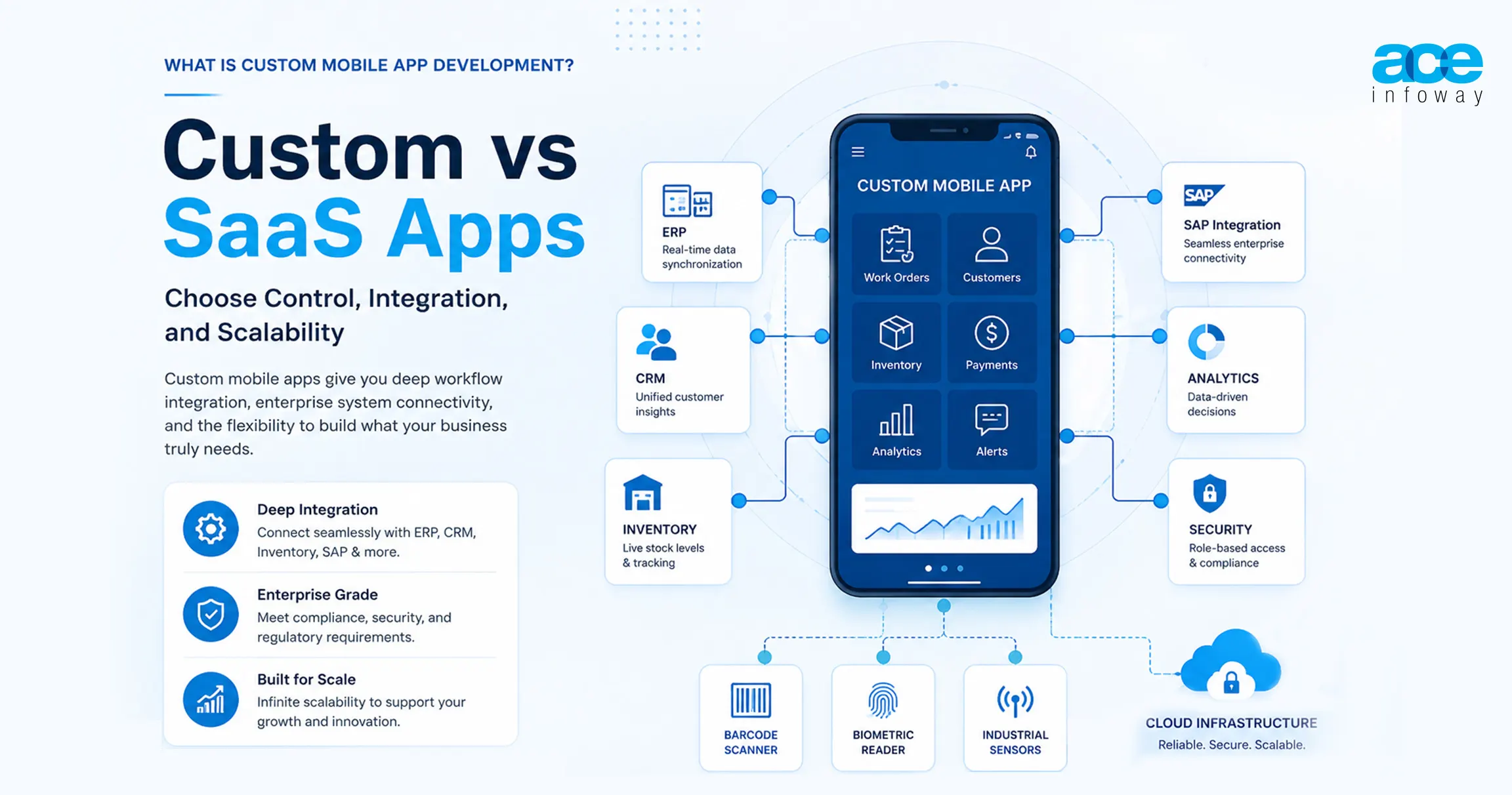
Custom mobile app development refers to the creation of an app to suit a particular business need, targeted users, and technological environment, and one that is not a modification of a ready-made commercial app.
Custom vs. Off-the-Shelf SaaS Apps: How To Tell Which One To Choose
The key point here is the depth of workflow integration. SaaS platforms perform well when the workflow is generic, the data model used is standard, and there are no requirements that differentiate the software behavior.
Once you find yourself in need of integrating deeply with ERP/CRM and other complex systems or in a situation in which the product is itself the differentiator, the equation changes. For instance, if a field service platform should integrate in real time with SAP and deliver pricing models to field techs, no generic SaaS app would do the job without expensive and time-consuming integrations.
That’s why custom business app development services were created. The key question is not whether a custom app is better in any sense. It is about whether you need control over the workflow or a unique competitive advantage that only a custom solution can provide you.
When is Custom Business App Development Required?
Obviously, a deep integration with enterprise applications and systems such as ERP, CRM, or inventory platforms belongs here. Though commercial products can solve some of these issues, in some cases, regulated data environments may require more from your solution. HIPAA for healthcare and SOC2 for fintechs are common examples of this problem.
Other examples in which a generic platform cannot do its job include sensors such asa barcode scanner, a biometric reader, or industrial sensors.
When Custom App Development Is Not the Right Solution?
First, generic workflows which cannot offer any value for competitive differentiation fall under custom development services that will drain your budget with no returns. If you need expense reports, time tracking software, or a simple CRM, use commercial apps that will cost less, get done faster, and will be supported by vendors. Lack of in-house product experience is the second major warning sign.
To benefit from custom mobile app development services, the buyer should be able to provide a clear product brief and define the scope. Otherwise, the agency risks drifting away from the brief.
The table below shows how all four build options differ along the lines that matter to you.
| Choosing the Right Mobile App Development Approach | ||||
| Approach | Control | Time to Market | TCO (3-year Perspective) | Scalability |
| Off-the-shelf SaaS | Low | Fastest (Days to Weeks) | Low to Medium (Subscription Costs) | Limited by Platform |
| White Label | Medium | Fast (Weeks) | Medium | Moderate |
| Low-code / No-code | Medium | Moderate (Weeks to Months) | Medium | Limited by Workflow |
| Custom Mobile App | High | Slower (Months) | Higher Upfront, Lower Long-term Cost | Unlimited |
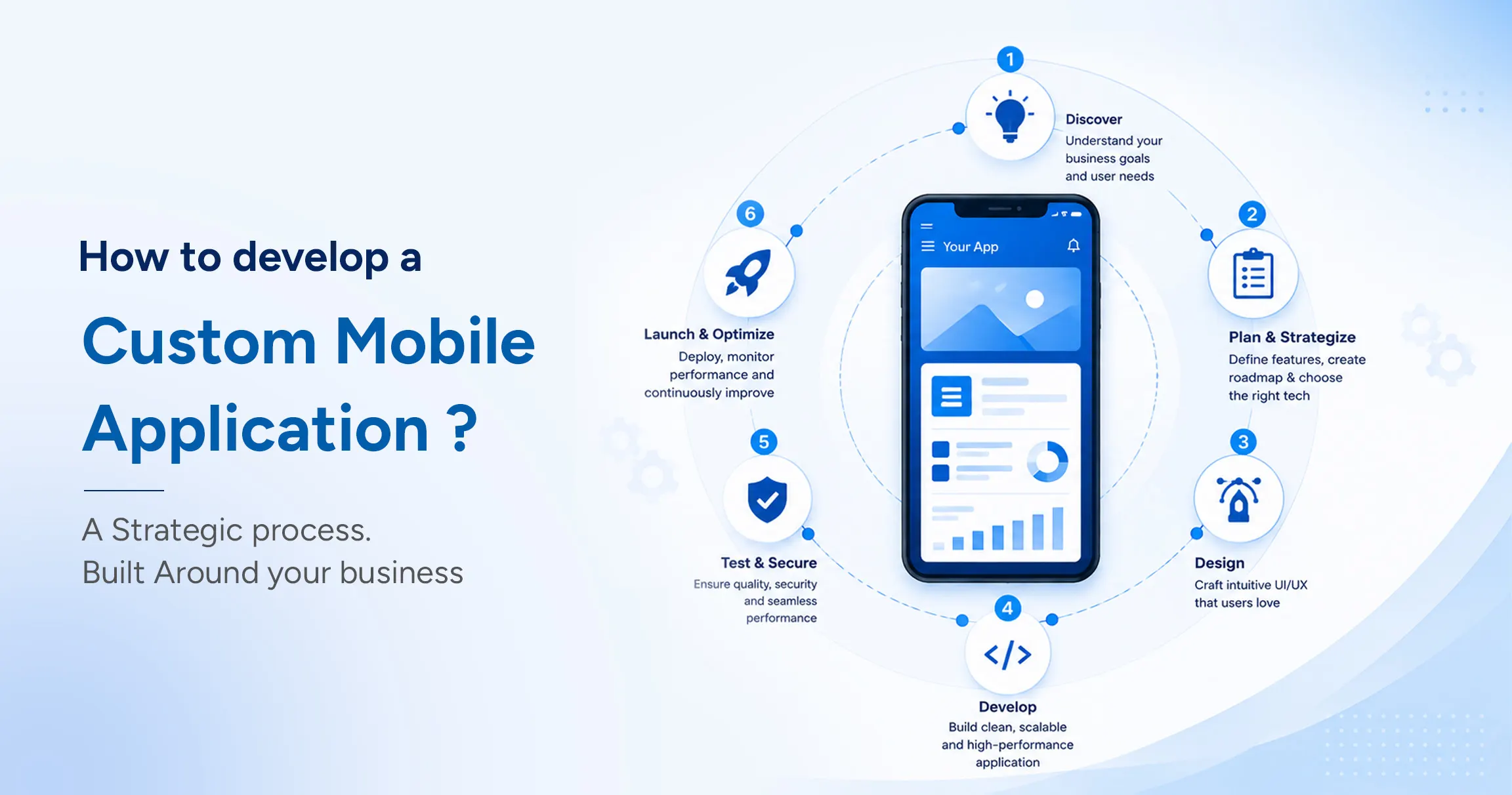
Custom Mobile App Development Services: 7 Phases Of Delivery
Each professional client needs to know the custom app development lifecycle before committing to a statement of work. Any vendor trying to shorten this process in order to impress is sure to ask for more later through extra charges or last-minute bugs.
The seven phases outlined below demonstrate how the custom app development services work.
| Typical Mobile App Development Lifecycle & Timeline | ||
| Phase | Description | Estimated Time |
| Discovery & Strategy | Business requirements, user research, technical assessment, project scoping, and risk evaluation. | 2–4 Weeks |
| UX/UI Research | User journey mapping, information architecture, wireframes, prototypes, and design system creation. | 3–5 Weeks |
| Technical Architecture & Tech Stack | Selecting native or cross-platform technologies, designing back-end architecture, APIs, and security framework. | 1–2 Weeks |
| Development Process | Frontend and backend development, API integration, and iterative feature delivery through 2-week agile sprints. | 8–20 Weeks |
| Quality Assurance & Testing | Unit testing, integration testing, device compatibility testing, penetration testing, and compliance validation. | 3–5 Weeks |
| Submission to App Stores & Launch | App Store and Google Play submission, beta releases, approval process, and production launch. | 1–3 Weeks |
| Post-launch Support | Bug fixes, crash monitoring, performance optimization, user feedback implementation, and ongoing feature enhancements. | Continuous |
Skipping discovery saves you just two weeks in the beginning. However, this phase determines the scope and protects your budget for the future.
How Much Does It Cost to Make an App in 2026?
Custom mobile application development cost in 2026 can vary significantly, depending on the complexity and scope of the project. The cost of mobile application development in 2026 can vary greatly depending on the project’s complexity and scope.
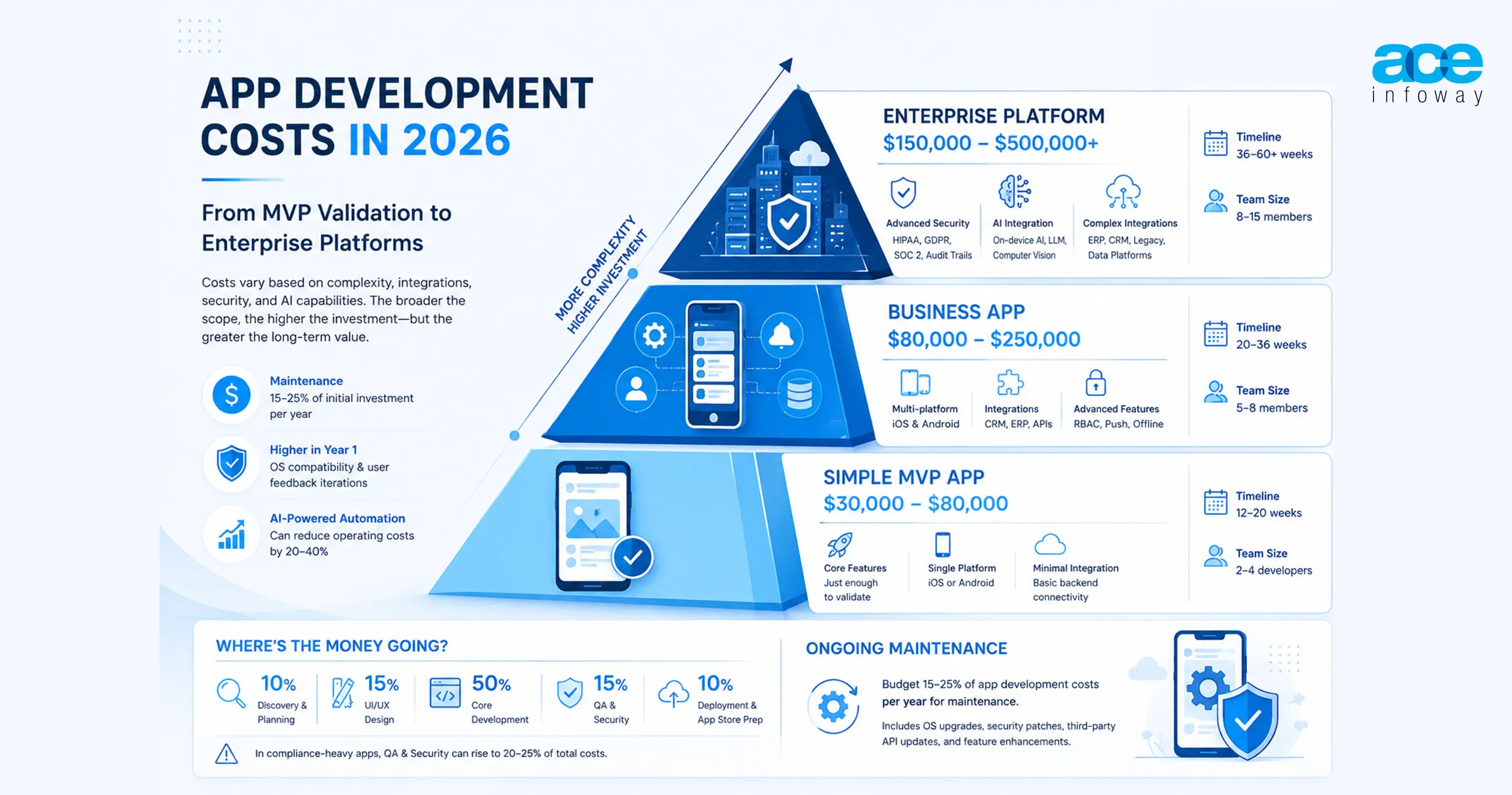
The annual rate of maintenance for a mobile app for an enterprise is usually 15-25% of the initial investment in the mobile application, and for the first year of maintenance, it is often higher due to OS compatibility work or due to the iteration based on user feedback.
The breadth of the range is a true representation of the variation in team size, level of integration, platform, and security needs.
Simple MVP App: $30,000 to $80,000
An MVP will generally have the functionality that it takes to fulfill its function, usually one platform (iOS or Android), a clean but not overly complex UI, and minimal/no back-end integration. This mobile app development cost level is ideal for startups testing a product hypothesis in the initial stages before investing in full development.
Mid-Tier Business App: $80,000 to $250,000
This tier includes iOS and Android (or a well-designed cross-platform application), CRM or ERP integration, role-based access control, push notification, and an offline feature. Such custom business app development normally requires a team of five to eight developers, a project manager, and a DevOps resource for setting up the CI/CD pipeline.
At this level, AI-powered automation coupled with mobile can save 20 to 40% in operating costs when compared to the manual processes that replace them.
Enterprise-Grade Platform: $150,000 to $500,000 and Above
With the enterprise tier, it’s not a sideshow. HIPAA audit trails and GDPR data residency, SOC 2 access controls, and penetration testing each cost weeks and money.
At this level, AI integration, such as on-device inference, LLM-driven search, or computer vision analysis, costs all of a sudden $20,000-$80,000 per capability.
You can assume that you are going to get a team of 8-15 people, and one of them will be a solutions architect, a security engineer, and a security QA automation lead.
| Mobile App Development Cost by Project Complexity | |||
| App Tier | Cost Range | Typical Timeline | Team Size |
| Simple MVP | $30,000–$80,000 | 12–20 Weeks | 2–4 Developers |
| Mid-tier Business App | $80,000–$250,000 | 20–36 Weeks | 5–8 Members |
| Enterprise Platform | $150,000–$500,000+ | 36–60+ Weeks | 8–15 Members |
Where’s the money going?
Discovery will consume around 10% of your budget, design 15%, core development 50%, QA/security 15%, and app store submission/preparation another 10%.
In compliance-heavy enterprise apps, however, QA/security can climb to 20-25% of total costs. Budget 15-25% of your app development expenses per year to maintain your mobile application. That includes
OS upgrades, security patches, updates to third-party APIs, and feature refinements.
Hire App Developers: In-House vs. Freelance vs. Agency
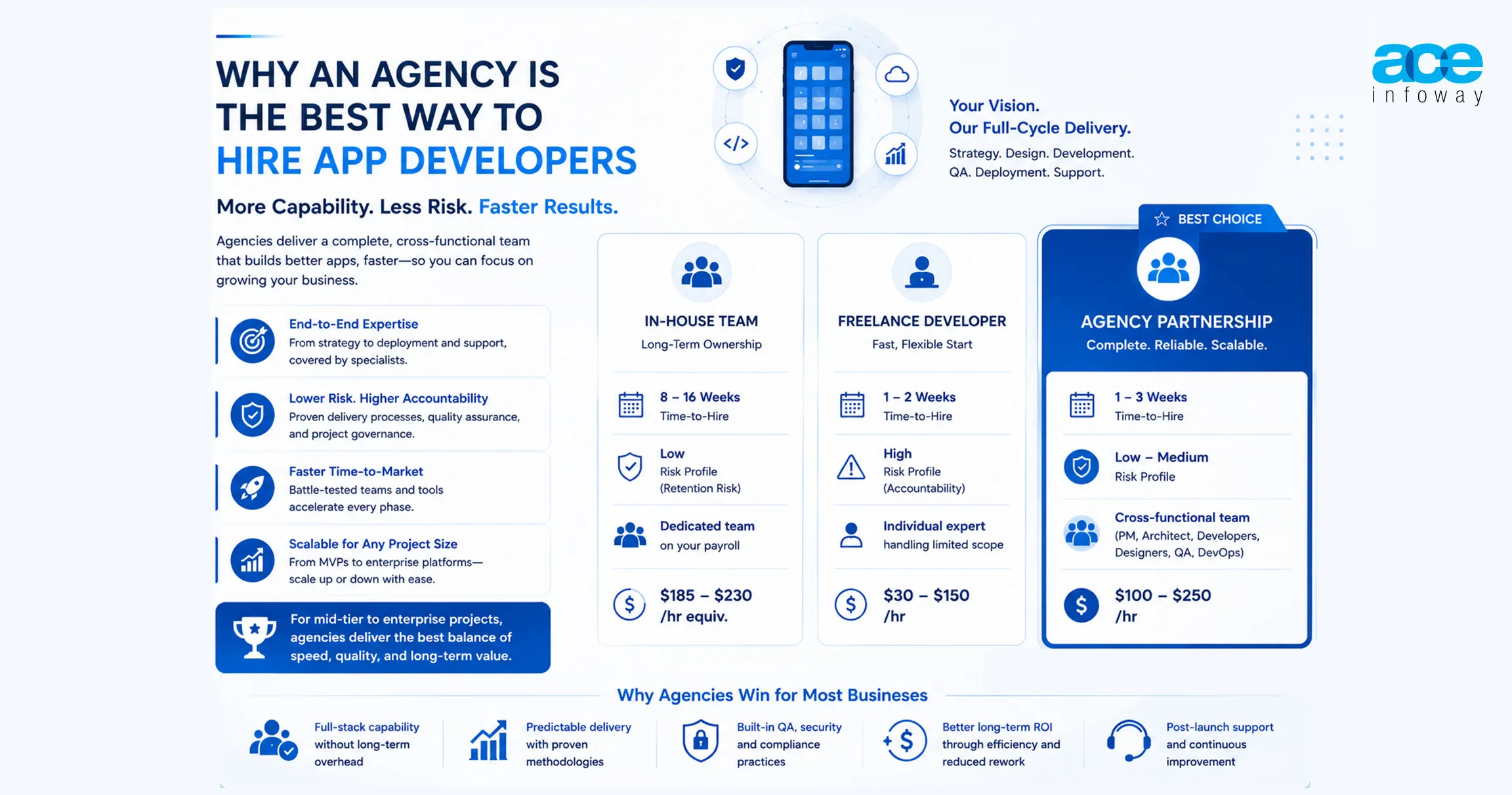
Three variables determine what you actually pay when you hire app developers: geography, experience.e There are three key factors that affect how much app developers cost: location, seniority/level, and specialization.
A top-notch React Native programmer working in San Francisco will cost you three to four times more than an equivalent specialist from Eastern Europe or India. According to McKinsey, 82% of firms need support in sourcing digital talent, indicating that the hiring risk associated with in-house app developers goes beyond simply the price tag on the services.
When to Hire an App Programmer In-House?
In-house is a good option if mobile is your product competence, and your development plan is iterative in nature.
The fully loaded cost of an in-house senior mobile developer in the US runs $180,000 to $220,000 annually. Once you factor in salary, benefits, recruiting, and tooling, the standard 1.3 to 1.6x multiplier on base salary.
You also carry the cost of hiring peaks and troughs. When a sprint ends, and there are no new features for eight weeks, the engineer is still on payroll.
In-house is the wrong model for project-based builds with a defined end state. It is also the wrong model when you need five disciplines simultaneously, such as iOS, Android, back-end, DevOps, and QA, but cannot sustain all five roles post-launch.
When to Hire Freelance App Developers?
Freelancing is fast to start and cheap to stop. For small-scope projects, an experienced freelance hire app programmer can deliver an MVP faster than a formal agency engagement.
The risk is accountability at scale. A solo developer cannot handle front-end, back-end, QA, and project management simultaneously. Scope changes that an agency project manager resolves in one email can send a freelance engagement sideways for two sprints.
Freelance work best when the scope is locked, the buyer has strong technical oversight, and post-launch support requirements are minimal.
When to Hire Mobile App Developers via an Agency?
When engaging the services of an established custom mobile application development company, the bundle comes complete with a project manager, an architect, a developer with platform-specific skills, a graphic artist, and a quality assurance expert, all bundled together.
In any case that involves mid-level or enterprise-level projects, the bottom line on price advantage is invariably in favor of the outsourcing agency once factors like hiring time and headcount are considered.
| Comparing Mobile App Development Hiring Models | ||||
| Model | Hourly Rate | Best For | Risk Profile | Time-to-Hire |
| In-house | $185–$230/hr (Equivalent) | Long-term Product Roadmap | Low (Retention Risk) | 8–16 Weeks |
| Freelance | $30–$150/hr | Small, Locked-scope Projects | High (Accountability) | 1–2 Weeks |
| Agency | $100–$250/hr | Mid-tier to Enterprise Builds | Low to Medium | 1–3 Weeks |
10-Question Vetting Checklist for Hiring App Developers
Before signing any engagement, confirm answers to all ten of these with any hire app programmer or agency:
- Can you provide three native or cross-platform apps you own end-to-end, with live links to the App Store or Play Store?
- What is your Git branching and code review process for a sprint team of this size?
- Does IP transfer fully to the client at project close, and does your contract confirm this explicitly?
- What NDA scope covers the client’s proprietary data, architecture decisions, and business logic?
- How do you handle scope change requests, and what is your change order process?
- What automated test coverage percentage do you target before any release?
- Who owns the App Store developer accounts, and what is the handover process post-launch?
- What post-launch SLA do you offer for critical bug response?
- How do you handle third-party API deprecation or breaking changes after launch?
- Can you share a project that went over budget or timeline, and how you managed it with the client?
Picking the Right Technology Stack for Custom Mobile App Development Services
Technology stack selection is a business decision that engineers execute. The wrong framing is asking which stack your developers prefer. The right framing is asking which stack best fits your user base, your performance requirements, your integration environment, and your budget. Read the full breakdown in Technologies to Develop Mobile Apps for a deeper stack comparison.
Native iOS and Android: When Performance and Platform UX Are Non-Negotiable
In-app development of custom apps based on Swift & SwiftUI enables the full power of iOS, including Core ML machine learning, ARKit augmented reality, and regulated HealthKit data support.
Development of cross-platform apps with Kotlin & Jetpack Compose on Android provides an identical experience. Apps created through native development boast optimal frame rates, minimal latency in interactions with hardware, and maximum consistency with the look-and-feel of each platform.
The price paid is having to maintain a separate codebase for each platform, which is a fair price when platform-native features have to be used to provide a particular user experience.
Cross-Platform (React Native and Flutter): 30 to 50% Cost Reduction
When developing a cross-platform app with React Native and Flutter, only one codebase has to be maintained for iOS and Android development.
Developers working with React Native estimate 30-50% cost reductions compared to native development of comparable features. Flutter apps are known for excellent GPU-based performance and rising adoption by enterprises.
But there is a cost as well: advanced augmented reality, deep integration with hardware like creating a custom Bluetooth protocol stack, or rendering 3D graphics cannot be done without a bridge into native features.
Back-End and Integration Stack
Back-end selection for a dedicated mobile app development team typically runs
- Node.js for high-concurrency real-time features
- .NET or Java for enterprise-grade transactional systems with existing Microsoft or Oracle infrastructure
- Firebase or Supabase for rapid MVP builds needing real-time sync without a custom API layer.
AWS and Azure dominate cloud hosting for enterprise deployments, with Azure preferred where M365 and Active Directory integration are required. API integration for mobile apps is where most back-end cost lives, specifically the time spent translating legacy enterprise data models into clean, typed API contracts a mobile client can consume reliably.
The Real ROI of Custom Mobile App Development (with Numbers)
ROI from custom mobile app development depends on which operational metric you are replacing. The benchmarks below are drawn from documented research across three verticals.
McKinsey (2025) confirms that digital transformations with effective implementation achieve 143% of expected ROI, while those without structured change management deliver only 35%.
The implication for custom app builds is clear: technology alone does not close the ROI gap.
Retail: Native Checkout Reduces Mobile Cart Abandonment
Mobile cart abandonment on retail web experiences runs at 85.65% on mobile browsers versus 73.76% on desktop.
A native checkout flow reduces that gap by eliminating redirect-based payment flows, supporting biometric authentication, and enabling one-tap address and payment autofill. Deloitte research confirms that mobile-engaged in-store shoppers bring higher traffic, conversion, and spending than non-mobile shoppers.
For a retailer doing $5 million in mobile revenue, recovering even 8 to 12 percentage points of abandonment through native checkout translates to $400,000 to $600,000 in annual revenue, a payback window well inside 18 months for most mid-tier build budgets.
Logistics: Custom Field-Service App Reduces Administrative Overhead
Administrative tasks consume roughly 30% of an average field technician’s working hours, nearly a third of their day spent on paperwork, phone calls, and data entry that should happen on a mobile device.
Companies with mobile-first field service management report 75% productivity gains after deployment. For a 50-technician operation at a loaded cost of $65 per hour, recovering even half of that 30% administrative burden returns over $750,000 annually in productive field capacity.
Fintech: Automated Mobile Onboarding Reduces Customer Acquisition Cost
Financial institutions with fully digital mobile onboarding have seen a 20% rise in customer acquisitions and a 15% reduction in associated costs. Deloitte adds that AI-driven automation in onboarding reduces operational costs by 20 to 40%. For a fintech acquiring 10,000 customers per quarter at $120 CAC, a 15% reduction returns $180,000 annually, with higher-performing implementations exceeding that benchmark materially.
| Mobile App ROI Timeline and Business Value | ||
| Phase | Timeline | Primary Value Driver |
| Launch and Stabilize | Months 1–4 | Bug resolution, user adoption, performance optimization, and improved app store ratings. |
| Retention and Automation Savings | Months 6–12 | Push notification engagement, workflow automation, reduced churn, and measurable operational ROI. |
| Scale Without Proportional Headcount | Year 2+ | Feature expansion on existing infrastructure while avoiding linear increases in staffing costs. |
7 Mistakes That Wreck Custom Mobile App Projects (and How to Avoid Them)
These are not hypothetical risks. They are the recurring failure modes that show up in post-mortems across enterprise and startup custom mobile app development engagements.
- Skipping the discovery phase to save cost. Teams that skip scoping to move faster almost always pay for it in change orders, scope disputes, and delayed launches. Discovery is not overhead. It is the document that makes every subsequent decision faster and cheaper.
- Choosing tech stack based on developer comfort, not product fit. An agency that defaults to the stack its team knows fastest is optimizing for their efficiency, not your product requirements. Stack selection must trace back to the user base, performance requirements, and integration environment.
- Treating QA as a phase, not a parallel discipline. QA that starts after development ends discovers bugs that would have been trivial to fix two sprints earlier. Automated testing integrated from sprint one reduces total bug-fix cost by 40 to 60%.
- No analytics or event tracking from day one. Launching without a mobile event tracking framework means you cannot measure retention, conversion, or feature adoption. Retrofitting analytics into a shipped product is expensive and often incomplete.
- Ignoring app store guidelines until submission. Apple App Store and Google Play rejection cycles average 7 to 14 days. Teams that design for store compliance from the start avoid launch delays that push go-live dates by three to six weeks.
- Forgetting the 15 to 25% annual maintenance line item. Every custom mobile app development budget that excludes ongoing maintenance underestimates the total cost of ownership by a material margin.
- OS updates alone require testing and patching twice a year.Hiring on an hourly rate alone is not a delivery model fit. The cheapest hire app programmer per hour is rarely the cheapest project outcome. Delivery model, communication quality, and post-launch accountability structure determine actual cost more reliably than the rate card.
How Ace Infoway Delivers Custom App Development Solutions
Ace Infoway is a US-focused custom mobile app development partner with recognized delivery expertise across native iOS, native Android, React Native, Flutter, and integrated web platforms. As an award-winning mobile app development company, Ace Infoway brings the full SDLC under one engagement model, from discovery and product strategy through to post-launch analytics and feature iteration.
- Three delivery commitments define how Ace Infoway operates. First, a proven SDLC: every project runs through a structured seven-stage delivery process with documented checkpoints at discovery, design sign-off, architecture review, sprint demos, QA sign-off, and launch.
- Second, cross-stack capability: the team covers native iOS with SwiftUI, native Android with Kotlin, cross-platform builds in React Native and Flutter, and full back-end integration across AWS, Azure, and Google Cloud environments.
- Third, engagement flexibility: clients choose between a dedicated mobile app development team model, a fixed-scope project, or staff augmentation for teams with existing developers who need specialized reinforcement.
The Decision is Not Technical
Custom app development solutions are not a technology purchase. They are an operating-model bet. The buyer who scopes clearly, calibrates the budget to tier, picks a talent model on fit rather than price, and measures ROI against named business metrics has already solved most of what causes custom mobile app development projects to fail.
The four takeaways from this guide: scoping clarity matters more than feature ambition; budget should be calibrated to the tier you actually need; talent model selection should follow delivery requirements, not rate cards; and ROI should be measured against specific operational metrics in your vertical, not industry averages. McKinsey (2025) makes the point cleanly: only 30% of transformation efforts succeed overall. The ones that do share one trait. They started with a clear scope, not optimistic timelines.
Ace Infoway’s Mobile App Development Services are designed to meet buyers at that decision point and build custom app development solutions around their operating reality.
Frequently Asked Questions
What is the cost of custom app development in 2026?
The cost of custom mobile app development in 2026 typically ranges from $30,000 for a simple MVP to $500,000+ for enterprise-grade applications with AI, advanced integrations, and compliance requirements. Most mid-sized iOS and Android applications fall between $80,000 and $250,000, depending on features, complexity, and development approach.
How long does it take to develop a custom mobile app?
A simple MVP generally takes 12 to 20 weeks, while a mid-sized application requires approximately 20 to 36 weeks. Large enterprise mobile applications with AI capabilities, complex integrations, and regulatory compliance may take 36 to 60 weeks or longer. Timelines also depend on discovery, changing requirements, testing, and app store approval.
Should I hire an in-house team or partner with a custom app development company?
An in-house development team is a strong choice when mobile development is a long-term strategic function requiring continuous product evolution. A custom app development company is often the better option when you need experienced specialists, faster project execution, and access to multiple technical skills without expanding your permanent workforce.
Which is better: native app development or cross-platform development?
Cross-platform frameworks such as Flutter and React Native are the preferred choice for many business applications because they reduce development costs and accelerate delivery across iOS and Android. Native development using Swift or Kotlin is recommended when applications require maximum performance, deep hardware integration, advanced AR capabilities, or platform-specific features.
What does a custom app development solution typically include?
A complete custom app development solution typically includes business analysis, UX/UI design, architecture planning, frontend and backend development, API integrations, quality assurance, deployment, and post-launch maintenance. Ongoing support usually covers bug fixes, operating system updates, security patches, performance monitoring, analytics, and future feature enhancements.