








|
Getting your Trinity Audio player ready...
|
Table of Contents
Customer expectations continue evolving faster than traditional eCommerce platforms can accommodate. Businesses now require flexible architectures that support continuous innovation without disrupting customer experiences.
This shift has encouraged brands to rethink what composable commerce is and its strategic value. Unlike monolithic systems, composable commerce adopts a modular architecture built through API-driven services.
Industry analysts have also recognized this architectural shift. Gartner introduced composable commerce as a strategic approach that enables organizations to build adaptable digital commerce ecosystems using modular, best-of-breed technologies.
A modern composable commerce platform empowers retailers to select, replace, or enhance individual components without rebuilding complete infrastructures. This flexibility accelerates innovation while reducing technical debt that often limits long-term digital growth.
Consumers also expect personalized recommendations, mobile-first journeys, and seamless transitions across every shopping touchpoint. Meeting these expectations requires connected systems capable of delivering consistent experiences regardless of channels and devices.
As digital commerce becomes increasingly competitive, composable architectures create lasting business advantages through agility, scalability, and continuous optimization.
What is Composable Commerce?
Understanding composable commerce begins with recognizing a fundamental shift in eCommerce architecture. Instead of relying on rigid, all-in-one platforms, businesses assemble independent services tailored to specific operational requirements.
At its core, composable commerce follows a modular, API-first approach where specialized applications work together seamlessly. Capabilities like product catalogs, checkout, payments, content management, and search remain independent while exchanging data efficiently.
A modern composable commerce platform allows organizations to replace, upgrade, or expand individual services without affecting the broader ecosystem. This architectural flexibility accelerates innovation, simplifies technology adoption, and reduces long-term dependency on a single vendor.
Rather than forcing businesses to adapt around platform limitations, composable architecture adapts around evolving business goals.
Difference Between Composable Commerce and Traditional eCommerce Platforms
The difference between composable commerce and traditional eCommerce platforms lies in architectural flexibility rather than storefront functionality. Monolithic platforms tightly connect every business capability, making upgrades, integrations, and customization increasingly complex as businesses grow.
By comparison, a composable commerce platform allows organizations to combine independent, API-driven services that evolve without affecting the complete ecosystem. This architectural approach improves scalability, accelerates innovation, and simplifies technology modernization.
What Are The Benefits of Composable Commerce
The growing adoption of composable commerce reflects changing business priorities rather than temporary technology trends. Modern retailers require adaptable architectures that improve customer experiences while supporting continuous innovation and operational efficiency.
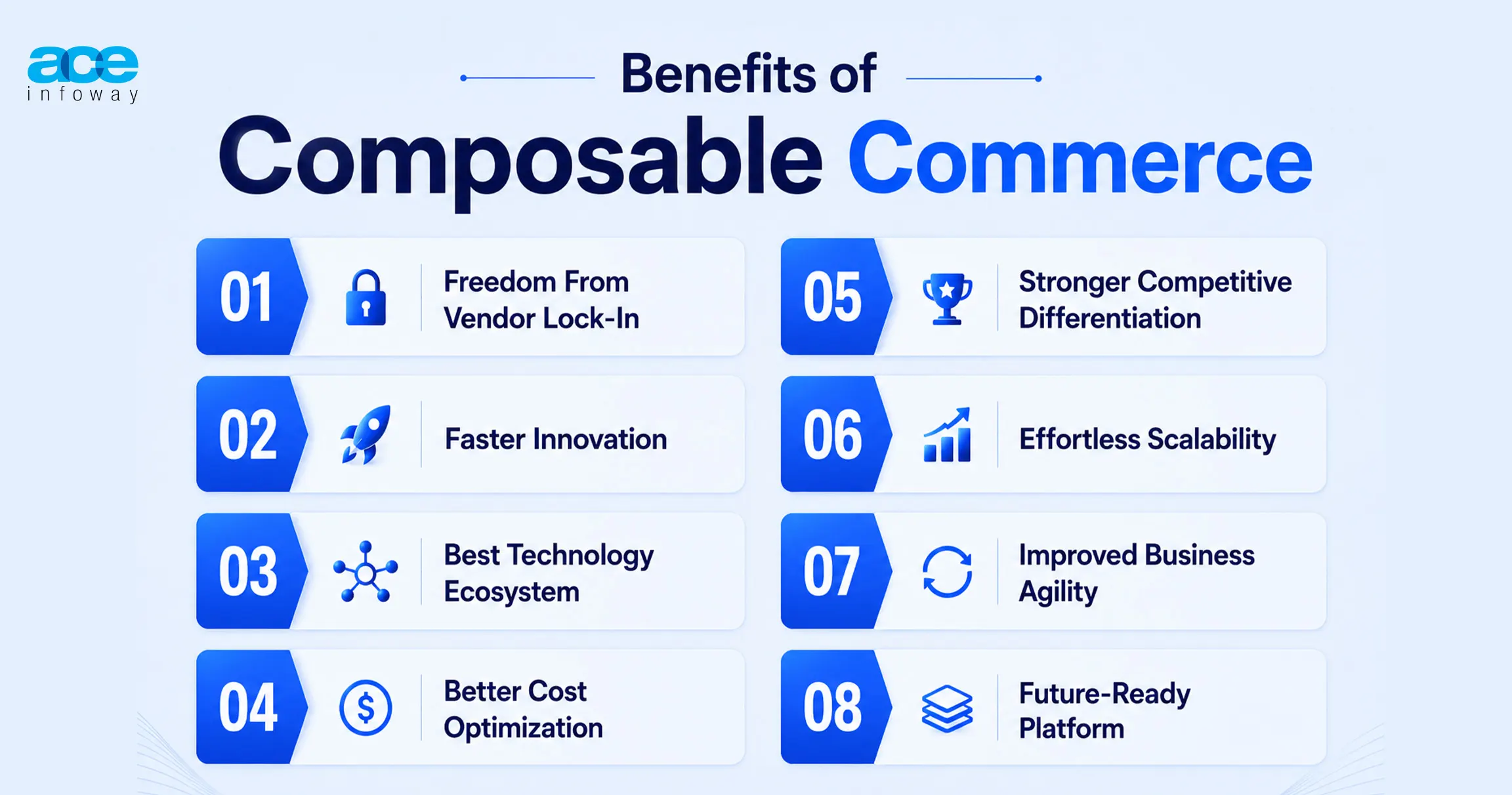
Freedom From Vendor Lock-In
A composable commerce platform allows businesses to choose specialized technologies instead of depending on one provider. Individual services can be replaced or upgraded without rebuilding the complete commerce ecosystem.
Why It Matters
Businesses retain complete technology control, reducing long-term risks while accelerating innovation through flexible vendor selection and seamless service replacement.
Faster Innovation Through Modular Architecture
Independent microservices allow development teams to deploy updates without affecting unrelated business functions. This modular approach shortens release cycles while improving platform stability and development efficiency.
Why It Matters
Teams launch customer-facing improvements faster, reducing deployment risks while responding quickly to changing market expectations and consumer behavior.
Best Technology Ecosystem
Instead of compromising with limited native capabilities, composable commerce integrates leading applications through APIs. Organizations combine internal systems, third-party services, and custom solutions into one connected ecosystem.
Why It Matters
Every business capability performs optimally because organizations select technologies based on business value instead of platform limitations.
Better Cost Optimization
Businesses invest only in services delivering measurable operational or commercial value. This targeted investment approach minimizes unnecessary licensing costs while simplifying long-term platform management.
Why It Matters
Technology budgets remain focused on growth initiatives instead of maintaining unused features or unnecessary enterprise software licenses.
Stronger Competitive Differentiation
Modern digital commerce depends on unique customer experiences instead of standardized storefronts. Composable commerce enables brands to experiment rapidly with personalized journeys, emerging technologies, and innovative buying experiences.
Why It Matters
Faster experimentation creates distinctive customer experiences that competitors using rigid platforms often struggle to replicate consistently.
Effortless Scalability
Growing businesses can expand individual services without scaling the entire technology stack simultaneously. Resources remain aligned with actual demand across different commerce capabilities.
Why It Matters
Infrastructure scales efficiently during seasonal peaks, reducing performance bottlenecks while controlling operational complexity and cloud infrastructure expenses.
Improved Business Agility
Changing customer expectations demand rapid operational adjustments across every digital touchpoint. Flexible architecture enables organizations to introduce capabilities without lengthy redevelopment projects or platform migrations.
Why It Matters
Businesses adapt confidently to evolving customer preferences while maintaining uninterrupted shopping experiences across multiple digital channels.
Future-Ready Platform
Organizations integrate emerging technologies without replacing their existing commerce foundation, ensuring continuous innovation as market demands evolve.
Why It Matters
Future technology adoption becomes significantly easier because new capabilities integrate seamlessly without disrupting established business operations or customer experiences.
Which Businesses Benefit Most from Composable Commerce?
Although composable commerce offers flexibility for many organizations, its greatest value appears in businesses managing complex digital commerce operations.
Organizations planning to modernize their commerce architecture often rely on experienced eCommerce development services partners to design scalable, API-first ecosystems while minimizing implementation risks.
Fast-Growing and Enterprise Businesses
Rapidly expanding organizations benefit from a composable commerce platform because individual services scale independently. Teams can introduce new capabilities, modernize existing systems, and expand into new markets without disrupting ongoing operations.
Retail and B2C Brands
Composable commerce for B2C enables retailers to deliver personalized shopping journeys using AI-powered search, dynamic promotions, and omnichannel engagement. Independent services also simplify experimentation with new customer experiences across multiple sales channels.
B2B Organizations
Businesses managing negotiated pricing, bulk purchasing, and contract-based transactions can tailor every commerce capability to support complex operational requirements while maintaining flexibility for future growth.
Marketplaces and Multi-Vendor Platforms
Marketplace businesses efficiently manage diverse product catalogs, vendor onboarding, payment workflows, and fulfillment processes by integrating specialized services that evolve independently as platform requirements change.
Innovation-Driven Businesses
Organizations investing in artificial intelligence, automation, or emerging commerce technologies can adopt new capabilities faster. This modular architecture encourages continuous innovation without requiring complete platform replacements.
Embracing Composable Commerce for Omnichannel Success
Modern shoppers interact with brands through websites, mobile applications, marketplaces, social platforms, and physical stores before making purchasing decisions.
As per the report, customers receiving effective personalized experiences were 1.8 times more likely to pay a premium, reinforcing the importance of connected customer journeys.
It is significantly effective for:
Unified Customer Insights
A composable commerce platform consolidates customer data from multiple channels into a centralized ecosystem. Businesses gain a complete understanding of customer behavior, shopping preferences, and engagement patterns, enabling smarter marketing strategies and data-driven decision-making.
Personalized Customer Experiences
Real-time customer insights allow businesses to deliver personalized product recommendations, targeted promotions, and relevant content across every touchpoint. Consistent personalization strengthens customer engagement while creating seamless shopping experiences regardless of the purchasing channel.
Centralized Inventory and Order Management
Composable architecture synchronizes inventory, fulfillment, and order processing through connected services. Businesses maintain accurate stock visibility while managing orders efficiently across eCommerce websites, marketplaces, retail stores, and mobile commerce platforms.
Consistent Brand Experience
Independent commerce services help maintain consistent product information, pricing, promotions, and messaging across every customer interaction. This consistency builds trust while delivering a recognizable brand experience throughout the entire buying journey.
Faster Channel Expansion
One of the major benefits of composable commerce is the ability to integrate emerging sales channels without rebuilding the existing ecosystem. Businesses quickly adopt new marketplaces, social commerce platforms, or digital experiences through API-driven integrations while maintaining operational continuity.
Composable Commerce vs Headless Commerce
Understanding composable commerce vs headless is essential because both architectures use APIs and decoupled technologies. However, their objectives, flexibility, and long-term business value differ significantly.
Architecture
Composable commerce adopts a modular architecture where every business capability operates as an independent microservice. Businesses assemble only the services they require, creating a technology stack tailored to their operational goals.
Headless commerce separates the frontend presentation layer from the backend commerce engine. This separation improves frontend flexibility while the backend often remains a unified commerce platform.
Flexibility
A composable commerce platform allows organizations to mix, replace, or upgrade specialized services such as search, checkout, payments, inventory, and promotions independently. Every capability evolves without disrupting the remaining ecosystem.
Headless commerce provides flexibility mainly for frontend development. Teams can build experiences using frameworks like React, Vue, or Angular while connecting them to backend services through APIs.
Customization
One of the biggest composable commerce advantages is complete business-level customization. Organizations choose best-of-breed technologies for every commerce function instead of adapting their operations around platform limitations.
Headless commerce focuses primarily on creating customized customer interfaces. While businesses gain greater control over UI and UX, backend business capabilities remain comparatively less flexible.
Content Management
Composable architecture integrates dedicated content management systems alongside other specialized services. Marketing teams update content independently while maintaining seamless connections with commerce capabilities through APIs.
Headless commerce also commonly integrates an external CMS. The separation between content and commerce enables faster content publishing across multiple digital channels.
Scalability
Composable commerce enables every microservice to scale independently according to demand. Businesses optimize infrastructure without increasing resources across the complete commerce ecosystem.
Headless commerce also supports scalable frontend experiences. However, backend scalability largely depends on the capabilities of the underlying eCommerce platform.
Speed to Market
Independent services allow development teams to release new capabilities much faster. Businesses reduce development effort by integrating proven services instead of building every feature from scratch.
Headless commerce accelerates frontend releases because presentation updates occur independently from backend development. This improves deployment speed for customer-facing enhancements.
| Difference Between Composable Commerce and Headless Commerce | ||
| Capability | Composable Commerce | Headless Commerce |
| Architecture | Modular ecosystem built using independent microservices connected through APIs. | Frontend is decoupled from the backend commerce platform. |
| Flexibility | Individual services can be selected, replaced, or upgraded independently. | Primarily offers flexibility for frontend technologies and user experiences. |
| Customization | Enables end-to-end customization across every commerce capability. | Focuses mainly on customizing the customer interface and experience. |
| Content Management | Integrates dedicated CMS platforms alongside modular commerce services. | Uses a separate CMS connected to the frontend through APIs. |
| Scalability | Every commerce capability scales independently based on business demand. | Frontend scales independently, while backend depends on the commerce platform. |
| Speed to Market | Faster feature releases through reusable microservices and modular integrations. | Accelerates frontend deployments without affecting backend operations. |
The Technologies Powering Composable Commerce
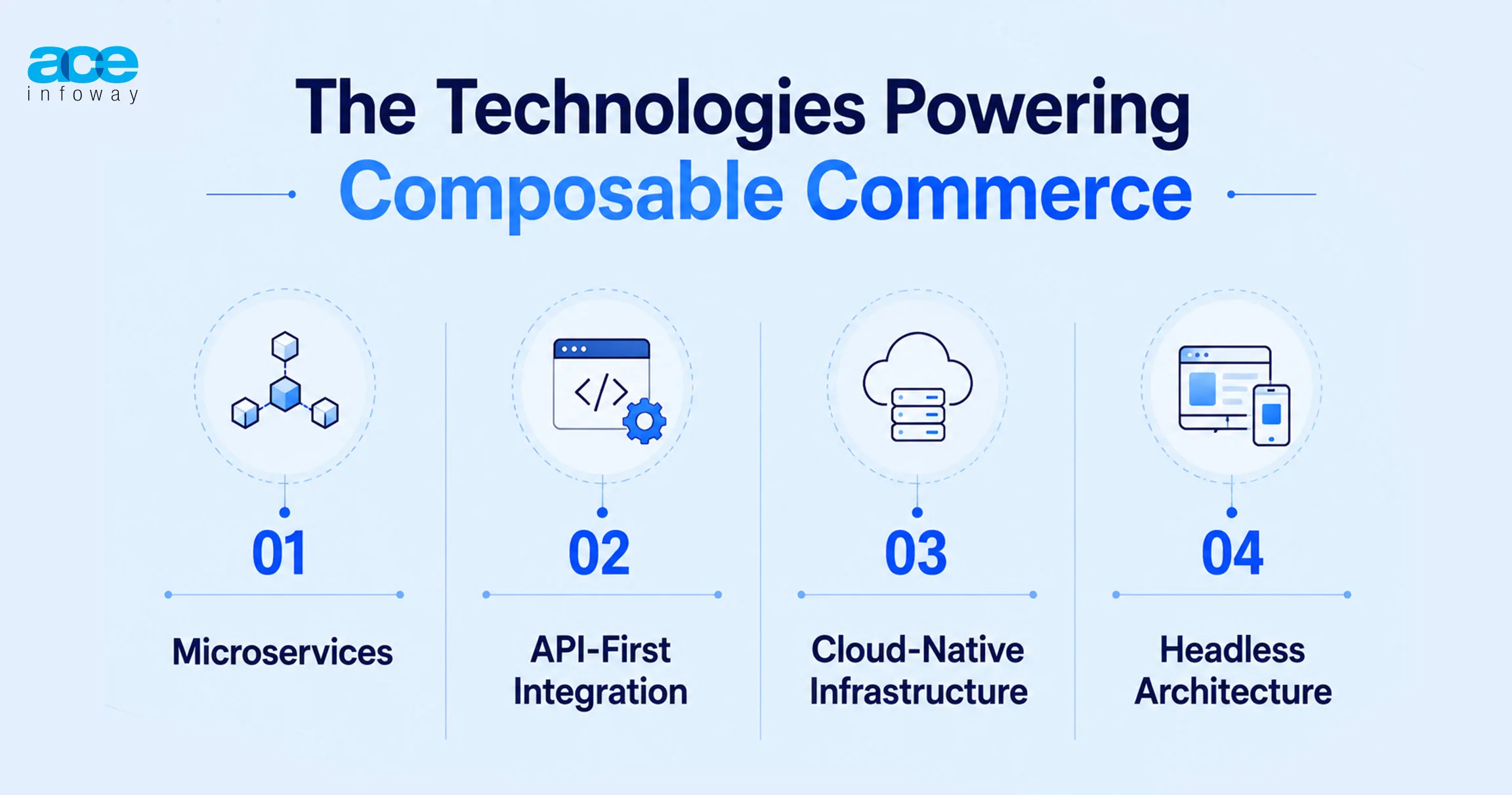
A modern composable commerce platform is built on technologies that prioritize flexibility, scalability, and seamless connectivity. Together, these technologies form the foundation of the MACH architecture, enabling businesses to assemble best-of-breed commerce services that evolve independently while delivering connected customer experiences.
Microservices
Microservices divide the commerce ecosystem into independent business capabilities such as search, checkout, payments, inventory, and customer accounts. Since every service operates separately, development teams can upgrade or replace individual components without affecting the remaining architecture.
API-First Integration
APIs connect every application within composable commerce, allowing secure data exchange between commerce services, ERP systems, CRM platforms, third-party solutions, and customer-facing applications. This integration-first approach simplifies technology expansion while reducing implementation complexity.
Cloud-Native Infrastructure
Cloud-native infrastructure provides the scalability required for modern digital commerce. Businesses automatically adjust computing resources during seasonal demand, ensuring consistent performance, improved resilience, stronger security, and optimized infrastructure costs.
Headless Architecture
Headless architecture separates customer-facing experiences from backend commerce services. This enables organizations to create engaging shopping journeys across websites, mobile applications, marketplaces, and emerging digital channels without disrupting core business operations.
Conclusion
Digital commerce is no longer defined by launching an online store. Sustainable growth depends on building an architecture that continuously adapts to evolving customer expectations, emerging technologies, and changing business priorities. Choosing the right foundation today determines how quickly your business can innovate tomorrow.
Ace Infoway helps enterprises design scalable, future-ready commerce ecosystems through modern engineering, cloud technologies, and tailored digital transformation strategies. Our focus remains on delivering solutions that align technology investments with measurable business outcomes and long-term growth.
Contact us to explore a composable strategy built around your unique business goals and challenges.

Frequently Asked Questions
- Is composable commerce suitable for small and mid-sized businesses?
Yes. While enterprises often adopt composable commerce first, growing businesses can also benefit by implementing modular capabilities gradually. This approach reduces future migration challenges while supporting long-term scalability.
- How long does a composable commerce migration typically take?
The timeline for composable commerce migration depends on existing infrastructure, integrations, and business complexity. Many organizations migrate incrementally, replacing specific services without disrupting daily commerce operations.
- How do I choose the right composable commerce platform?
The ideal composable commerce platform should provide API-first integrations, cloud-native scalability, flexible microservices, and compatibility with your existing business applications. Vendor ecosystem, security, and implementation support should also influence your decision.
- Is composable commerce only designed for B2C businesses?
No. Although composable commerce for B2C enables highly personalized shopping experiences, the same architecture effectively supports B2B commerce, marketplaces, subscription models, and hybrid business environments.
- What should businesses evaluate before adopting composable commerce?
Before implementing composable commerce, organizations should assess business objectives, integration requirements, technology maturity, internal development capabilities, and long-term scalability goals. A clear roadmap helps maximize implementation success while minimizing operational risks.