








|
Getting your Trinity Audio player ready...
|
Table of Contents
The most revealing signal in the 2026 B2B buyer data isn’t the pace of digital adoption. It’s the scale of what buyers are now prepared to transact online. According to Shopify, 83% of B2B decision-makers will complete purchases of at least $10 million through digital channels.
These changes every architecture decision in b2b eCommerce website development. The question is no longer whether enterprise buyers will transact online.
The question is whether your platform can carry the operational weight of those transactions with accurate pricing, real-time inventory, ERP-synchronized order logic, and a buying experience that doesn’t send a procurement director back to the phone.
This article addresses the architecture, integration, and AI-readiness decisions that determine the answer.
Why Legacy Systems Are Blocking Successful B2B eCommerce Website Development
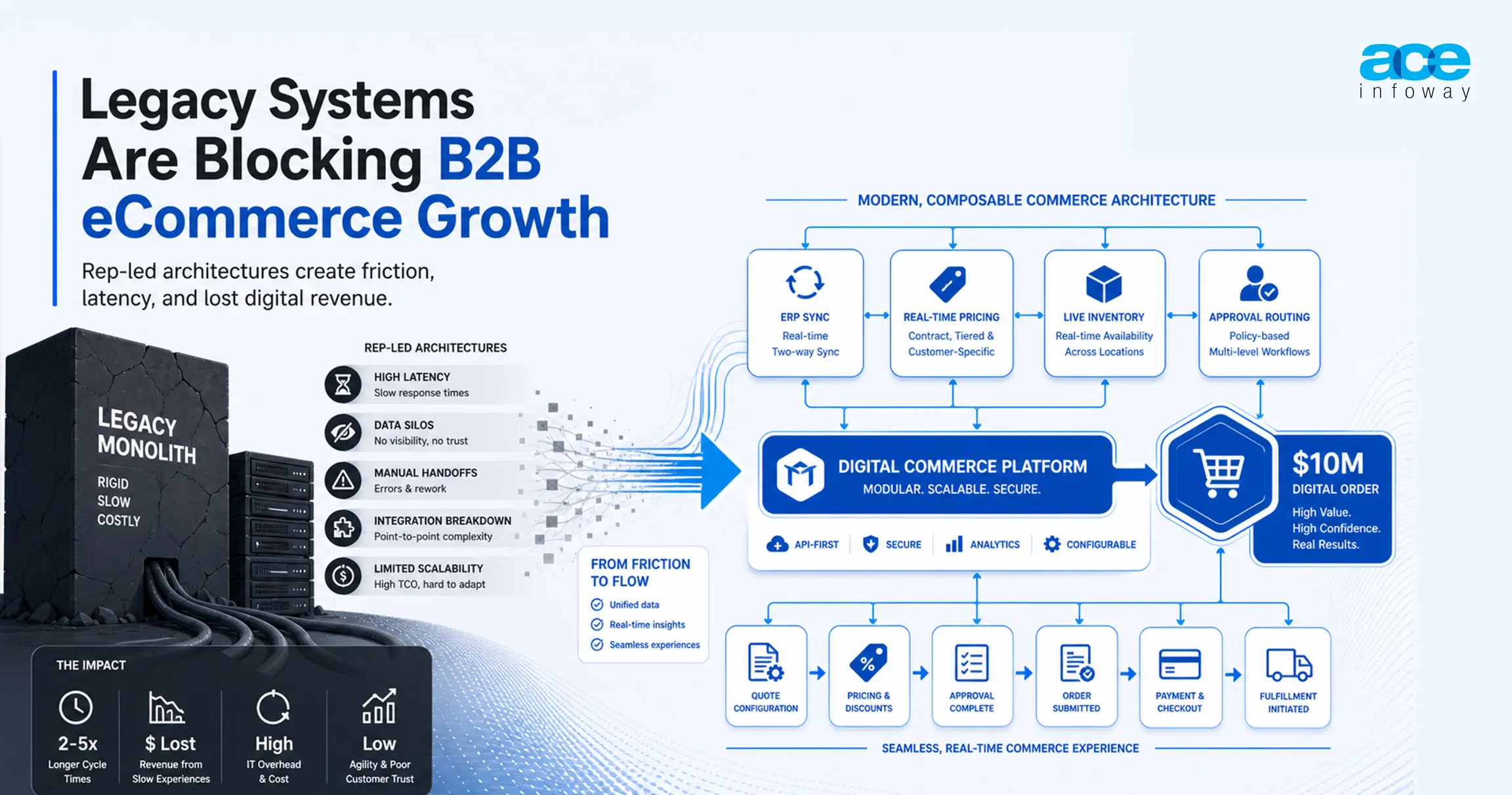
B2B eCommerce website development starts with an uncomfortable diagnosis: most legacy platforms were built around the sales rep, not the buyer. Overcoming this mismatch requires a comprehensive eCommerce digital transformation to stop revenue bleed.
Why Most Buyers Reject Rep-Led Sales Cycles?
Millennials and Gen Z have assumed core purchasing authority across most B2B organizations, and they carry fundamentally different expectations into procurement.
They default to self-service, expect real-time pricing with live inventory data, and treat friction as a signal to look elsewhere when your platform forces them into a call or a PDF quote request, that friction converts to competitor revenue.
Buyers who hit friction once don’t complain; they quietly shortlist alternatives and reduce order frequency before the trend surfaces in your CRM data.
The $10 Million Online Transaction: What It Reveals About Digital Buyer Confidence
The willingness to commit $10 million through a digital channel signals that trust in B2B eCommerce infrastructure has crossed a threshold that most legacy platform architects did not anticipate.
This isn’t a story about low-value commodity reorders moving online. It’s a structural shift in how enterprise procurement operates.
Whether your platform is ready to handle that transaction with customer-specific contract pricing, multi-tier approval routing, and ERP synchronization, the operational question your architecture must answer before any UI conversation begins is whether it completes within acceptable latency.
The Ultimate Guide to B2B eCommerce Data Architecture
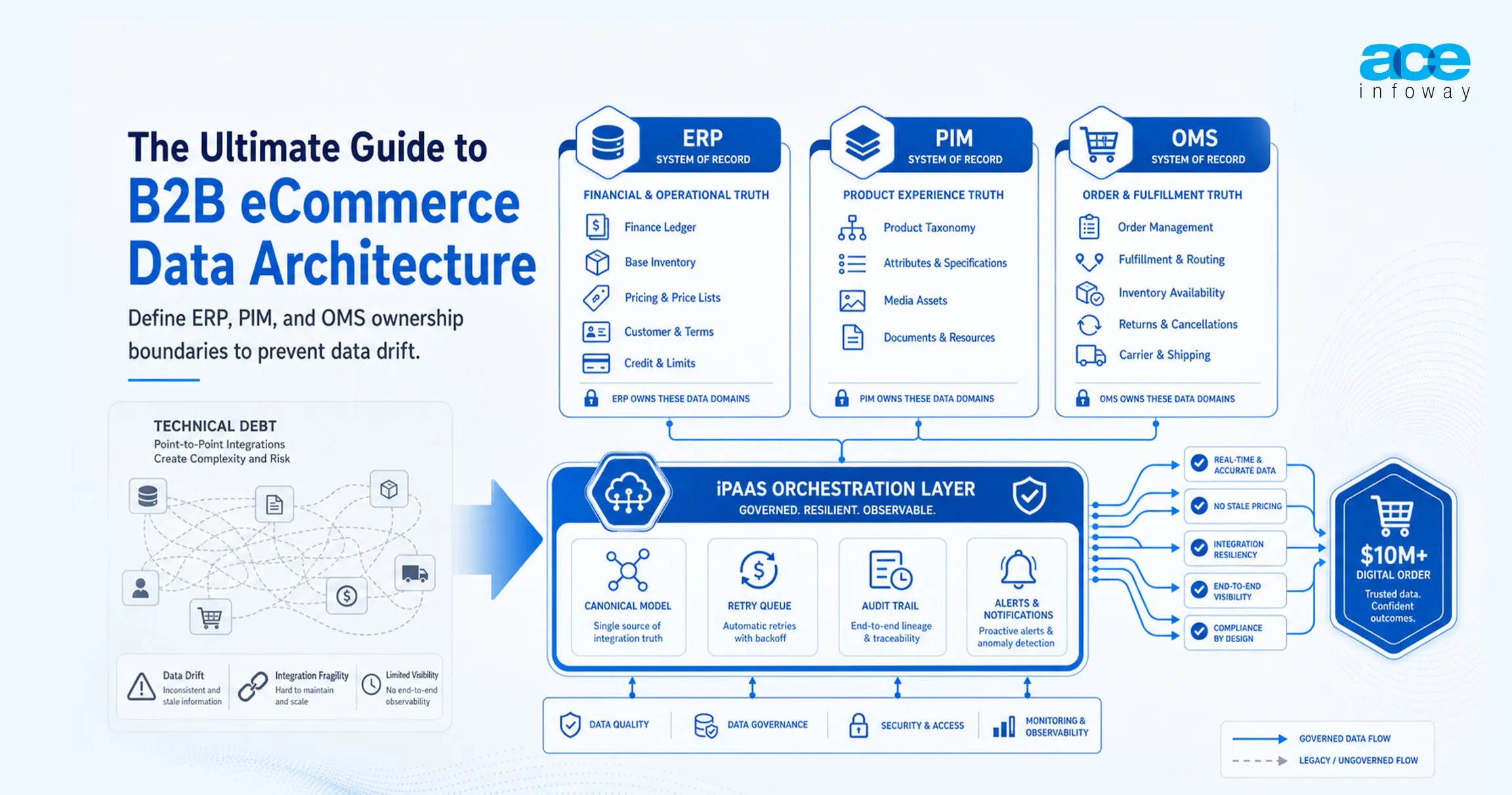
The primary cause of B2B eCommerce implementation failure is undefined data ownership. Successful B2B eCommerce development requires strict boundaries between systems of record, specifically the ERP, PIM, and OMS, connected via an iPaaS layer to prevent data drift and integration breakdowns.
1. The Core Problem: Undefined Data Ownership
Most B2B eCommerce platforms fail due to backend data mismanagement, not poor frontend design.
- The Mistake: Relying on a single system (usually the ERP) to handle all data, or failing to define which system owns which data before coding begins.
- The Consequence: Data drift. When systems overreach their domains, storefront accuracy degrades. This manifests as lost high-value orders rather than in visible system error logs.
2. The 3 Systems of Record: Establishing Boundaries
To prevent data drift, B2B eCommerce development services must establish three non-overlapping data domains before selecting a platform.
Here is the ideal architecture for system data ownership:
3. Integration Strategy: iPaaS vs. Point-to-Point
Connecting these distinct systems of record requires a scalable B2B SaaS integration architecture.
Why Point-to-Point Integration Fails?
While point-to-point integration between a storefront and an ERP may seem simple in initial project plans, it inevitably becomes a technical debt that is difficult to maintain within 12 to 18 months.
Why iPaaS is the B2B Standard?
An Integration Platform as a Service (iPaaS) layer is the recommended architecture for mid-market and enterprise B2B deployments.
Key advantages of iPaaS include:
- Canonical Data Modeling: Establishes a universal language across all connected systems.
- Automated Error Handling: Features built-in transaction retries and real-time error alerting.
- Complete Audit Trails: Tracks data movement across the entire ecosystem.
- Fail-Safe Synchronization: If a pricing engine fails to sync, the iPaaS layer queues the transaction instead of silently serving stale prices to a buyer.
Customized B2B eCommerce architectures built on iPaaS can recover from integration failures in minutes rather than hours, a critical safeguard when dealing with high-value transactions.
B2B eCommerce Platform Selection: TCO and Architectural Complexity
Platform viability in B2B eCommerce is strictly dictated by Total Cost of Ownership (TCO) and architectural complexity, not just feature sets. The primary metric for evaluating a platform is the ratio of custom requirements to available native features.
Choosing an architecture that misaligns with your engineering capacity creates expensive technical debt that typically compounds by year three.
1. Platform Comparison: Shopify Plus vs. Adobe Commerce vs. MACH
Many projects underestimate scope by applying B2C standards to B2B workflows, unless they are purposely building a hybrid eCommerce platform to manage B2B and B2C seamlessly from a single place. A standard B2B session involves severe constraints:
The right platform depends on business complexity, scalability goals, and operational requirements.
Note: For mid-market companies without large, dedicated engineering teams, a full MACH build on a first deployment is generally an operational liability rather than a benefit.
2. When to Choose Composable (MACH) Architecture?
While monolithic platforms serve the mid-market well, Enterprise B2B eCommerce solutions often outgrow native features within 2 to 3 years.
A composable architecture becomes the superior choice when an enterprise manages:
- Tens of thousands of SKUs.
- Multiple sales channels, regions, and customer-specific price books.
- Active, heavy integrations across legacy systems.
3. The 40% Customization Rule
To evaluate whether the higher initial TCO of a composable stack is justified, organizations must calculate their customization ratio during the discovery phase (not estimate it).
When more than 40% of required workflows demand custom development regardless of the chosen platform, the composable (MACH) approach begins to narrow the TCO gap and outperform native monolithic workflows.
Optimizing B2B eCommerce UX for Complex Procurement Workflows
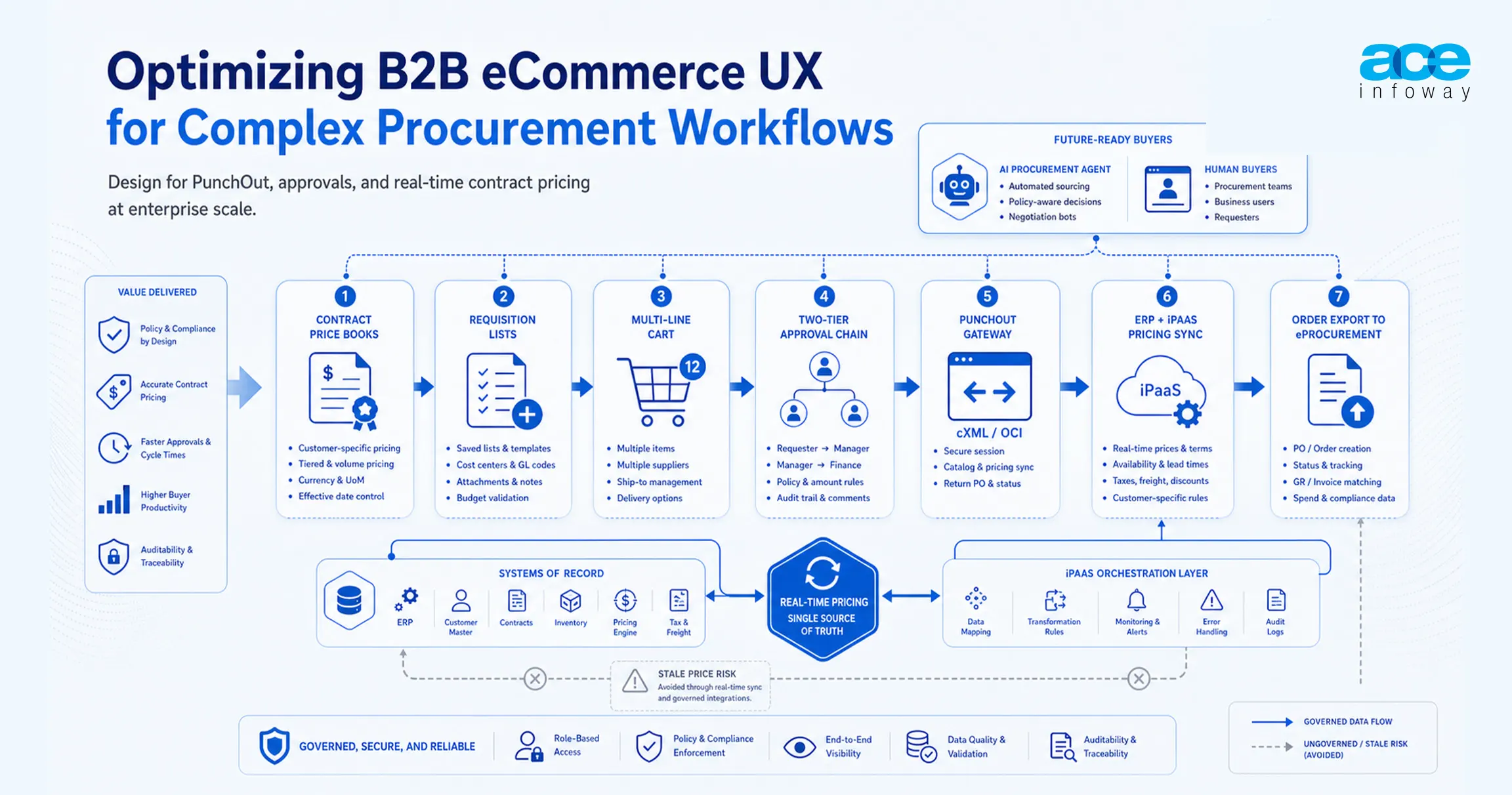
B2B eCommerce UX goes far beyond the consumer expectations of fast load times and attractive imagery. A successful B2B storefront must accommodate highly specialized procurement realities, multi-tier approval chains, and real-time custom pricing, while preparing the data architecture to eventually serve non-human, automated buyers.
1. The B2B UX Reality: Beyond the Consumer Cart
Many projects underestimate the scope of B2B user experience by applying B2C standards to B2B workflows.
A standard B2B buyer session involves severe constraints and complex actions that do not exist in retail:
- Querying contract-specific price books.
- Building multi-line orders from saved requisition lists.
- Routing carts through two-tier internal approval chains.
- Exporting confirmed orders back into corporate procurement systems before transaction completion.
2. PunchOut Integration: The Enterprise Differentiator
PunchOut integration is the defining feature that separates platforms capable of winning enterprise accounts from those that cannot.
How PunchOut Works:
- Protocols: Utilizes cXML or OCI protocols to connect directly to buyers’ eProcurement systems.
- The Workflow: Allows buyers to browse a supplier’s catalog and build a cart within their own procurement interface, then passes the order data back to their system for managerial approval.
- The Advantage: Enterprise B2B eCommerce solutions offering native PunchOut support carry a measurable competitive edge in RFP responses. Industry benchmark: eProcurement adoption rates in manufacturing and distribution verticals currently exceed 70%.
3. Customer-Specific Pricing: A Data Architecture Problem
Customer-specific pricing is frequently misunderstood as a UI feature request rather than a data architecture challenge.
A standard mid-market distributor with 500 accounts might require 200 distinct price books, volume discounts, and contract-specific rates. Standard eCommerce pricing plugins cannot manage this complexity.
Best Practices for Customized B2B eCommerce Pricing:
- Do Not: Maintain static pricing tables in the storefront database.
- Do: Pull contract rates from the ERP via the iPaaS layer in real-time.
The Cost of Pricing Errors: Displaying the wrong price on a $200,000 order due to stale data does not just generate a support ticket; it triggers contract renegotiations and creates a trust deficit that permanently damages the buyer-supplier relationship.
4. Future-Proofing: The Rise of Non-Human Buyers
An underlying reality must dictate current development: the UX and integration architecture being built today must be rigorously structured enough to serve a rapidly approaching future where the “buyer” navigating the catalog and executing the transaction is an automated procurement system or AI agent, rather than a human being.
AI-Driven Automation: Agentic Commerce and GEO
The next era of B2B eCommerce will be driven by AI automation. With autonomous AI agents projected to execute over $15 trillion in purchases by 2028, market leaders must re-architect their platforms to serve non-human buyers. Success requires shifting focus from visual merchandising to sub-200ms API responses and LLM-extractable data.
1. Agentic Commerce Architecture (API-First)
AI buyers do not browse websites; they query APIs in milliseconds. To capture this automated revenue, wholesale eCommerce platforms must prioritize machine-to-machine capabilities:
- Sub-200ms API Latency: Essential middleware performance to handle rapid-fire enterprise transaction queries.
- Machine-Readable Data: Real-time inventory and exact contract pricing structured for instant algorithmic parsing rather than human layout.
2. Generative Engine Optimization (GEO)
Large Language Models (LLMs) are replacing traditional search engines as the primary tool for B2B procurement research, projected to drive 14.5% of organic traffic. To remain visible, B2B eCommerce web development must transition from standard SEO to GEO.
The New Infrastructure: Deep schema markup, highly structured product attributes, and high-entity-density technical documentation. This ensures your catalog is actively extracted and cited in AI-generated procurement recommendations, keeping your products visible to next-generation buyers.
Conclusion:
Successful B2B eCommerce website development is fundamentally an integration-and-data-governance strategy, not a frontend design project.
The storefront is merely the surface.
The architecture beneath defined data domains, an iPaaS synchronization layer, and API-ready product data determines whether that surface survives under enterprise load. If you are looking to scale with expert custom eCommerce web development services, ensure your platform is built to handle the operational complexity of real procurement environments.
Frequently Asked Questions
What is B2B eCommerce website development?
B2B eCommerce website development is the process of building digital commerce platforms designed specifically for business purchasing workflows. Unlike standard B2C stores, B2B platforms must support customer-specific pricing, approval hierarchies, bulk ordering, ERP integrations, inventory synchronization, and PunchOut procurement systems while maintaining strong backend data governance.
How much do B2B eCommerce development services cost for a mid-market business?
B2B eCommerce development costs generally range from $300,000 for structured SaaS deployments to $1.5 million or more for enterprise-grade composable commerce ecosystems. Pricing depends heavily on ERP integrations, custom workflows, multi-store management, API architecture, migration complexity, and the number of backend operational systems involved.
Which platform is best for B2B eCommerce web development?
The right platform depends on business scale and operational complexity. Shopify Plus works well for rapid SaaS deployments with predictable costs. Adobe Commerce supports advanced native B2B workflows for mid-market companies. MACH-based composable commerce platforms are better suited for enterprises requiring highly customized integrations, multi-channel flexibility, and scalable architecture.
What are enterprise B2B eCommerce solutions, and when are they needed?
Enterprise B2B eCommerce solutions are large-scale commerce ecosystems built to handle complex operational requirements such as thousands of custom catalogs, contract pricing, multi-location inventory, procurement integrations, and real-time ERP synchronization. Businesses usually require enterprise-grade architecture when standard monolithic platforms cannot support operational scale or when custom workflows exceed 40% of platform functionality.
How do customized B2B platforms handle customer-specific pricing?
Customized B2B platforms typically manage pricing through ERP-connected architecture rather than static storefront databases. Real-time integrations pull contract pricing, negotiated discounts, customer-specific catalogs, and volume-based rates directly from backend systems using middleware or iPaaS layers. This approach improves pricing accuracy while reducing manual maintenance errors.
What integrations are essential for a modern B2B eCommerce platform?
Modern B2B eCommerce platforms commonly require ERP integration, CRM connectivity, PIM systems, OMS platforms, payment gateways, logistics providers, procurement systems, and analytics tools. These integrations help maintain centralized product data, accurate inventory visibility, automated order processing, and smoother procurement experiences for business buyers.
How long does it take to build a B2B eCommerce platform?
Development timelines usually range between 3 and 12 months depending on platform architecture, integration complexity, migration requirements, and customization scope. Standard SaaS deployments can launch within a few months, while enterprise composable commerce ecosystems with deep backend integrations and custom workflows require significantly longer implementation cycles.