








|
Getting your Trinity Audio player ready...
|
Table of Contents
Enterprise agility has improved for most organizations with rapid cloud migration. However, it has created a velocity trap. What this means is teams can build fast and deploy rapidly, but effectively overseeing the entire process and what they have built becomes difficult.
Cloud provisioning has become frictionless, but organizations often lose control operating in hybrid and multi-cloud environments. This gap in visibility and lack of centralized oversight has a price tag. A report suggests wasted spend at 29% of IaaS and PaaS budgets. First increase in five years.
Cloud governance is the discipline that closes that distance. This guide walks through the four pillars, the three tooling layers that enforce them, the compliance deadlines already live, and a 90-day rollout you can start on Monday.
What is Cloud Governance?
Cloud Governance encompasses all the policies, controls, and automated guardrails that an organization implements to govern its cloud resources from a cost, security, compliance, and operations perspective. It outlines the conditions in which certain entities can make certain provisions and the rules for enforcement, as well as being reviewed quarterly and enforced at all times.
4 Pillars Your Cloud Governance Framework Has to Cover
A detailed list of the four pillars that need to be balanced in your cloud governance framework to drive innovation, security, and cost.
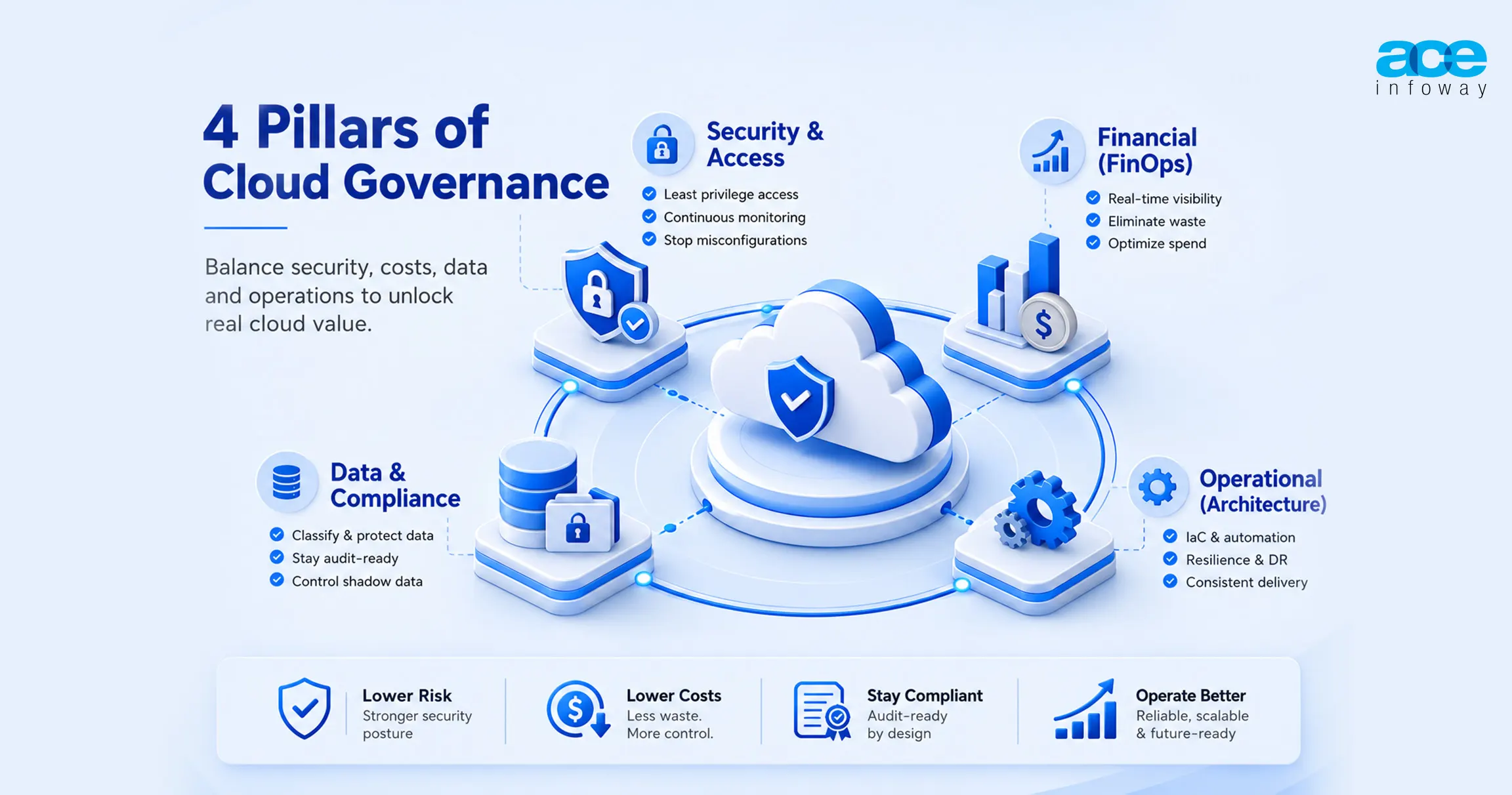
1. Security and Access Governance
The traditional network perimeter has been broken down in the cloud, and now identity is the new security perimeter. This pillar is concerned with defining boundaries to block credential breaches, unauthorized access, and misconfiguration.
- Identity and Access Management (IAM): Your solution needs to adhere to the principle of least privilege, which means that every human user requires Multi-Factor Authentication (MFA) and that access to resources needs to be restricted and limited by Just-In-Time (JIT) or Privileged Identity Management (PIM) to the extent that the blast radius of any compromised credentials is limited.
- Preventing Misconfigurations: Misconfigurations are a major contributor to cloud security incidents, accounting for approximately 82% of them, so you need to use Cloud Security Posture Management (CSPM) tools. They constantly monitor your environment for vulnerabilities and will automatically fix them, such as exposed storage buckets, unencrypted databases, etc.
Governance needs to be proactive and identify and track unauthorized tools as Shadow IT and AI Control. In 2026, this will be expanded to “Shadow AI ”: LLMs or AI agents used by employees without the company’s knowledge, which can result in serious IP and data leakage issues.
2. Financial Governance (FinOps)
Financial governance is not just a matter of bill tracking,g as enterprises typically lose almost 30% of their cloud spend every year from underutilization. FinOps is a discipline that establishes financial accountability by fostering collaboration between engineering, finance, and business teams, which fuels this pillar.
- Real-Time Visibility and Allocation: Your framework should require strict tagging taxonomies, such as Owner, CostCenter, Environment, and so on, at the time of resource creation, so that all dollars spent can be assigned to a specific project or department.
- Automated Rightsizing and Waste Elimination: Governance policies need to be automated to decommission orphaned resources (storage volumes that are not attached to any instance) and to dynamically reduce the size of instances that are over-provisioned based on the number of active workloads.
- Unit Economics: Mature frameworks have a “Unit Spend Optimization Ratio” that correlates cloud costs directly with the business value that is delivered (e.g., cost per transaction). This way, cost-cutting won’t affect the performance or creativity of the system!
3. Data & Compliance Governance
Data and compliance governance converts the regulatory compliance requirements into real-time software-defined technical controls. With the ever-increasing volume of data, this pillar guarantees data’s accuracy, security, and legal compliance throughout its lifecycle.
- Regulatory Alignment: You need to be continuously aware of and generate audit evidence for regulations, such as GDPR, HIPAA, PCI-DSS, and current AI regulations, like the EU AI Act and ISO 42001.
- Data Lifecycle and Classification: Data should be properly classified and cataloged for its sensitivity. Governance determines where certain data can be stored (data residency/sovereignty), and how long it needs to be kept on site, as well as requiring that it be encrypted during transport and at rest.
- Shadow Data: In a multi-SaaS and AI world, rising data generation, sharing, or storage outside of formal IT control is now known as shadow data. The need to proactively identify unmanaged data sprawl and to implement access controls is crucial, which is where Data Security Posture Management (DSPM) practices come in.
4. Operational Governance (and Architecture)
Operational Governance requires teams to use “Landing Zones” to build up environments rather than creating them from scratch. These are pre-configured multi-account environments that automatically take action on top of your baseline security, networking, and identity controls before you even deploy any workloads.
- Infrastructure as Code (IaC): All infrastructure changes to be made should be done via CI/CD pipelines and IaC (Terraform/Bicep). It is essential for the framework to be automated and provide drift detection as well as remediation for live cloud configurations when they drift from your approved codebase.
- Resilience and Business Continuity: There are strict Backup, Disaster Recovery (DR), and Incident Management procedures in place that are created by the operational governance. It establishes Service-Level Objectives (SLOs) and Recovery Time Objectives (RTOs) to ensure high availability and speedy recovery from downtime situations.
Cloud Security Governance Breaks at Identity, Not at the Perimeter
In modern cloud environments, the traditional network perimeter has effectively dissolved, making identity the primary security boundary and control plane. Legacy security models relied on physical networks, assuming that anyone inside the corporate perimeter could be trusted.
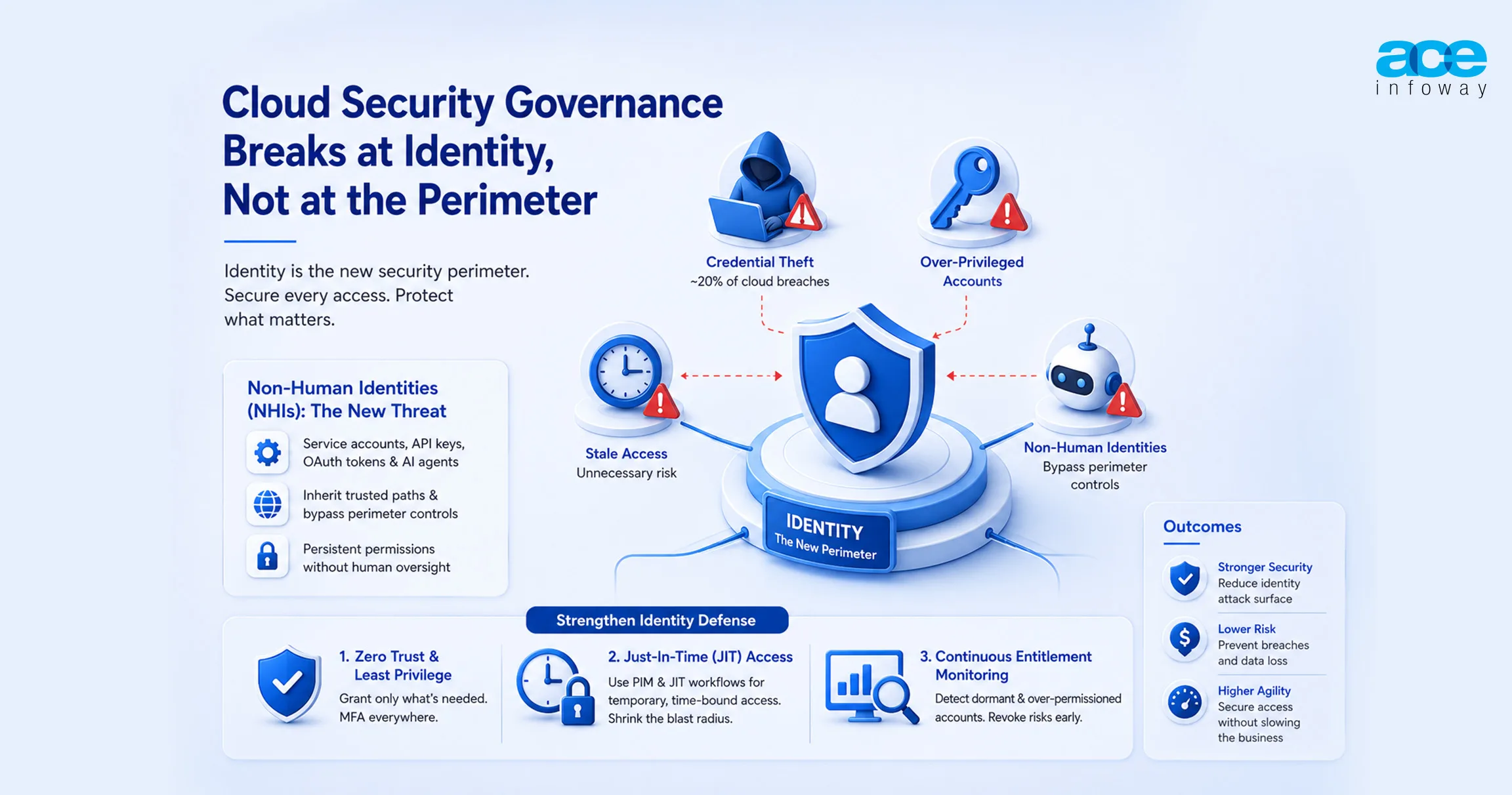
In the cloud, however, every access request arrives over the internet, meaning your security succeeds or fails based on Identity and Access Management (IAM).
Identity failures such as over-privileged accounts, stale access, and compromised credentials are now the most critical vulnerabilities in cloud infrastructure. Credential theft accounts for roughly 20% of cloud breaches, and even the smallest IAM misconfigurations can create direct attack paths to an organization’s most sensitive “crown jewel” data.
Non-Human Identities (NHIs): The New Threat to Cloud Security
This vulnerability is heavily magnified by the explosion of Non-Human Identities (NHIs), such as service accounts, API keys, and OAuth tokens. With the rise of interconnected SaaS applications and autonomous AI agents, these non-human identities often accumulate persistent, broad permissions that operate entirely without human oversight.
Because these tokens inherit trusted network paths, they can completely bypass traditional perimeter controls like firewalls, web gateways, or Data Loss Prevention (DLP) tools. To prevent security from breaking at the identity layer, a robust cloud governance framework must shift focus from network defense to identity defense through several key practices:
- Zero Trust and Least Privilege: Governance policies must strictly enforce the principle of least privilege, granting users and applications only the exact access needed to perform a task while mandating Multi-Factor Authentication (MFA) across the board
- Just-In-Time (JIT) Access: Organizations must move away from granting standing, permanent administrative privileges. Instead, they should utilize Privileged Identity Management (PIM) and JIT workflows to provide temporary, time-bound access, which drastically shrinks the potential blast radius if a credential is ever compromised.
- Continuous Entitlement Monitoring: Relying on tools like Cloud Infrastructure Entitlement Management (CIEM) allows security teams to continuously scan for dormant accounts, detect over-permissioned roles, and automatically revoke unauthorized access before an attacker can exploit it.
Cloud Governance Tools Come in Three Layers, Not One Product
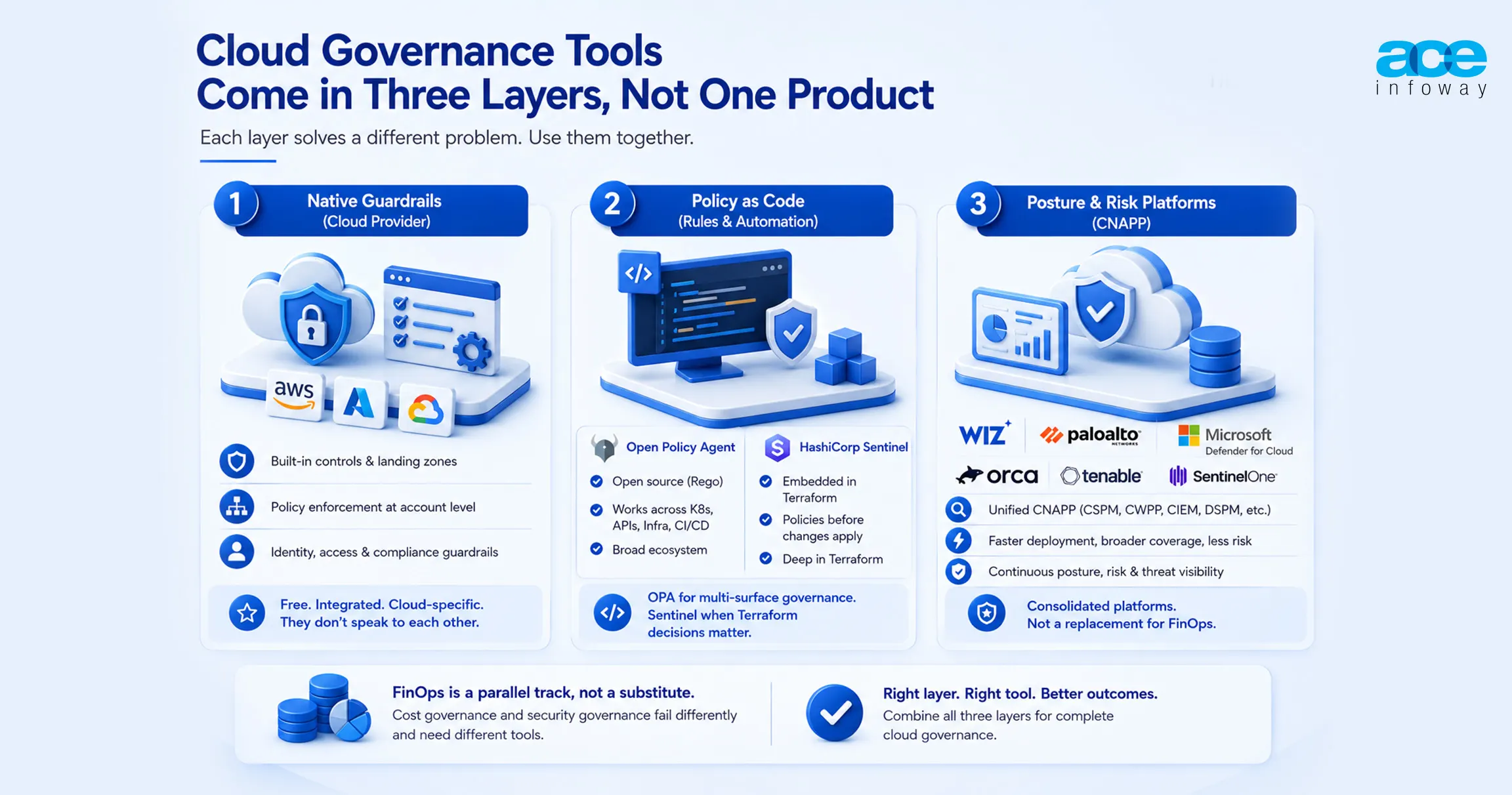
The most expensive mistake buyers make with cloud governance tools is purchasing at the wrong layer. Cloud governance tools fall into three tiers doing genuinely different jobs, and vendors in each tier will happily imply they cover the other two.
Layer 1: native guardrails from your cloud provider
- AWS Control Tower handles multi-account governance natively, with automated landing zone setup, an Account Factory for standardized account creation, and preventive plus detective controls. Service Control Policies act as hard permission boundaries at the account level, which makes AWS Organizations paired with Control Tower.
- Azure Policy defines and enforces resource configuration rules, with Blueprints packaging policies, role assignments, and templates into deployable frameworks. Azure’s real differentiator sits in adaptive access. Conditional Access enables context-aware policy against location, device, and risk score, while Privileged Identity Management delivers just-in-time access with approval workflow and audit logging.
- Google Cloud Organization Policy enforces constraints across the resource hierarchy, with Google positioning its governance story at the infrastructure layer through the same zero trust architecture protecting Google’s own services.
Native guardrails are free, deeply integrated, and cloud-specific. That last quality is the catch. They don’t speak to each other.
Layer 2: policy as code
Policy as code means defining organizational and regulatory rules as machine-readable code, storing them in version control, and evaluating them automatically at decision points across your delivery lifecycle.
- Open Policy Agent is open-source, CNCF-graduated, and vendor-agnostic, using Rego for policy expression. Its ecosystem runs the broadest: Gatekeeper for Kubernetes admission control, Envoy for API authorization, Terraform validation, and CI/CD gate checks.
- HashiCorp Sentinel takes the narrower, deeper path, embedded in HCP Terraform and Terraform Enterprise with a purpose-built language supporting conditional logic, iteration, and policy composition. Rules must pass before infrastructure changes apply.
Pick OPA if you need one policy language across Kubernetes, APIs, and infrastructure. Pick Sentinel if Terraform is where your cloud governance decisions actually get made.
Layer 3: posture and risk platforms
Start with the consolidation, since it changes what you’re shopping for. The standalone CSPM and CWPP categories have effectively been absorbed into unified CNAPP platforms. Evaluating a CSPM today means buying a CNAPP, planned or not.
Of the platforms enterprises actually shortlist, Wiz wins on deployment speed, with agentless scanning returning results in hours instead of days. Palo Alto Prisma Cloud covers more surface than anyone, spanning CSPM, CWPP, CIEM, DSPM, code security, and web application protection.
Defender for Cloud is the Azure-first default. Orca, Tenable Cloud Security, and SentinelOne round out most evaluations.
And treat FinOps tooling as a parallel track, never a substitute. Cost governance and security governance fail in different ways and need different instrumentation. A platform that promises both usually does one well.
A 90-Day Cloud Governance Rollout You Can Actually Run.
Sequence matters more than ambition here. Ownership before frameworks, frameworks before automation. Teams that invert the order end up automating enforcement of rules nobody agreed to.
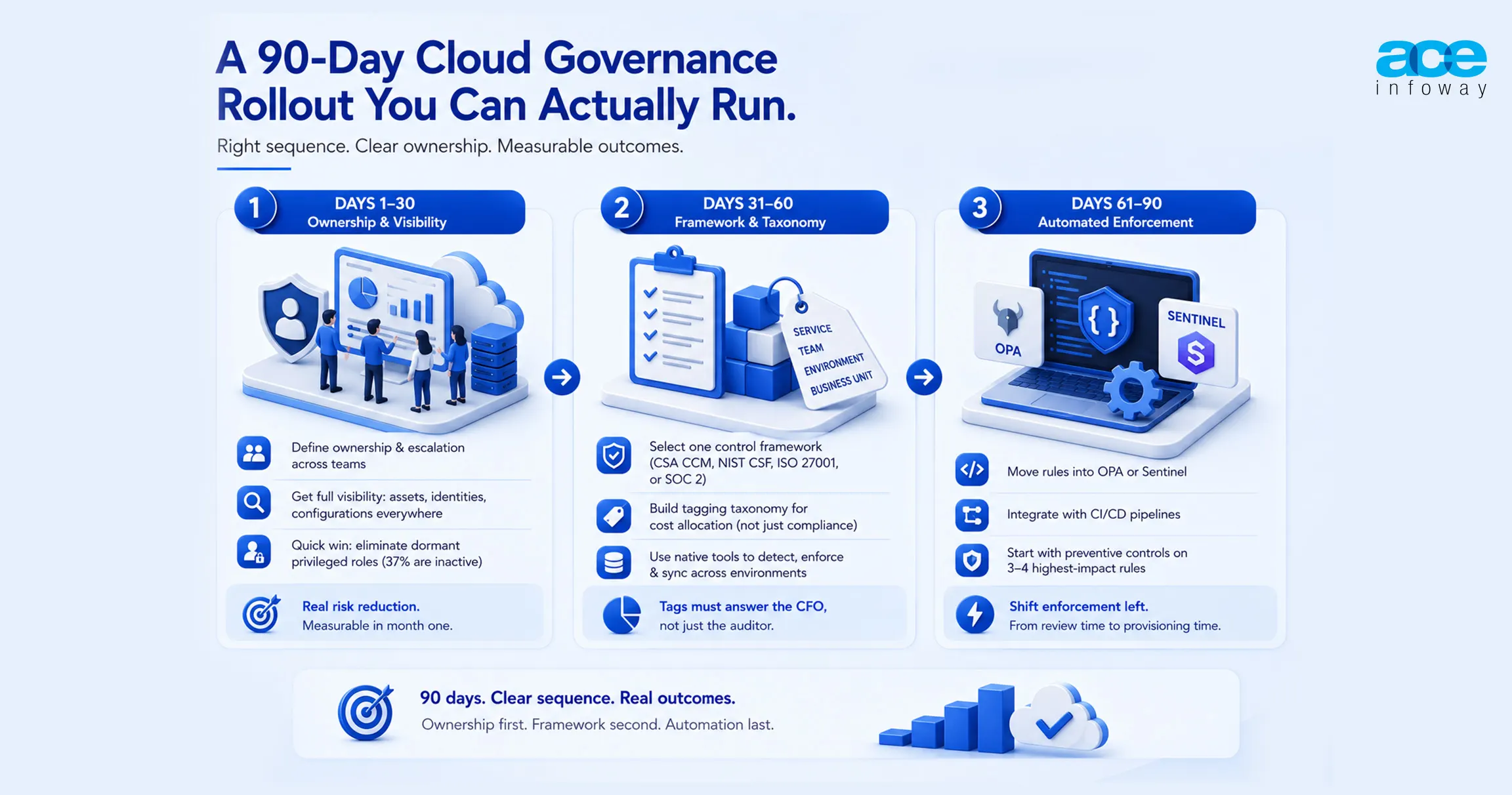
Days 1 to 30: ownership and visibility
Define responsibility across security, engineering, operations, and compliance. Document who owns approvals, who owns remediation, and where escalation goes. This step produces no technology, which is exactly why most programs skip it.
Then get your inventory honest. Full asset, identity, and configuration visibility across every environment, including the accounts nobody claims.
Your quick win lives here. Kill the dormant privileged roles. With 37% of overprivileged non-human identities sitting inactive, this delivers real risk reduction, needs no negotiation with product teams, and puts a measurable result on the board inside month one. Start there because it’s uncontroversial.
Days 31 to 60: framework and taxonomy
Pick one control framework and stop debating it. CSA CCM, NIST CSF, ISO 27001, or SOC 2, chosen against whatever your auditors and customers actually ask for.
Build the tagging taxonomy in the same window. Build it for cost allocation, not compliance alone, because tags have to support allocation by service, team, environment, and business unit, and a taxonomy that only satisfies auditors will never answer the CFO’s question. Native cloud governance tools handle the mechanics: detecting untagged assets, enforcing standards, syncing metadata across environments.
Days 61 to 90: automated enforcement
Now the policy as code work. Move your agreed rules into OPA or Sentinel, wire them into CI/CD, and shift enforcement from review time to provisioning time. Start with preventive controls on the three or four rules causing the most rework.
The Decision You’re Actually Making
Most organizations don’t fail at cloud governance for lack of a framework. They fail because the framework lives in a document and the cloud lives in an API. That single mismatch is why 55% are still reactive, and writing more policy has never once closed it.
What closes it is moving enforcement from review time to provisioning time. Everything else here is detail sitting underneath that one move.
So the decision isn’t whether to govern your cloud estate. Your auditors, your regulators, and your cloud bill already settled that. The real decision is whether cloud governance runs as code inside your pipeline, or as a document somebody opens the week before an audit.
Frequently Asked Questions
What is cloud governance?
Cloud governance is the framework of policies, automated controls, and accountability structures that determines how an organization provisions, secures, and pays for cloud resources. It differs from documentation in one respect that matters: enforcement happens continuously at provisioning rather than during periodic review.
What are the four pillars of cloud governance?
The four pillars are cost governance, security governance, compliance governance, and operational or data governance. Skipping any one produces a predictable failure, and cost is the pillar most often mistaken for solved, with waste currently running at 29% of IaaS and PaaS spend according to Flexera’s 2026 research.
What is the difference between cloud governance and cloud management?
Governance sets the rules and enforces them, while management executes daily operations within those rules. Governance answers what is allowed and who decides, and management answers whether the workload is running well.
Who is responsible for cloud governance in an enterprise?
Responsibility is shared, with a Cloud Center of Excellence or FinOps function typically owning the framework and engineering teams owning compliance with it. That model is now standard rather than aspirational: 71% of organizations run a CCoE, and 63% run a FinOps team, per Flexera’s 2026 State of the Cloud Report.
Does cloud governance slow down engineering teams?
Badly designed governance does, because it routes every change through human review. Guardrail-based governance does not, since approved paths get automated and only genuine exceptions require a decision, which is why the 8% of organizations running fully automated governance ship faster than the 55% still operating reactively.