








|
Getting your Trinity Audio player ready...
|
Table of Contents
Choosing a payment gateway is one of the most important decisions for any eCommerce business. While transaction fees and payment methods often influence the final choice, they are only part of a much larger decision.
A payment gateway directly affects how customers complete purchases, how payments are processed, and how efficiently businesses manage financial operations. It also plays a significant role in checkout experience, payment security, reporting, and future technology integrations.
The global digital payments market is projected to process more than US$20 trillion in transaction value by 2026, as per the report by Statista, so businesses need to take payment gateway integration more seriously.
As businesses grow, payment requirements become more complex. Expanding into new markets, supporting additional payment methods, integrating business applications, and handling larger transaction volumes all require a payment gateway that can scale with changing business needs.
Why Choosing a Payment Gateway Is More Than a Payment Decision?
Most businesses compare payment gateways based on pricing and transaction fees.
While cost is important, it should not become the only deciding factor.
A payment gateway influences every stage of the payment journey, from customer checkout to payment authorization, settlement, reporting, and financial reconciliation. The right solution improves operational efficiency while creating a reliable purchasing experience for customers.
As businesses continue adding new sales channels, mobile applications, marketplaces, and international customers, payment processing becomes increasingly connected with other business systems.
The objective is not simply to accept payments. It is to build a payment infrastructure that supports business operations today while remaining flexible enough for future growth.
7 Factors to Consider Before Choosing a Payment Gateway
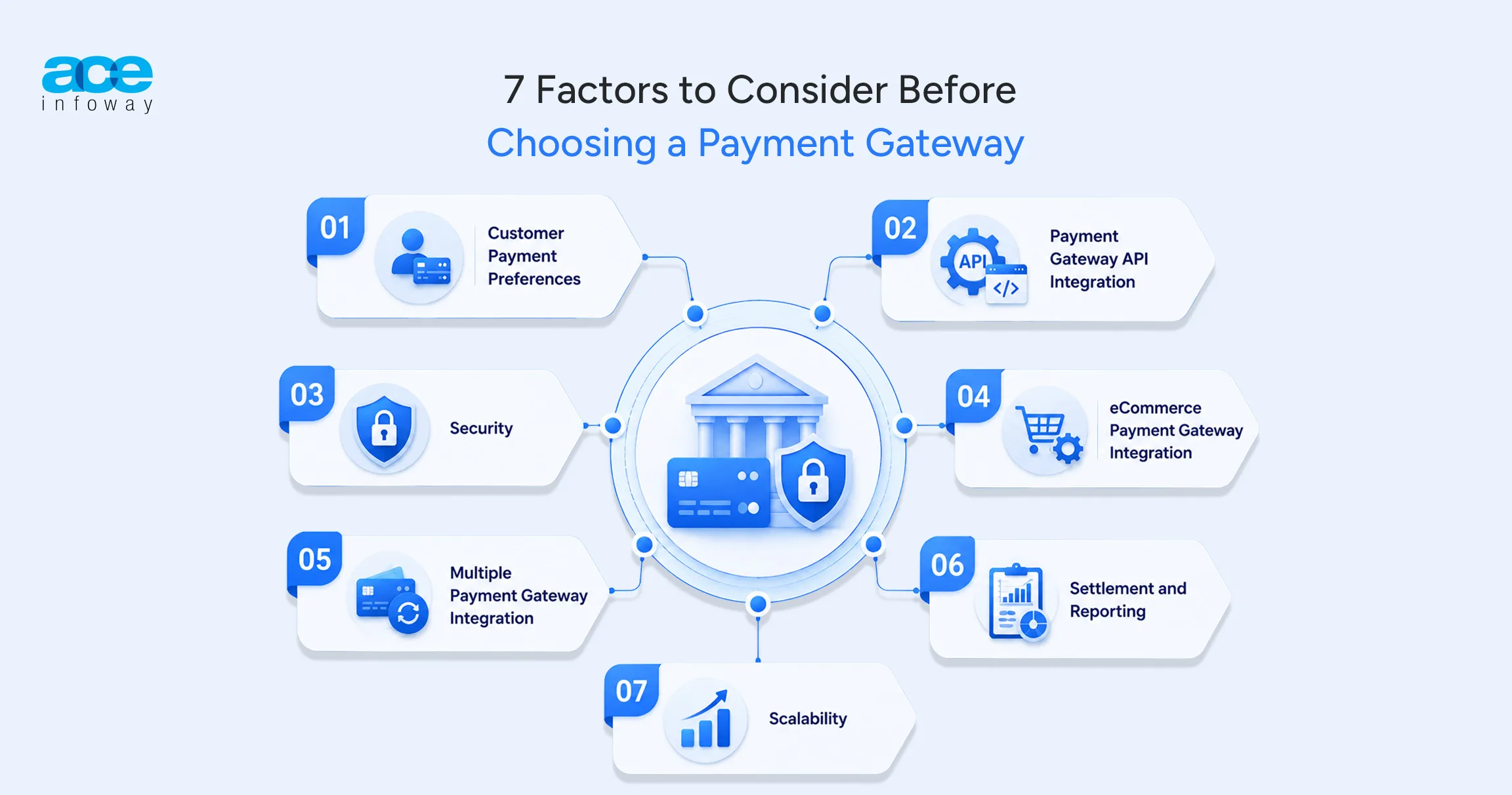
1. Customer Payment Preferences
Every customer expects a payment experience that feels familiar and convenient. Baymard Institute reports that the average documented online shopping cart abandonment rate is approximately 70%. One of the major contributors is a lengthy or complicated checkout process.
Some prefer digital wallets, while others rely on credit cards, bank transfers, Buy Now Pay Later (BNPL), or local payment methods. Selecting a payment gateway without understanding these preferences can introduce unnecessary friction during checkout.
A gateway that performs well in one market may not offer the same payment options or customer experience elsewhere.
What Should Businesses Do To Improve?
- Analyze customer payment behaviour
- Support preferred payment methods
- Offer digital wallets where relevant
- Review regional payment requirements
Actionable Insight: Review your last three months of transactions and identify the payment methods customers use most frequently. These insights should influence your gateway selection.
2. Payment Gateway API Integration
Modern businesses rarely operate with a single platform. Customer payments often need to connect with ERP systems, accounting software, CRM platforms, subscription services, inventory management, and reporting tools.
This makes payment gateway API integration an important consideration before implementation. Well-designed APIs simplify communication between business applications while reducing manual work and improving operational efficiency.
Businesses investing in payment gateway integration should also evaluate future integration requirements rather than current needs alone. Choosing flexible APIs today reduces development effort as new business systems are introduced.
Working with experienced payment gateway integration services providers can further simplify implementation by ensuring secure data exchange, reliable performance, and long-term scalability.
What Should Businesses Do To Improve?
- Review available APIs before implementation
- Evaluate integration documentation
- Consider future application requirements
- Work with experienced integration specialists
Actionable Insight: Prepare a list of every application that will exchange payment data before selecting your payment gateway. This helps identify compatibility requirements early in the implementation process.
3. Security Should Strengthen Customer Confidence
Customers expect payment information to remain secure throughout the checkout process.
A reliable payment gateway should support industry security standards while maintaining a seamless customer experience. Features such as tokenization, fraud detection, PCI DSS compliance, and secure payment processing help reduce business risk without introducing unnecessary checkout complexity.
Security should also extend beyond payment authorization. Businesses need visibility into fraud prevention, chargeback management, transaction monitoring, and ongoing compliance as payment volumes increase.
What Should Businesses Do To Improve?
- Verify PCI DSS compliance
- Review fraud prevention capabilities
- Support secure payment authentication
- Monitor payment security regularly
Actionable Insight: Review how your shortlisted payment gateways manage fraud detection, tokenization, and chargebacks before making a final decision.
4. eCommerce Payment Gateway Integration
A payment gateway should integrate seamlessly with the eCommerce platform that powers your business.
Reliable eCommerce payment gateway integration helps ensure payments, order information, and customer data move efficiently between systems.
An integrated payment gateway also reduces manual processes by connecting payment workflows with inventory, order management, accounting, and customer service platforms.
What Should Businesses Do To Improve?
- Verify platform compatibility before implementation
- Review available plugins and API support
- Integrate payment workflows with business applications
- Test payment functionality before going live
Actionable Insight: Map your payment flow from checkout to order fulfillment. Identifying every system involved helps avoid integration issues during implementation.
5. Multiple Payment Gateway Integration Improves Business Continuity
Many businesses depend on a single payment gateway until they experience transaction failures, regional payment limitations, or service interruptions.
Implementing multiple payment gateway integrations provides greater flexibility by allowing businesses to support different payment providers based on customer location, payment preferences, or business requirements.
If one provider experiences downtime or reduced authorization rates, transactions can be routed through an alternative gateway without disrupting the customer experience.
What Should Businesses Do To Improve?
- Evaluate whether one gateway meets all business needs
- Support regional payment providers where required
- Monitor payment success rates regularly
- Plan gateway redundancy for business continuity
Actionable Insight: If your business serves multiple countries, review whether different regions would benefit from local payment providers alongside your primary gateway.
6. Settlement and Reporting Are Just as Important as Payment Processing
Accepting customer payments is only one part of the payment lifecycle.
Settlement timelines, transaction reporting, refunds, chargebacks, and financial reconciliation all influence how efficiently finance teams manage daily operations. A gateway with limited reporting capabilities often creates additional manual work as transaction volumes increase.
Resorting to a payment gateway that provides detailed reporting and integrates with accounting systems helps businesses maintain better financial visibility while reducing administrative effort.
What Should Businesses Do To Improve?
- Compare settlement timelines
- Review reporting capabilities
- Evaluate reconciliation features
- Verify accounting software compatibility
Actionable Insight: Ask payment providers to demonstrate their reporting dashboard before implementation. The quality of reporting becomes increasingly important as your business grows.
7. Choose a Payment Gateway That Can Scale with Your Business
Your payment requirements today may look very different a year from now.
Business growth often introduces international customers, new sales channels, subscription services, digital wallets, and higher transaction volumes. Selecting a gateway that only satisfies current requirements can lead to costly migrations later.
Scalable payment solutions provide the flexibility to support future business expansion without requiring significant infrastructure changes.
What Should Businesses Do To Improve?
- Consider future transaction volumes
- Support international expansion plans
- Evaluate recurring payment capabilities
- Review long-term scalability
Actionable Insight: When comparing payment gateways, evaluate where your business will be in the next three years rather than where it is today.
Common Mistakes Businesses Make When Choosing a Payment Gateway
Many businesses select a payment gateway based only on transaction fees or brand recognition. While these factors are important, overlooking integration capabilities, reporting features, scalability, or customer payment preferences often creates operational challenges later.
A payment gateway should support both current business requirements and future growth. Evaluating the complete payment ecosystem before implementation helps reduce migration costs and minimizes integration complexity as the business expands.
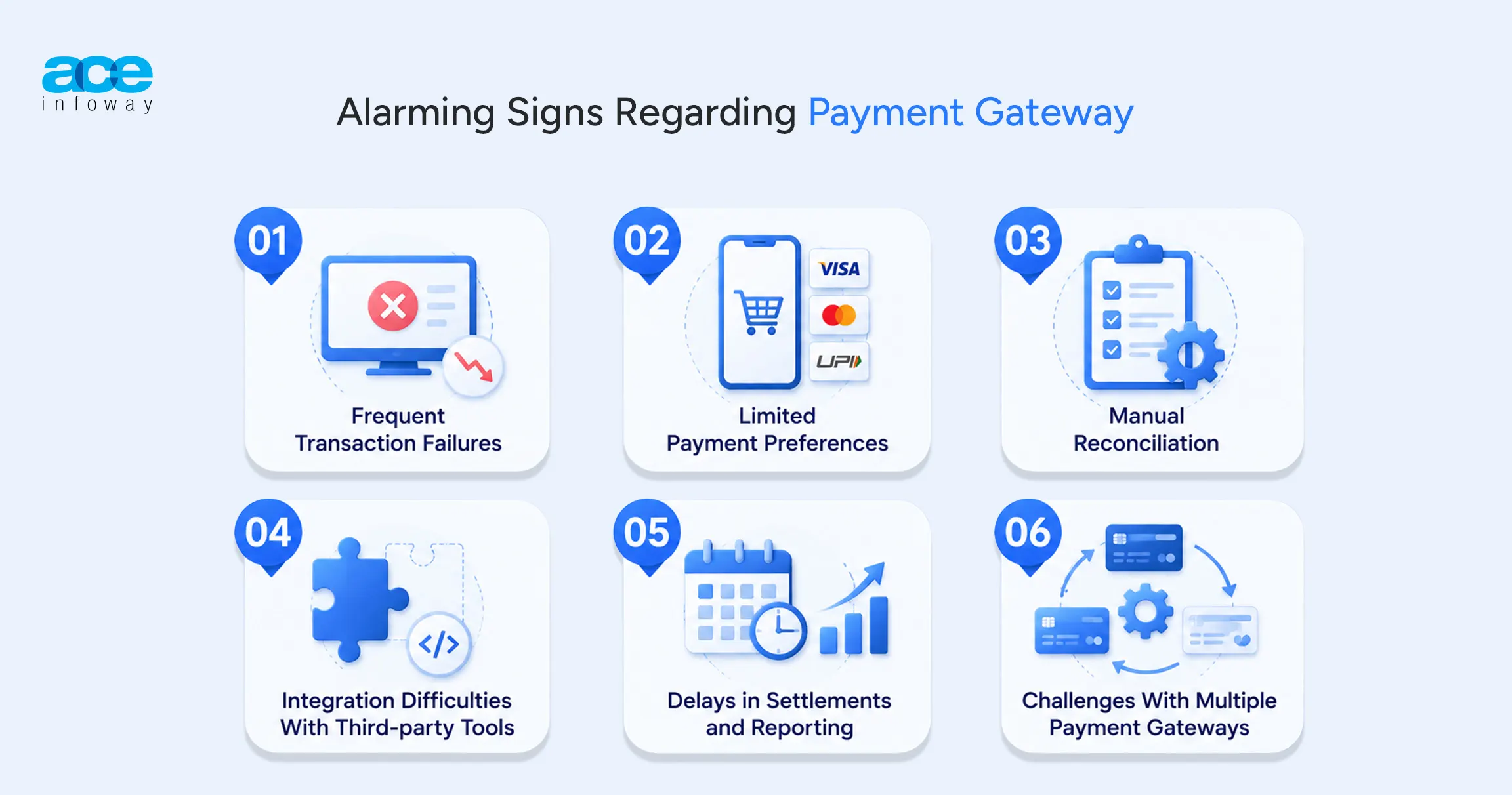
Signs Your Business Has Outgrown Its Payment Gateway
As transaction volumes increase, customer expectations evolve, and businesses expand into new markets, payment requirements naturally become more complex.
A payment gateway that supported your business a few years ago may no longer provide the flexibility, scalability, or integration capabilities needed today. Identifying these limitations early can help businesses avoid operational bottlenecks and deliver a more reliable payment experience.
Your current payment gateway may require an upgrade if you regularly experience:
- Declining payment success rates or frequent transaction failures
- Limited support for customer-preferred payment methods
- Manual reconciliation between payment and accounting systems
- Difficulties integrating with ERP, CRM, or eCommerce platforms
- Delays in settlements, refunds, or payment reporting
- Challenges supporting international payments or multiple currencies
None of these issues may appear critical individually. However, together they can affect operational efficiency, customer experience, and future business growth.
How Does Ace Infoway Help Businesses Build Reliable Payment Integrations?
Selecting the right payment gateway is only one part of building a reliable payment ecosystem.
Successful implementation requires secure integrations, seamless payment workflows, and ongoing optimization to ensure every transaction supports both customer experience and business operations.
Ace Infoway helps businesses implement secure and scalable payment solutions through customized integration strategies.
Payment Gateway Integration
We deliver reliable payment gateway integration solutions that connect payment providers with your eCommerce platform and business applications.
Custom Integration Services
Our payment gateway integration services include API implementation, payment workflow optimization, platform connectivity, and end-to-end integration testing.
Business System Integration
We connect payment gateways with ERP, CRM, accounting, inventory, and order management systems to improve operational efficiency and reduce manual processes.
Performance and Security Optimization
Our team reviews payment workflows to improve transaction reliability, strengthen security, and support long-term business scalability.
We focus on building payment ecosystems that support business growth while delivering secure and reliable customer payment experiences.
Conclusion
A reliable payment gateway does more than process transactions. It creates a connected payment ecosystem that supports better decision-making, improves operational visibility, and adapts as customer expectations and business models evolve. Investing in the right payment infrastructure today helps businesses stay agile, reduce operational complexity, and prepare for future digital growth.
At Ace Infoway, we combine deep integration expertise with tailored digital solutions to help businesses implement secure, scalable, and future-ready payment ecosystems. Our team focuses on building solutions that align with your technology landscape and long-term business objectives, ensuring every integration delivers measurable value.
Contact us to discuss how we can help you create a seamless and future-ready payment experience.
Frequently Asked Questions
What Is Payment Gateway Integration?
Payment gateway integration is the process of connecting a payment provider with an eCommerce platform or business application to securely process online transactions. It enables customers to make online payments safely while ensuring payment information is transmitted securely between the customer, merchant, and financial institutions.
Why Is Payment Gateway API Integration Important?
Payment gateway API integration enables payment systems to communicate with business applications such as ERP, CRM, accounting, and inventory platforms. This automation reduces manual work, improves transaction accuracy, streamlines financial processes, and enhances the overall customer payment experience.
What Is an Integrated Payment Gateway?
An integrated payment gateway connects payment processing with other business systems, allowing payment information to flow seamlessly across sales, finance, inventory, and operational workflows. This creates a unified payment ecosystem that improves efficiency and data accuracy.
When Should Businesses Consider Multiple Payment Gateway Integration?
Businesses operating across multiple regions, processing high transaction volumes, or requiring uninterrupted payment processing should consider multiple payment gateway integration. Using more than one gateway improves payment reliability, reduces the risk of transaction failures, and provides customers with more payment options.
Why Should Businesses Use Professional Payment Gateway Integration Services?
Professional payment gateway integration services help businesses implement secure, scalable, and compliant payment solutions while minimizing integration risks. Experienced providers ensure smooth deployment, support regulatory compliance, optimize payment performance, and build solutions that can scale with business growth.