








|
Getting your Trinity Audio player ready...
|
Table of Contents
Digital transformation is the need of the hour for businesses to stay competitive and innovative for better efficiency as well as productivity. Organizations of all scales are investing in modern-age technologies such as cloud platforms, AI, automation, analytics, and advanced applications.
Gartner describes MACH as a specific architectural pattern emphasizing cloud-native domains, APIs, headless services, and business service composability.
Often, the challenge lies in the architecture supporting it and not the technology.
For stability, businesses were dependent on traditional monolithic systems, but as they grew, the system demanded flexibility. With growth, it becomes increasingly complex for businesses to add new features, integrate third-party platforms, and modernize legacy applications. The result is not just stagnation and everyday struggle; it also results in slow innovation, increased operational costs, and difficulty in responding to market changes.
For such complexity, businesses can respond with a composable architecture approach that offers flexibility, efficiency, and optionality.
What Is Composable Architecture?
In simple terms, composable architecture enables businesses to adapt quickly without rebuilding everything from scratch.
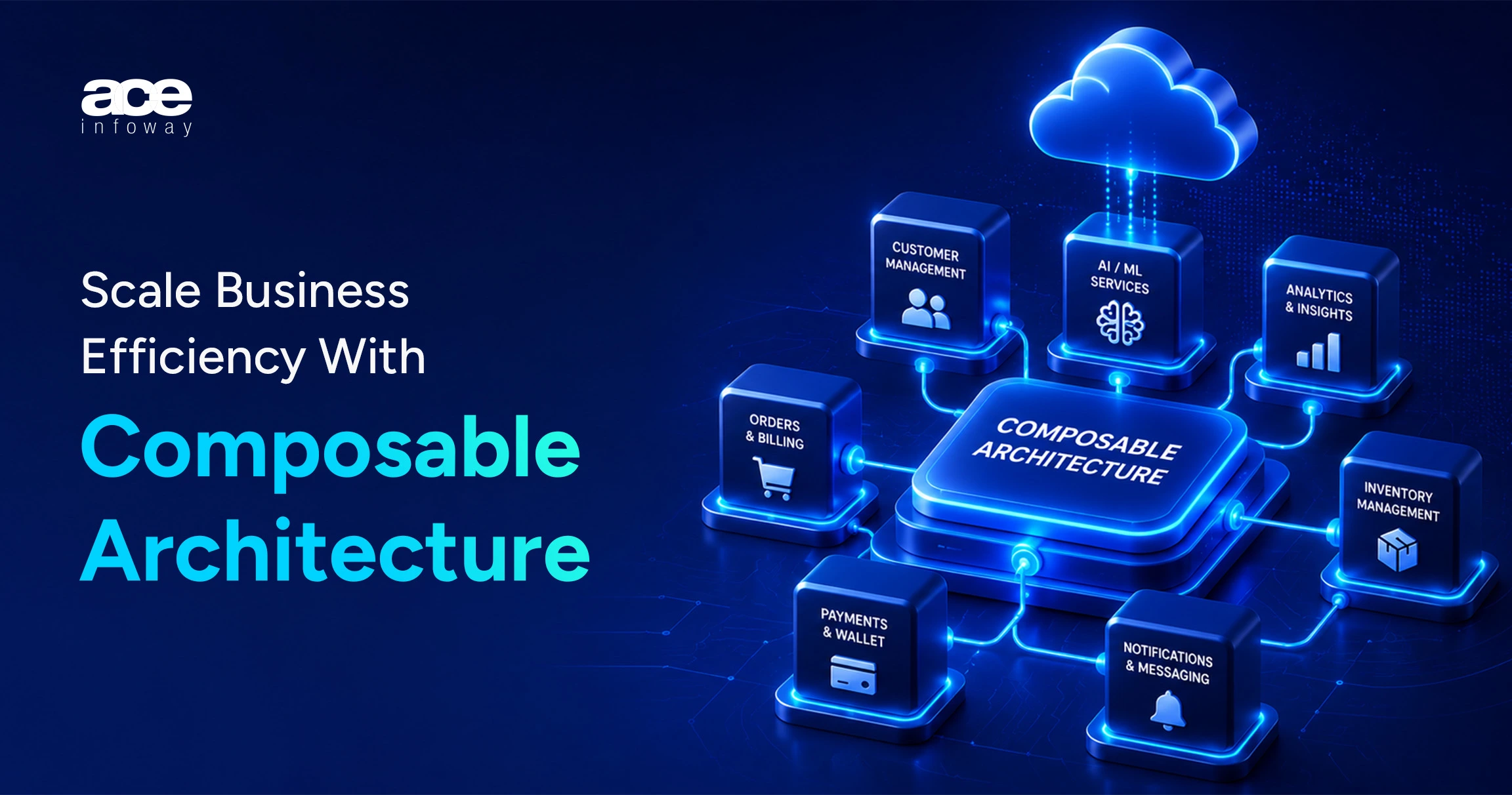
It helps create independent business capabilities that work together as a connected ecosystem. Businesses no longer need to depend on a single application that manages multiple business functions.
Each capability performs a specific function, communicates through APIs, and can evolve without affecting the rest of the system.
Think of it as moving away from building one massive machine toward assembling specialized components that can be upgraded or replaced whenever business needs change.
More Than Modular Software
When discussing what composable architecture is, many conversations focus on microservices or APIs.
While those technologies play an important role, composability is fundamentally about designing systems around business capabilities instead of applications.
Traditional software is usually developed as one tightly integrated solution where customer management, reporting, authentication, billing, notifications, and workflows all exist within the same application.
As the business grows, these interconnected components become increasingly dependent on one another.
Why Are Businesses Rethinking Their Architecture?
New regulations, evolving customer expectations, emerging technologies, mergers, acquisitions, and changing market conditions require organizations to adapt far more frequently than they did a decade ago.
As systems are tightly coupled, introducing a new capability often requires modifying existing applications, testing multiple integrations, and coordinating across several teams. Even relatively small initiatives can take months before they deliver business value.
Composable architecture reduces these dependencies by allowing organizations to modernize incrementally rather than through large-scale replacement projects.
Instead of replacing an entire platform, businesses can improve individual capabilities as priorities evolve. This reduces implementation risk while extending the value of existing technology investments.
The Technologies That Make Composability Possible
Composable architecture is supported by several modern architectural principles that work together to create flexibility and scalability.
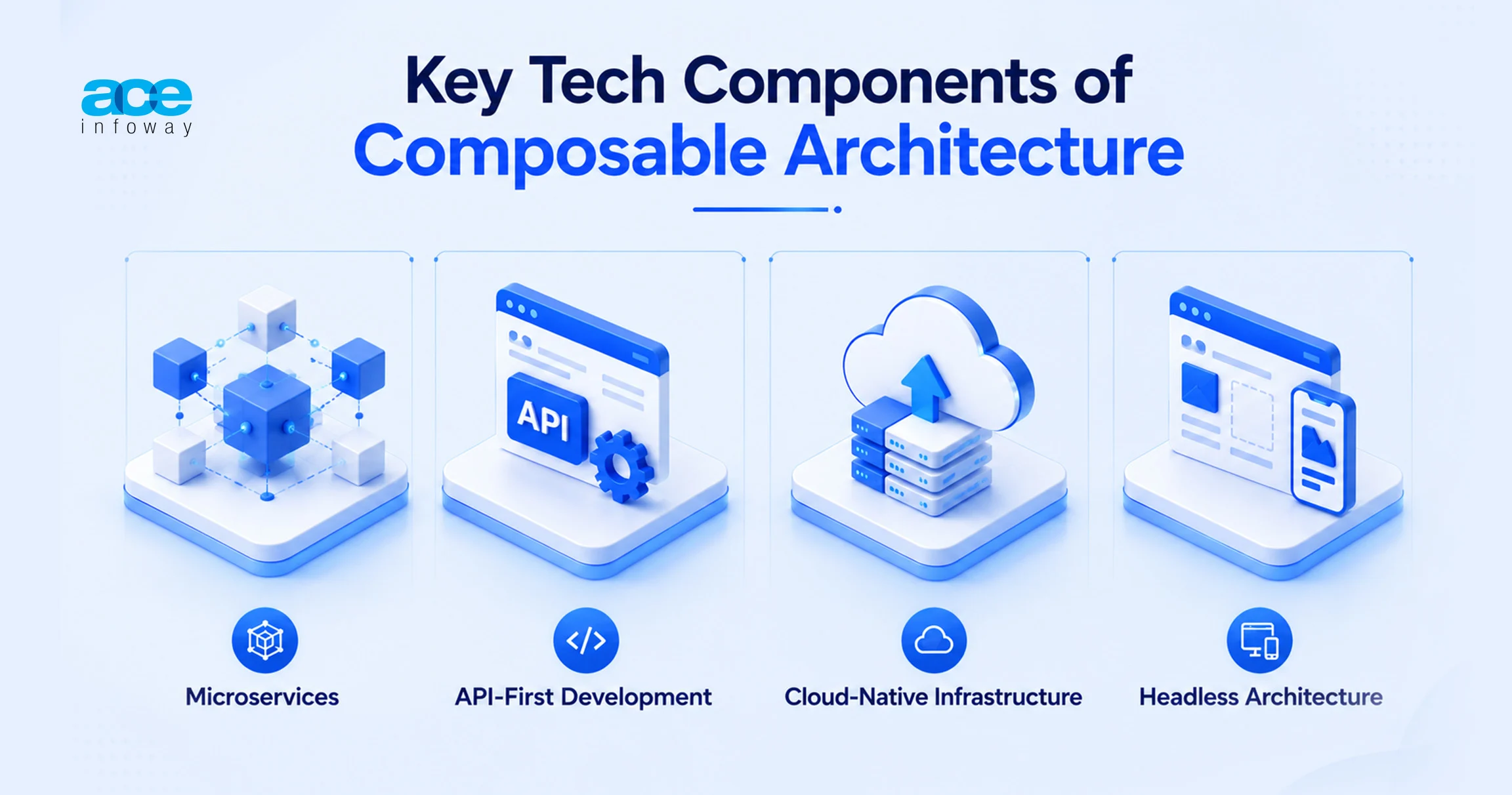
- Microservices: Applications are divided into smaller, independently deployable services instead of one large codebase. This allows development teams to update individual capabilities without impacting the rest of the application.
- API-First Development: Every capability communicates through standardized APIs, making it easier to integrate internal systems, cloud platforms, and third-party applications while reducing unnecessary dependencies.
- Cloud-Native Infrastructure: Cloud-native technologies enable organizations to scale individual services based on demand instead of scaling entire applications. This improves performance, resilience, and resource utilization.
- Headless Architecture: By separating the user interface from backend business logic, organizations can deliver consistent digital experiences across websites, mobile applications, customer portals, and future digital channels without rebuilding core functionality.
Together, these technologies create an architectural foundation that enables businesses to innovate continuously instead of periodically.

Composable Architecture vs. Microservices and MACH Architecture
Many organizations use terms like microservices, MACH architecture, and composable architecture interchangeably. While they’re closely related, they aren’t the same thing.
Composable Architecture vs. Microservices
Microservices are one of the building blocks of composable architecture, but they don’t define the entire approach.
A microservices architecture focuses on breaking applications into smaller, independently deployable services.
Composable architecture takes this concept further by combining microservices with API-first integration, cloud-native infrastructure, reusable business capabilities, and modular design principles.
| Microservices | Composable Architecture |
| Focuses on application development | Focuses on overall business architecture |
| Independent services | Independent business capabilities |
| Solves software modularity | Solves business agility and scalability |
| Can exist without APIs or headless | Combines APIs, cloud, headless, and modular services |
Composable Commerce vs. MACH Architecture
Businesses often confuse composable commerce with MACH architecture.
The difference is simple.
Composable commerce is a business implementation that applies composable principles specifically to digital commerce platforms.
MACH architecture, on the other hand, is the technology framework that enables composability through four principles:
- Microservices
- API-first
- Cloud-native
- Headless
While every composable commerce platform typically follows MACH principles, composable architecture extends beyond commerce into enterprise applications, customer portals, internal business systems, finance, healthcare, manufacturing, and many other industries.
Traditional vs. Composable Enterprise Architecture
| Traditional Enterprise Architecture | Composable Enterprise Architecture |
| Large, tightly coupled applications | Independent business capabilities |
| Platform-wide upgrades | Incremental capability-based modernization |
| Slow release cycles | Faster, independent deployments |
| High dependency across teams | Autonomous cross-functional teams |
| Difficult third-party integrations | API-first connectivity |
| Scaling entire applications | Scaling individual services |
| Limited flexibility | Continuous adaptability |
Benefits of Composable Architecture and Why Businesses Are Rethinking Their Architecture
Composable architecture is a smarter way of building businesses that can adapt, innovate, and grow without constantly rebuilding their technology foundation.
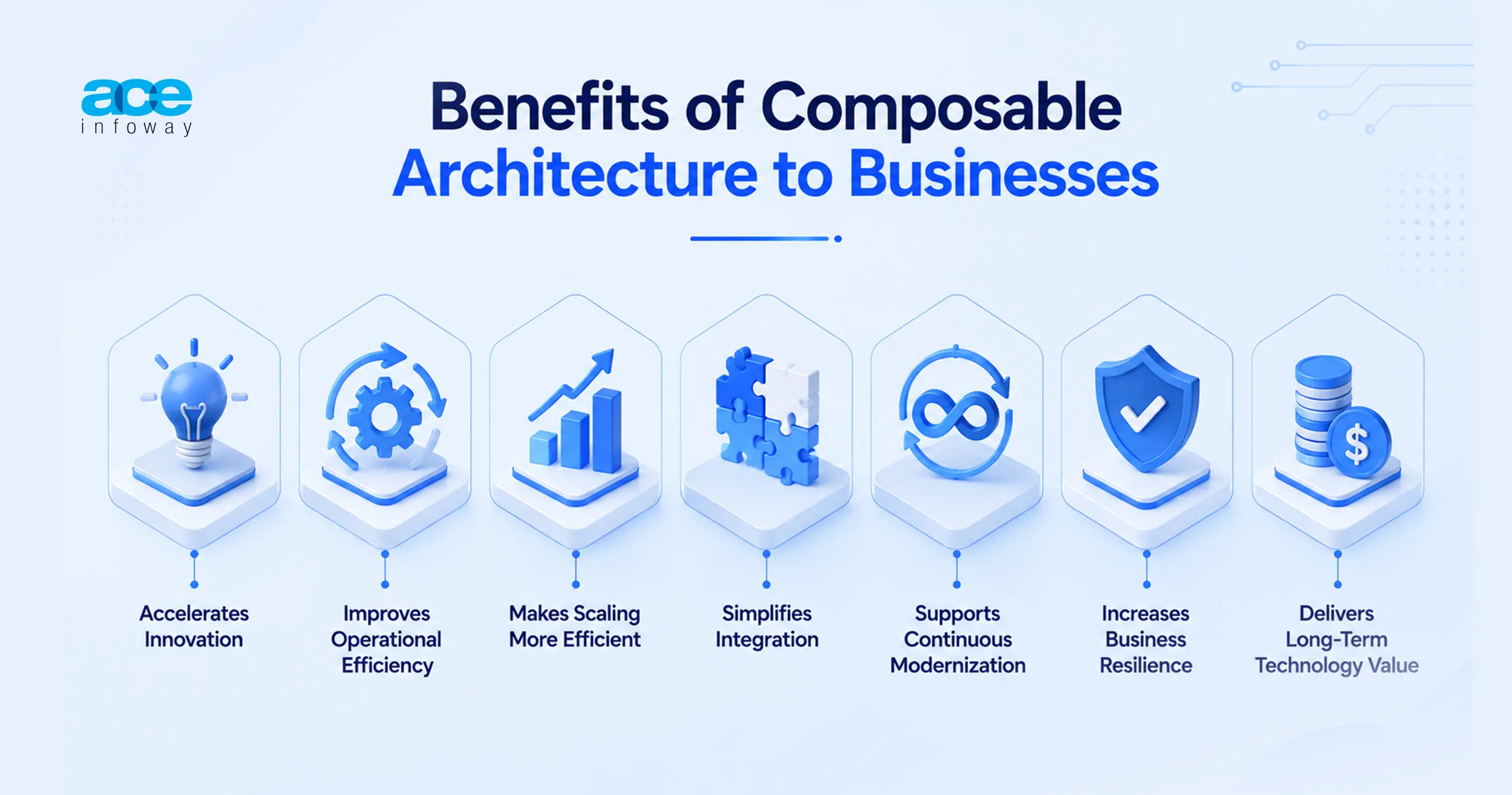
Here are some of the biggest business benefits organizations experience after adopting a composable approach.
Accelerates Innovation
Innovation shouldn’t be delayed because multiple systems need to be updated simultaneously.
Composable architecture allows teams to develop and deploy new capabilities independently, reducing release cycles and making experimentation significantly easier.
Instead of waiting months for platform-wide updates, businesses can deliver improvements continuously.
Improves Operational Efficiency
Disconnected systems often lead to duplicate work, manual processes, and unnecessary operational complexity.
Composable architecture simplifies operations by enabling independent services to communicate seamlessly through APIs. Teams spend less time maintaining complex integrations and more time improving business outcomes.
The result is greater productivity across both business and technology teams.
Makes Scaling More Efficient
Business growth doesn’t happen uniformly.
Some applications experience increased demand while others remain unchanged.
Traditional architectures often require organizations to scale the entire application, consuming unnecessary infrastructure resources.
With composable software architecture, businesses can scale only the services experiencing higher demand, improving both performance and infrastructure efficiency.
Simplifies Integration
Modern enterprises rely on a growing ecosystem of cloud applications, analytics platforms, AI tools, and third-party services.
Integrating these technologies into legacy systems can be complex and time-consuming.
Composable architecture addresses this challenge through API-first connectivity, allowing new technologies to integrate faster without disrupting existing business operations.
This creates a technology ecosystem that’s easier to expand as business needs evolve.
Supports Continuous Modernization
Many organizations postpone modernization because replacing core systems feels too risky.
Composable architecture removes this barrier.
Instead of pursuing large-scale transformation projects every few years, businesses can modernize gradually by improving one capability at a time.
Modernizing digital platforms becomes easier with the right web design and development services that support scalable, future-ready experiences.
Increases Business Resilience
Unexpected changes are inevitable.
Whether it’s evolving customer expectations, regulatory requirements, or emerging technologies, organizations need systems that adapt quickly.
Composable architecture creates resilience by ensuring that changes in one service don’t affect the entire environment.
Businesses can respond faster to change while maintaining operational stability.
Delivers Long-Term Technology Value
Technology investments should continue delivering value long after implementation.
Composable architecture extends the lifespan of enterprise systems by allowing organizations to replace or upgrade individual capabilities instead of entire applications.
This protects previous investments while creating a flexible foundation for future innovation.
How Ace Infoway Helps You Build a Composable Architecture?
Building a composable architecture isn’t just about adopting microservices or APIs. It requires a strategic roadmap that aligns technology with your business goals while ensuring every component works together seamlessly.
Strategy First
At Ace Infoway, we help businesses move beyond traditional architectures by designing scalable, modular, and future-ready digital ecosystems. Our approach focuses on creating solutions that support continuous innovation instead of one-time transformation.
End-to-End Expertise
From planning to implementation, our team helps you:
- Modernize legacy applications
- Build cloud-native solutions
- Develop API-first architectures
- Enable seamless third-party integrations
- Create scalable digital platforms
- Built for Long-Term Growth
Every business evolves differently. That’s why we build flexible architectures that allow you to introduce new capabilities, modernize existing systems, and scale operations without disrupting business continuity.
Whether you’re beginning your modernization journey or expanding your digital capabilities, Ace Infoway provides the technical expertise to help you build resilient, adaptable, and high-performing business solutions.
Conclusion
Composable architecture provides flexibility by replacing rigid, interconnected systems with modular business capabilities that can adapt, scale, and improve independently. Instead of relying on large-scale transformation projects, organizations can modernize continuously while reducing complexity and improving operational efficiency.
As digital transformation continues to accelerate, businesses that invest in adaptable architectures will be better positioned to embrace innovation, integrate emerging technologies, and respond confidently to future challenges.
At Ace Infoway, we help organizations design scalable, future-ready digital solutions that align technology with long-term business goals.
Contact us to know more about how composable architecture can help your business operations be flexible, streamlined, and automated.
Frequently Asked Questions
What is composable architecture?
Composable architecture is a modular approach to enterprise architecture that enables organizations to assemble independent business capabilities into flexible systems. It helps businesses modernize technology, scale efficiently, and introduce new capabilities without disrupting the entire technology ecosystem.
What is the difference between composable architecture and microservices?
Microservices focus on breaking applications into smaller, independently deployable services. Composable architecture is broader and focuses on assembling independent business capabilities using technologies such as microservices, APIs, cloud-native infrastructure, and reusable components.
Is composable architecture the same as MACH architecture?
No. MACH architecture is a technology framework based on Microservices, API-first, Cloud-native, and Headless principles. Composable architecture is a broader approach that uses these principles and other modular technologies to create flexible and adaptable business systems.
How does composable enterprise architecture improve business agility?
Composable enterprise architecture improves business agility by allowing organizations to deploy, scale, replace, and update individual capabilities without changing the entire technology stack. This reduces system dependencies, accelerates modernization, and makes it easier to respond to changing business requirements.
Which businesses should adopt composable architecture?
Composable architecture is well suited for organizations undergoing digital transformation, managing complex enterprise systems, or needing greater flexibility to integrate new technologies. It is particularly useful for businesses that need to scale independently, modernize incrementally, and adapt quickly to changing market requirements.