








|
Getting your Trinity Audio player ready...
|
Table of Contents
Choosing between Shopify and Magento is one of the most important decisions that any eCommerce business can make. And why is that?
If you are an eCommerce business, the platform becomes your engine driving revenue, customer experiences, and organic growth.
Take an example of Gymshark, a fitness apparel brand. It launched first on Shopify. Later, the fitness apparel brand migrated to Magento (Adobe Commerce). While you may think the migration would have made them highly performant, there is a twist in the tale.
During the Black Friday sale, the Magento site of Gymshark crashed for 8 hours. Gymshark lost £100,000 in sales. And they migrated back to Shopify to increase their holiday revenue by 197%.
So why didn’t the migration to Magento work for Gymshark? Because they did not predict the traffic on their site and customer base by the time the site was built. And they are not alone; many eCommerce businesses make the same mistake, spending heavily on migration only to spend more migrating again to a new platform.
This article focuses on providing you with a breakdown of the total cost of ownership and a comparison of choosing between Magento and Shopify.
What Total Cost of Ownership Actually Means in eCommerce
Your monthly invoice is not your TCO. Not close. Total cost of ownership is every dollar a platform pulls out of your business over a fixed window, usually 36 months, to keep it running and moving forward.
Licensing. Hosting. Security management. Developer retainers. Agency fees. Extension licensing. And the line item almost nobody prices correctly: engineering hours that maintenance eats instead of shipping revenue-generating work.
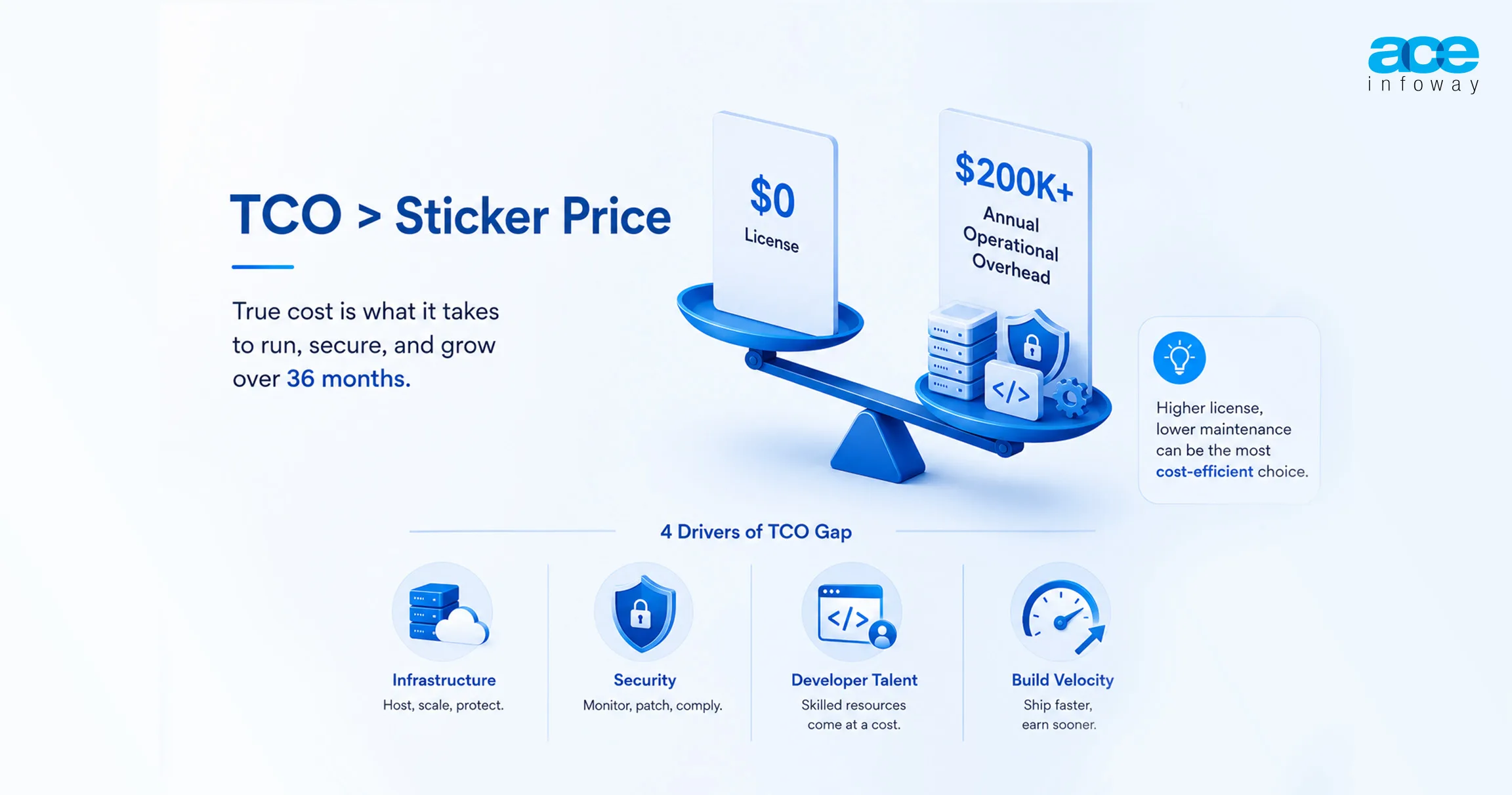
Here is the math that stings. A $0 license carrying $200,000 in annual operational overhead is not cheap. It just hides the bill in a different column. A $2,300-a-month platform with near-zero maintenance drag might be the most cost-efficient call you make this decade.
So the Magento vs Shopify comparison only means something once you run both scenarios against the same time horizon, the same team headcount, and the same growth roadmap. Compare sticker prices, and you get a marketing exercise, not a decision.
Four cost categories drive the TCO gap: infrastructure, security, developer talent, and build velocity. Each one rewards a different kind of buyer. Working out which of the four best fits your situation is essentially the entire decision.
Shopify vs Magento Total Cost of Ownership: The Numbers Side by Side
The table below covers mid-market brands running $2M to $20M in annual GMV. These are grounded ranges, not best-case projections. Your own numbers will move with catalog size, traffic volume, and how much custom engineering your store genuinely requires.
| Annual Cost Comparison: Magento Open Source vs Adobe Commerce Cloud vs Shopify Plus | |||
| Cost Category | Magento Open Source | Adobe Commerce Cloud | Shopify Plus |
| Platform Licensing | $0 | $40K–$200K+/yr | $28K–$55K/yr |
| Hosting & Infrastructure | $24K–$180K/yr | Included | Included |
| Security & PCI Compliance | $5K–$25K/yr | Included (partial) | Included |
| Core Updates & Patches | $10K–$50K/yr (dev time) | $10K–$30K/yr | $0 (automatic) |
| Agency / Dev Retainer | $15K–$60K/yr | $20K–$80K/yr | $10K–$30K/yr |
| Extension / App Licensing | $5K–$15K/yr | $5K–$15K/yr | $3K–$10K/yr |
| Total Annual Platform Cost | $59K–$330K | $75K–$325K | $41K–$95K |
Look at the low end first. Magento Open Source lands near $59,000 a year. Shopify Plus lands near $41,000. Eighteen thousand dollars apart. Annoying, not decisive.
Now look at the high end, because this is the number that keeps platform engineers awake. Adobe Commerce can run $325,000 in a single year. Shopify Plus, same scale, same traffic ceiling, runs closer to $95,000. That is a $230,000 annual gap.
Not a rounding error, and it does not close on its own. It compounds every year your team spends managing the infrastructure that created the gap in the first place.
Three years in, that compounding puts you north of $600,000 in extra maintenance spend alone. An independent study commissioned by Shopify and conducted by a third party consulting firm between December 2023 and January 2024 put Shopify’s TCO at 33% better on average than competing platforms.
This includes Adobe Commerce and can be up to 36% better, depending on the cost category. That figure tracks closely with what the cost table above shows.
Security Costs: The Line Item Nobody Forecasts
Magento Open Source pushes the entire security burden onto the merchant. Every quarter, Adobe ships patches that need to be pulled, tested against custom modules and third-party extensions, and deployed without breaking whatever is already working in production.
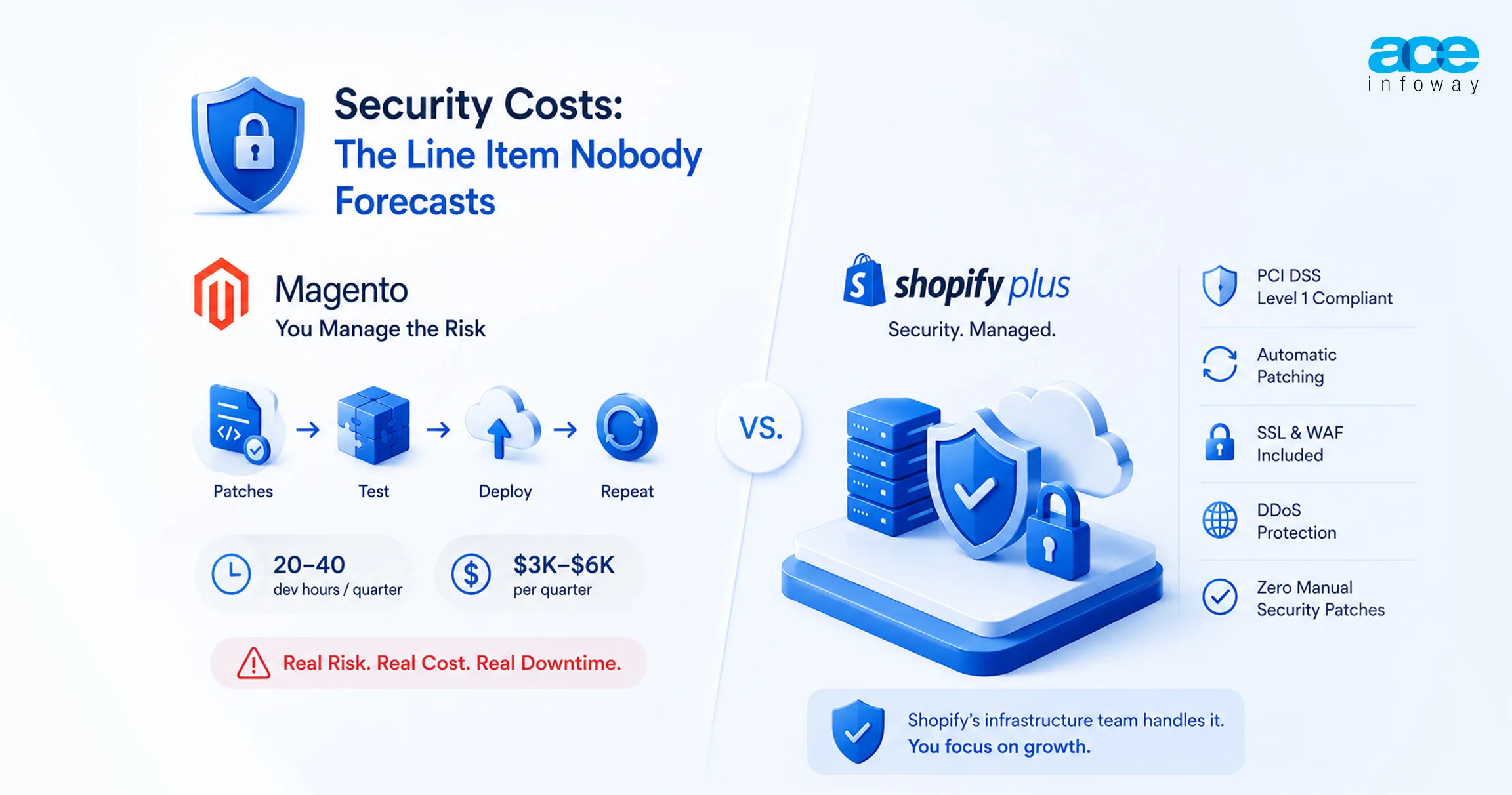
That cycle alone burns 20 to 40 developer hours per quarter. At $150 an hour on the conservative end, that is $3,000 to $6,000 a quarter just to stay patched. $12,000 to
$24,000 a year before a single emergency sprint gets added to the pile.
This is not a theoretical risk. In mid-2024, security researchers disclosed CosmicSting (CVE-2024-34102), a critical XML external entity vulnerability in Adobe Commerce and
Magento with a CVSS score of 9.8, allowing attackers to extract encryption keys and, when chained with a separate flaw, escalate to full remote code execution.
How Does Shopify Handle Security?
CISA added it to its Known Exploited Vulnerabilities catalog within weeks, and researchers tracked stores being compromised at a rate of three to five per hour during the exploitation wave. A second critical flaw, SessionReaper, forced another emergency patch cycle in 2025, and by October 2025, more than 250 Magento stores were compromised overnight through a related exploit chain.
Each disclosure triggers the same sequence: unplanned dev cycles, compatibility testing, emergency production pushes. Real money, real downtime. Layer on top of that the
$5,000 to $25,000 a year self-hosted Magento merchants typically owe for PCI compliance audits, and the true security line item stops looking like a footnote.
Shopify Plus handles this differently. PCI DSS Level 1 compliance, automatic patching, SSL, DDoS mitigation, and a web application firewall are managed entirely by Shopify’s infrastructure team. Merchants on Shopify Plus have never had to apply a security patch themselves.
Developer Talent: The Hidden Multiplier in the Magento vs Shopify Decision
Cost tables assume you can hire talent at the market rate at any time. For Magento, that assumption weakens yearly.
Magento dev rates:
Glassdoor: Average $116,632/yr ($56/hr), range $87,474 to $161,816, top 90th percentile $213,436 (102 salaries, Feb 2026)
Indeed: avg $100,783/yr (37 job-posting salaries, past 36 months, Apr 2026)
Why the pool shrinks:
Engineers moving to broader PHP/Laravel work, or crossing to Shopify entirely
Adobe’s pivot to PWA Studio + Edge Delivery Services demands devs fluent in Magento backend, React frontend, and GraphQL, all at once. Rare combo, rare cost.
Shopify dev rates:
Glassdoor: Average $122,074/yr ($59/hr), range $96,089 to $156,766, top earners $195,093 (40 salaries, May 2026)
Senior Shopify Developer: avg $119,604/yr ($58/hr), range $89,703 to $165,265 (Feb 2026)
ZipRecruiter: avg $109,905/yr ($52.84/hr), range $84,000 to $134,500, top 90th percentile $150,500 (May 2026)
Bigger gap: build velocity, not hourly rate
Features taking 4 to 6 weeks on Magento ship in 2 to 3 weeks on Shopify, same scope. Fewer moving parts.
Run that gap across a year: $40,000 to $80,000 in avoided dev cost, plus faster time-to-revenue
Matters as much as any single platform feature when speed is the competitive edge
Shopify Plus vs Magento: Enterprise Feature Showdown
The standard knock against Shopify for enterprise buyers has always been feature depth. That argument is running out of road. Shopify Plus has closed significant ground on
Adobe Commerce across most enterprise use cases over the past three years.
| Shopify Plus vs Adobe Commerce (Magento 2): Feature Comparison | ||
| Feature | Shopify Plus | Adobe Commerce (Magento 2) |
| Native B2B (Apr 2026) | Full support for company hierarchies, shared catalogs, purchase orders, payment terms, and quotes. | Advanced B2B features with multi-level approvals and highly customizable workflows. |
| Headless Commerce | Hydrogen (React) with Oxygen edge hosting. | API-first architecture with PWA Studio and Commerce Optimizer. |
| Multi-Store | Expansion stores with separate themes and content for each storefront. | Deep multi-store capabilities with shared catalogs and cross-store logic. |
| Checkout Customization | Checkout Extensibility framework (2024 onward). | Fully customizable checkout using custom modules. |
| ERP Integration | Integrates through apps, APIs, and middleware. | Supports native modules and custom ERP integrations. |
| Uptime SLA | 99.99% uptime backed by Shopify-managed infrastructure. | Depends on the selected hosting provider and infrastructure. |
Shopify Plus vs Magento 2: Which Handles Scale Better?
For most merchants who rely on their catalogs and follow standard selling practices, it’s time to join Shopify Plus. Shopify has the infrastructure: 99.99% uptime, on-demand elastic scaling, and no server configuration babysitting by your engineers.
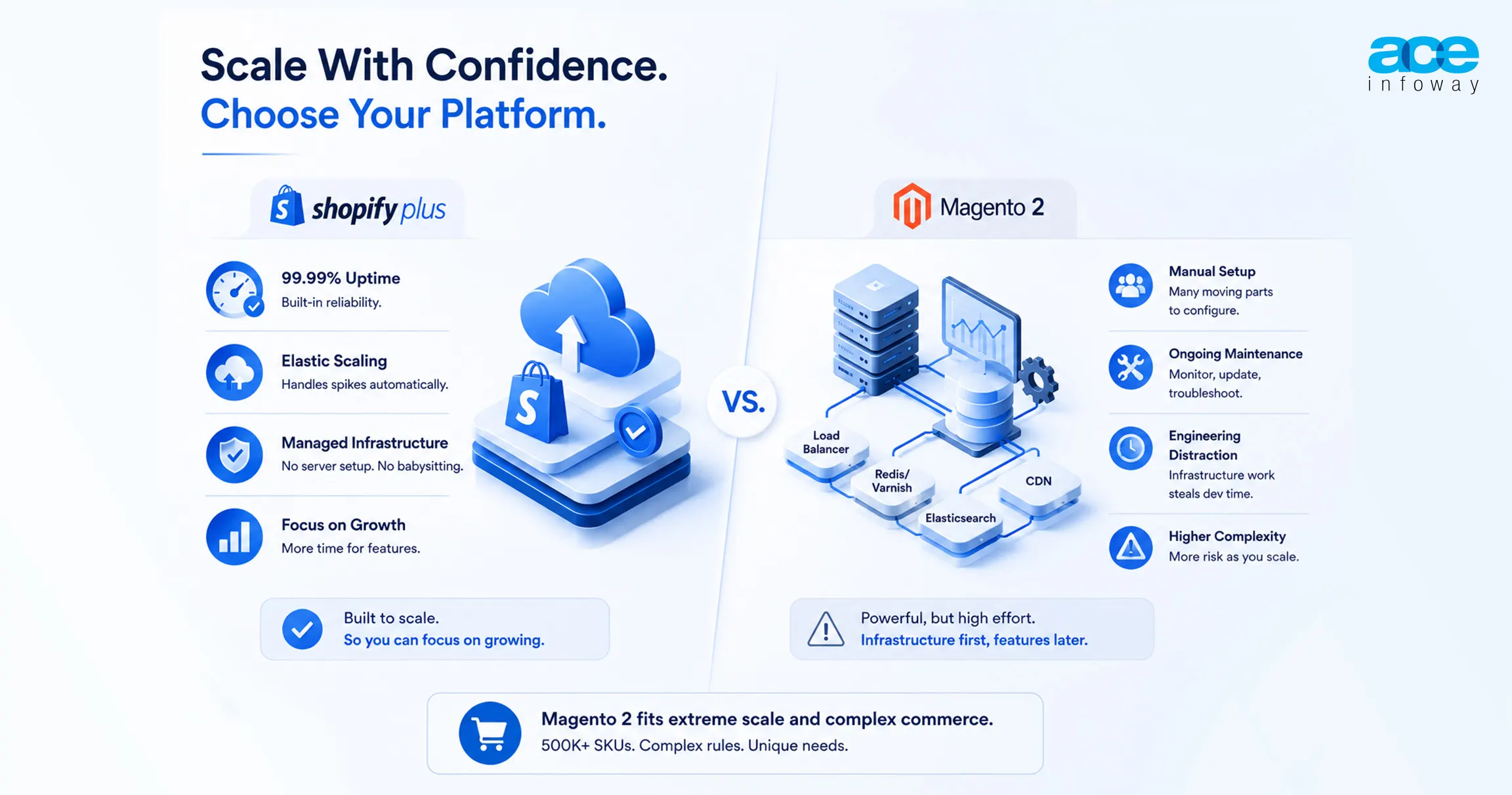
When Magento 2 is encountering similar traffic, it’s a completely different level of operation. You are deploying dedicated server clusters, configuring load balancers, configuring Redis or Varnish caching, installing Elasticsearch/OpenSearch, and manually integrating a CDN.
All those elements require people to set them up, monitor them, and repair them when they fail. But that person typically has a list of features they would like to see added to the product. The backlog is never allowed to interrupt infrastructure work. It cuts across in front of it.
For any merchants with truly large stores, with 500,000+ SKUs and intricate attribute logic or pricing in multiple currencies with complex tax calculation rules, the math has changed.
Shopify Plus vs Magento Enterprise: B2B, Headless, Multi-Store
When it comes to the choice between Shopify Plus and Magento Enterprise, B2B, headless, and multi-store capabilities are among the top considerations.
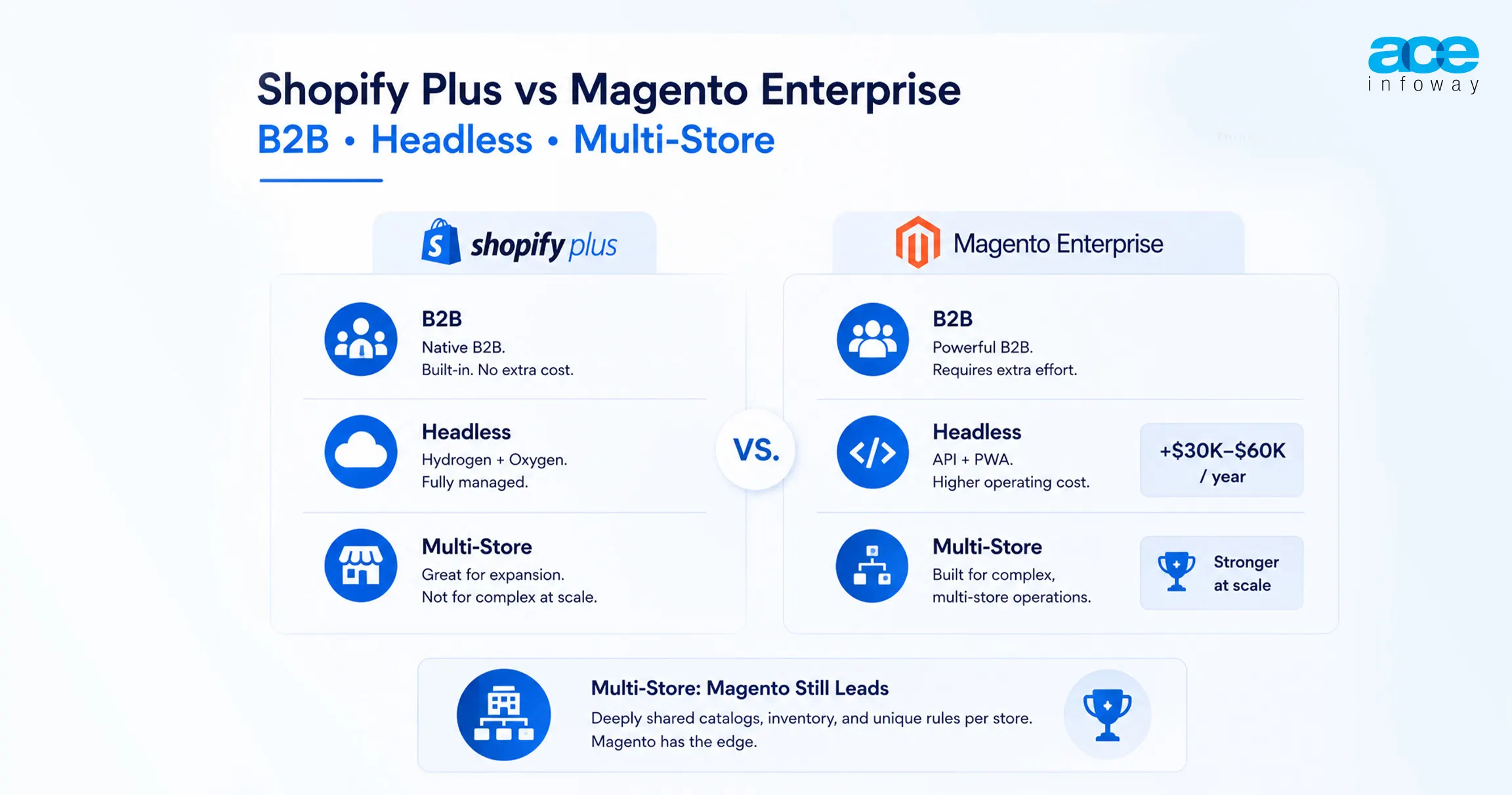
Shopify introduced native B2B capabilities on 2 April 2026 across all paid plans, making the Shopify Plus vs Magento Enterprise B2B comparison more complicated. Standard products now ship along with company hierarchies, shared catalogs with custom pricing, purchase orders, buyer roles, and self-service portals, and without extra licensing.
On headless, both platforms have a real path. Shopify’s Hydrogen framework, paired with Oxygen edge hosting, gives engineering teams a production-ready headless architecture with zero infrastructure overhead.
Adobe Commerce gets there through its API layer and Commerce Optimizer. The operational difference is what happens after launch: Hydrogen plus Oxygen runs on Shopify’s managed stack. Magento headless needs a separately managed API layer and frontend hosting stack of its own. That gap typically costs $30,000 to $60,000 more per year on the Magento side.
Magento continues to have an advantage when it comes to complex multi-store management. If your business operates 10 or more storefronts with shared product catalogs, cross-store inventory management, and unique business rules for each store, Magento offers greater flexibility and centralized control. While Shopify Plus supports expansion stores, it doesn’t yet provide the same depth of multi-store capabilities for highly complex enterprise environments.
When Magento Still Makes the Right Business Case
An honest Magento vs Shopify comparison names the scenarios where Magento is the correct answer. No platform wins every case, and pretending otherwise is how migrations go sideways.
- 10+ storefronts running fundamentally different business logic per store, not just different branding
- In-house teams of five or more Magento engineers, where the institutional knowledge lost in migration carries real, quantifiable cost
- Regulated industries or government contracts requiring on-premise hosting on specific audited infrastructure. Shopify is cloud-only, no exceptions
- Complex B2B with multi-level approval chains, negotiated contract pricing, and quote workflows beyond what native Shopify B2B currently supports
- Outside those four conditions, the case for Magento over Shopify Plus in 2026 rests mainly on organizational inertia rather than a genuine platform advantage. Knowing which camp you actually fall into is the single most valuable output of a proper platform assessment.
How Does Ace Infoway Help You Make the Right Platform Decision?
Ace Infoway provides both Shopify Development Services and Magento development, an unusual position in this market. It means the recommendation reflects your actual cost model and business goals, not whichever specialization the agency is trying to fill that quarter.
The team comprises Magento-certified developers and expert Shopify developers who have worked with retail, wholesale (B2B), and D2C brands.
Each engagement begins with a TCO model that’s unique to your operation: hosting costs, dev retainer, patch cycle overhead, roadmap.
That model, for many Magento merchants, pops up between $80,000 and $150,000 per year, which gets lost in the wash on Shopify Plus, while migration is paid for in 18 months or less. For the others, it proves that Magento’s versatility outweighs the operational costs due to the specific complexities of multi-store and B2B.
The migration process is structured: full data audit, staging validation, SEO redirect mapping, integration testing, and a zero-downtime cutover to ensure that order history, customer accounts, and catalog integrity remain intact.
Get Expert Guidance Before You Migrate
When you look at all the Magento vs Shopify questions, you can answer them with one word: “of course”! For merchants with annual revenue between $1M and $50M, Shopify Plus can save them $50,000 to $200,000 in annual costs compared to a similar Magento deployment. Only two months are spent working on servers, patches, and enterprise licensing negotiations, and the other two months are spent on building things that make money.
The relevance of that math to your operation will vary based on your catalog model, B2B complexity, in-house team makeup, and 36-month roadmap. Connect now to get your eCommerce development roadmap.

Frequently Asked Questions
Is Magento Open Source really free to use?
While Magento Open Source has no licensing fee, running a production store involves hosting, security, PCI compliance, maintenance, updates, and ongoing development costs. These expenses often make the total annual cost significantly higher than the free license alone suggests.
What is the estimated three-year cost of Shopify Plus?
For most mid-market businesses, Shopify Plus costs approximately $123,000–$285,000 over three years, including platform fees, apps, and agency support. Since hosting, security, and automatic updates are included, businesses typically experience more predictable long-term operating costs.
When should a business migrate from Magento to Shopify Plus?
A migration often becomes financially worthwhile when Magento operating costs continue to rise because of hosting, maintenance, and custom development. Businesses with growing infrastructure expenses can often achieve a positive return on investment within 12–18 months, depending on migration complexity and integration requirements.
Is Shopify Plus suitable for B2B ecommerce?
Yes. Shopify Plus includes native B2B capabilities such as company accounts, shared catalogs, purchase orders, payment terms, custom pricing, and self-service portals. However, businesses with highly complex procurement workflows or multi-level approval processes may benefit more from Adobe Commerce.
Which platform offers better SEO: Shopify Plus or Adobe Commerce?
Both platforms can achieve excellent SEO results when implemented correctly. Shopify Plus offers strong performance through its managed infrastructure and optimized Core Web Vitals, while Adobe Commerce provides greater flexibility for URL structures, canonical tags, and advanced technical SEO customization for large, complex catalogs.