









|
Getting your Trinity Audio player ready...
|
Table of Contents
Gartner projects that 75% of new enterprise applications will be built on low-code platforms by the end of 2026. That number reshapes how finance teams calculate project value, because the assumptions underneath traditional ROI models were never built for delivery timelines.
Rapid web application development bridges that gap between a validated idea and a working product. For a CIO managing constrained capital budgets against a backlog, that gap is where most of the strategic leverage sits.
But speed alone doesn’t close the argument. The harder question is what happens to the time you recover.
- How much of it converts into measurable revenue or cost reduction?
- How much bleeds out before it reaches either?
That’s what this piece examines. The tools and the organizational habits that determine which way the value tips, and where the recoverable time actually ends up.
Why Speed Itself is Not the ROI Story Most Enterprises Think It Is
Faster delivery does not ensure ROI. The return shows up in what speed unlocks instead: revenue that lands sooner, projects that don’t get abandoned, and a shorter gap between spending and payback.
A rapid web application earns its keep only when the time it saves gets poured back into features worth shipping, not into rebuilding the same thing a second time because nobody validated it.
The controlled studies make the case better than any vendor deck. Forrester’s Total Economic Impact analysis of OutSystems had customers reporting 506% ROI over three years.
A separate Forrester TEI study landed Microsoft Power Apps at 206% ROI. These are sponsored numbers, so don’t treat the exact percentage as gospel. The direction, though, is hard to argue with.
Companies recover what they put in well inside the window that hand-coded delivery usually eats up.
How Rapid Web Application Development Tools Compress Time to Value?
Rapid web application development is an iterative way to build. You ship in small iterations, not one giant release. You lean on parts that already exist. You let real feedback steer the next version instead of guessing. And you hit production way sooner because of it.
Push something usable every couple of weeks, and your team hears from real users while a waterfall crew is still drawing wireframes.
That early learning is the quiet engine. Every increment you ship either confirms there’s demand. Wait until launch to learn, and you have already paid the full build debt before finding out whether anyone wanted it.
Used this way, speed is risk reduction first, productivity second.

Where does the Approach Quietly Leaks Return?
Not every accelerated project pays off. The approach can reduce ROI the moment a team swaps governance for raw velocity and racks up technical debt. Skipped tests and undocumented integrations lead to a series of tech debt that hurts your team later.
Release one feels amazing. By release three, every little change knocks into something brittle, and the whole thing grinds down to a crawl.
The fix? Dull. Which is half the reason nobody does it. Stop pitting speed against maintainability like they’re two line items scrapping over the same hours. They’re one line. Teams that wire fast delivery into disciplined cost control across the web app lifecycle hang onto the return on the speed they earn. Everybody else just shoves the overrun from build into maintenance and tells themselves it vanished.
The Rapid Web Application Development Platform Decision Drives Most of the Outcome
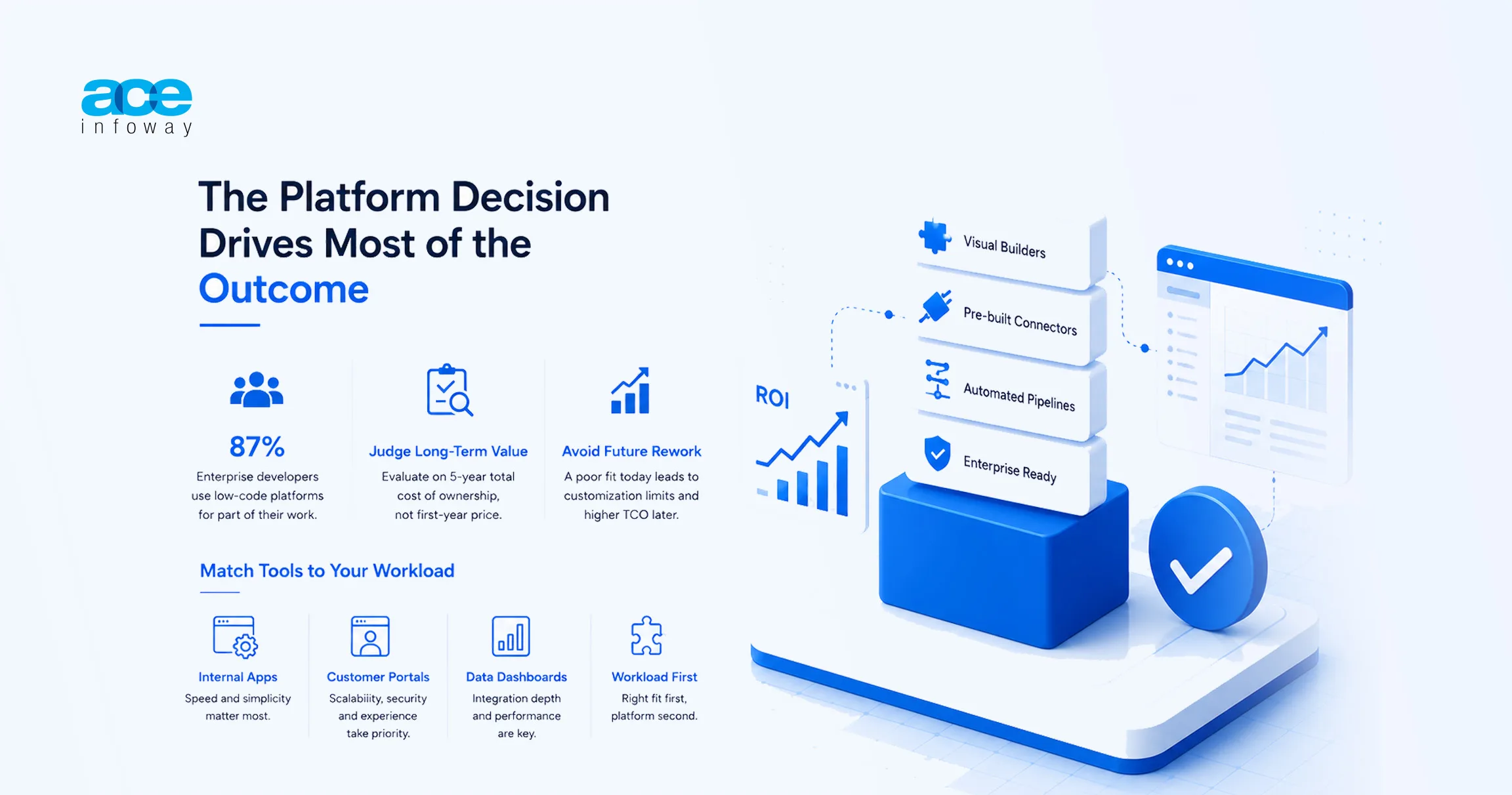
What you build on moves the return needle harder than nearly any other early call visual builders. Connectors are already wired. Pipelines that just deploy on their own. That’s the stuff a platform hands you, and it’s why good teams quit burning weeks on the dull plumbing that sinks ordinary projects.
Pick wrong, though? You’ll pay for it down the line. Lock-in. Licensing that creeps up. A customization wall you smack into, months after the ink dried.
Forrester’s enterprise survey found 87% of enterprise developers now use low-code platforms for at least part of their work. That’s not an experiment anymore. That’s the default. Which means the real question for an enterprise isn’t whether to adopt such a platform. It’s how to judge one against a five-year total cost of ownership instead of a first-year sticker price.
A platform that fits today’s workload but caps tomorrow’s customization quietly turns early savings into later rework, which is exactly why teams often pressure-test the fit through a focused web application development engagement before they standardize on anything.
Matching the Rapid Web Application Development Tools to Your Workload
The right rapid web application development tools hang entirely on what you’re trying to ship. A scrappy internal workflow app wants one thing. A customer portal wants another. A dashboard buried in data wants something else again, which is exactly why one blanket pick falls apart the second it meets a real backlog.
You will hear the same names thrown around at the enterprise tier. OutSystems. Microsoft Power Apps. Mendix. Retool. Each one parks at a different spot on the control-versus-speed line. OutSystems and
Mendix go deep on full custom builds. Power Apps clicks if you live in the Microsoft stack and need process automation.
Retool? That’s your grab when you want a quick internal tool sitting on a database you’ve already got. And the blunder companies keep repeating is forcing one platform onto everything, eating the bad fits, then wondering where the ROI they penciled in went. Teams that handle custom web app development across stacks tend to do it the other way around. Workload first. Platform second.
A Rapid Process Only Returns When the Governance Around It Holds
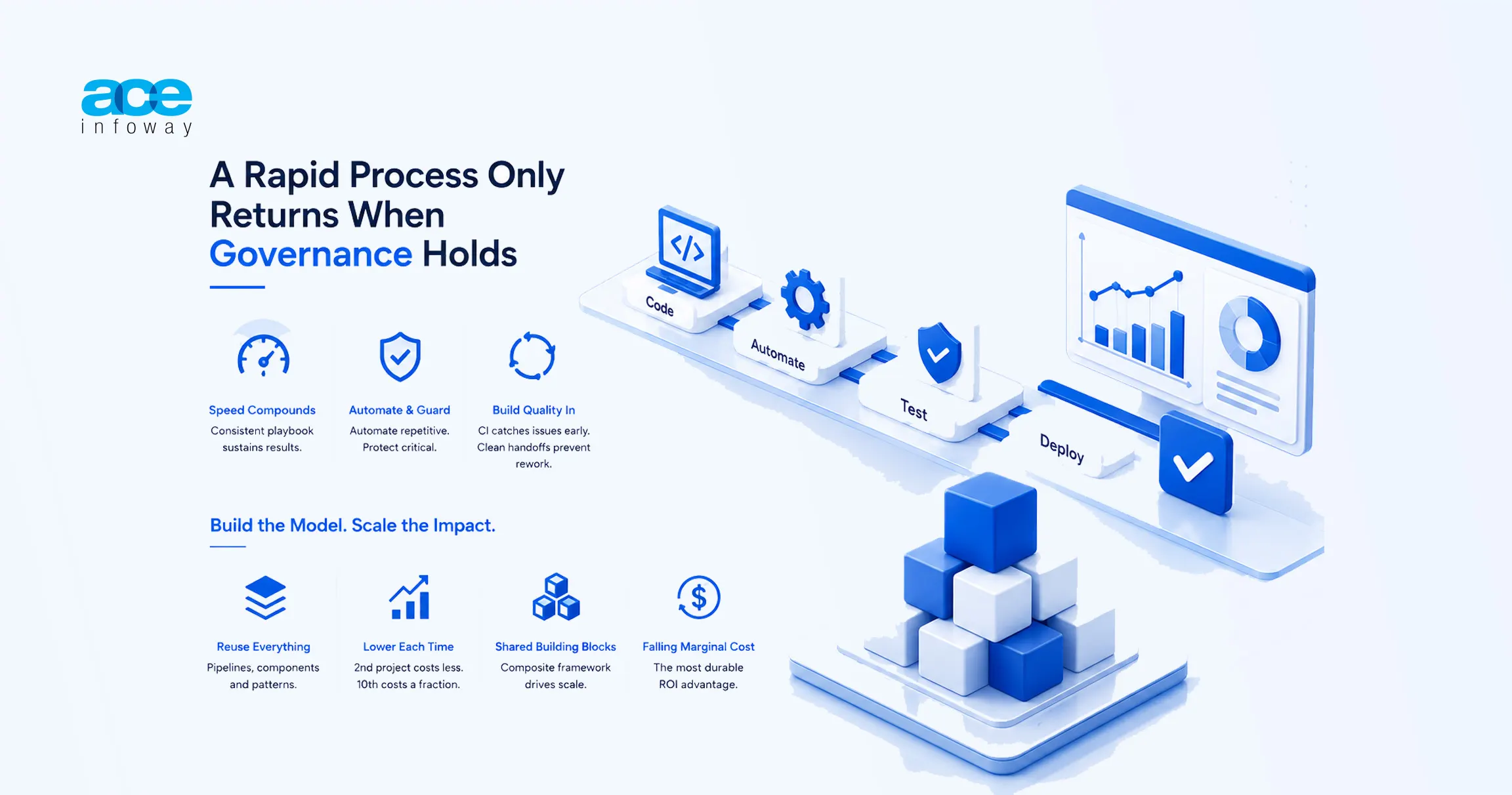
Process is the fork. Speed either compounds here or quietly comes apart. The teams are still moving fast after release five or six, and all run the same playbook. Automate the dull stuff. Guard the dangerous stuff.
Let continuous integration swat regressions before they ever touch production, and keep the design-to-build handoff clean so nobody redoes work twice.
None of that is clever or new, honestly. Yet it’s the exact spot where stalled projects go to die, not the tooling everyone blames.
McKinsey’s research reveals that tight delivery practices can push software development as much as 10 times faster than an ad-hoc approach. It leans on a maturity in automation that most shops just haven’t reached.
So read it as the best case, not the best. A well-run enterprise crew lands somewhere nearer a 40 to 50% cut in delivery time. Still huge. Spread it across a whole portfolio, and the number gets very real, very fast.
Building the Model Into a Repeatable Engine
The enterprises that win don’t run this model as a one-off sprint. They wire it into a repeatable engine, where every new project inherits the same pipelines, the same component library, the same review gates, and an operating pattern well-walked through in this rapid web app development guide.
That reuse is where the compounding lives. The second project costs less than the first because the scaffolding already exists. The tenth costs a fraction.
This is also why consolidating around a composite application framework matters once you hit scale. Assemble applications from shared, governed building blocks instead of rebuilding each one from scratch, and the marginal cost of delivery keeps sliding down. That falling marginal cost, not the raw speed everyone gets excited about, is the most durable ROI edge this whole approach hands an enterprise.

What the Return Actually Looks Like on the Balance Sheet
Where does the ROI actually land? Four spots, all of them countable. Revenue you booked sooner. The build cost has dropped. Projects nobody had to scrap. And quicker swings at the stuff that’s already pulling its weight. That first one dwarfs the rest, and weirdly, almost nobody talks about it. Get a billable feature live three months ahead, and you just pocketed three months of income that the slow path would have left on the table.
The cost side is more familiar, still way understated. Independent analysis from Integrate.io pegged the average org saving roughly $187,000 a year once they moved to low-code, with the ROI usually flipping positive inside six to twelve months. Then stack on the abandonment you sidestep. Cheap, fast validation knives weak ideas before they eat a whole budget. Add it all up, and the return profile stops resembling old-school delivery at all.
So rapid delivery has crept right to the heart of most digital transformation programs. It’s the execution layer now. The thing that turns a big strategy from a slide deck into something the finance team can actually believe.
Past your first easy wins, the curve wants to flatten. That’s where scalable custom web app development earns its name, keeping the return climbing instead of stalling out the moment the obvious gains are booked.
One more play worth saying out loud. A big chunk of this ROI piles up inside SaaS application development. Recurring revenue rewards fast iteration even harder than a one-time build ever could. Ship and validate quicker, and the subscription engine just starts compounding on its own.
Turning Speed Into Sustained Enterprise Return
A rapid web application lifts ROI on one condition, really. Govern the speed, fit the platform to the actual work, and let the process snowball from one project to the next instead of rebooting cold every time.
Those firms posting 200% to 500% in the vendor studies? They didn’t win on raw pace.
They won because they grabbed the hours’ speed, handed back and poured them into features people actually wanted, then bottled the whole motion into something repeatable. Speed gets you in the door.
Discipline is what drags the return all the way onto the balance sheet. Stop treating them as two separate calls. Make them one, and the math quietly tips your way.
Frequently Asked Questions
What is rapid web application development?
Rapid web application development (Rapid Web App Development or RAD) is an iterative software development approach that focuses on delivering working applications in short development cycles. By using reusable components, low-code tools, and continuous user feedback, organizations can launch web applications faster, reduce development risks, and quickly adapt to changing business requirements.
How does rapid web application development improve enterprise ROI?
Rapid web application development improves ROI by reducing development time, lowering implementation costs, and enabling businesses to release products faster. Earlier deployment allows organizations to generate revenue sooner, validate ideas before making large investments, and continuously improve applications based on real user feedback instead of assumptions.
Which rapid web application development platforms are commonly used by enterprises?
Leading enterprise platforms include OutSystems, Microsoft Power Apps, Mendix, and Retool. Each platform serves different business needs, from customer-facing applications to internal business tools and workflow automation. The right platform depends on scalability requirements, integration capabilities, security, and long-term maintenance goals.
Why is choosing the right rapid web application development platform important?
Selecting the right platform affects the total cost of ownership over the life of the application. Factors such as licensing fees, scalability, vendor lock-in, customization options, and integration flexibility influence long-term maintenance costs. Evaluating these factors early helps organizations maximize ROI while avoiding costly migrations later.
Can rapid web application development create technical debt?
Yes, technical debt can accumulate if development teams prioritize speed while neglecting code quality, testing, documentation, or governance. However, organizations can avoid these risks by following best practices such as automated testing, secure coding standards, regular code reviews, and continuous architecture improvements throughout the development lifecycle.