








|
Getting your Trinity Audio player ready...
|
Table of Contents
You have an app idea. A real one. Not a vague concept, but something users genuinely need. Then someone quotes you a number, and the conversation grinds to a halt.
Mobile app development costs are among the most misunderstood figures in tech. Ask three agencies, and you walk away with three wildly different estimates.
Scroll through Reddit threads on the topic, and you find startup founders describing $5,000 freelancer disasters sitting right next to CTOs who spent $500,000 and still launched late. Neither experience is rare. Both are entirely avoidable with the right information upfront.
So why is the cost of app development so hard to estimate?
Because it’s variable. What you build, where you build it, who builds it, and how well the project is scoped shapes the final number.
This guide walks through each variable honestly. Whether you are a founder trying to scope your first MVP or an operations lead planning a customer-facing mobile platform, here is what it actually costs to create an app in 2026, what pushes costs higher, and where AI has started shifting the math in both directions.
Why App Development Cost Varies So Dramatically?
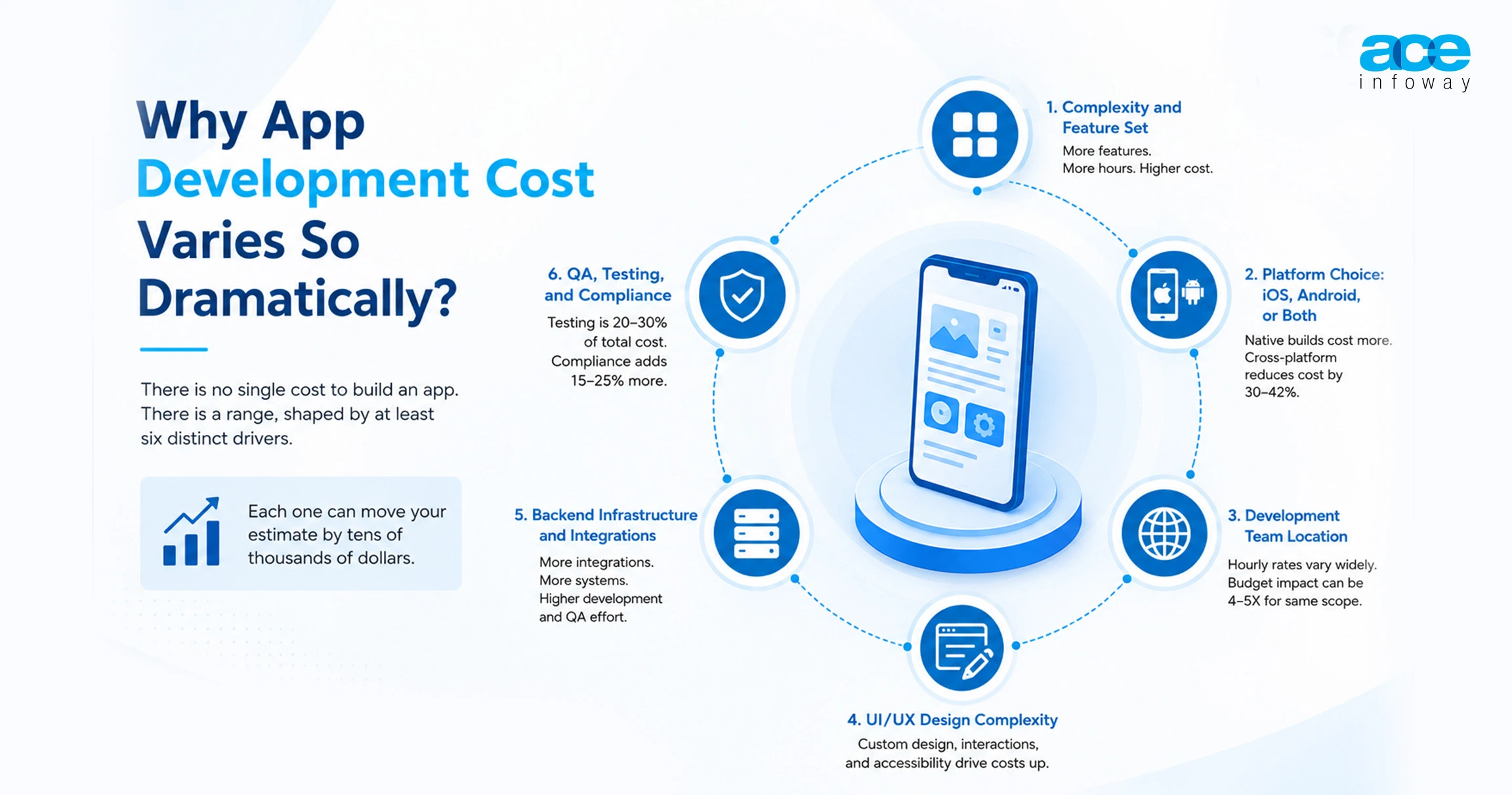
There is no single cost to build an app. There is a range, shaped by at least six distinct drivers. Each one can move your estimate by tens of thousands of dollars.
1. Complexity and Feature Set
A five-screen app with basic user login and no third-party connections is a fundamentally different build than a platform with real-time data sync, AI personalization, payment routing, multi-language support, and a handful of enterprise API integrations.
The development hours are not even in the same category. Basic apps typically land between $25,000 and $60,000. Mid-complexity projects, which are honestly where most business apps sit, run $60,000 to $150,000. Enterprise-grade mobile platforms regularly cross $300,000, sometimes by a wide margin.
2. Platform Choice: iOS, Android, or Both
Building natively for iOS and Android simultaneously roughly doubles both your timeline and your app creation price. iOS app development costs typically run $30,000 to $250,000, depending on scope. Android app development price sits in similar territory, $35,000 to $280,000, though
Android’s device fragmentation adds meaningful QA overhead that iOS largely avoids.
Cross-platform frameworks like Flutter and React Native change this math entirely. They reduce the cost of building an app for both platforms by 30 to 42% versus building two separate native codebases. For most early-stage and mid-market projects, cross-platform is the economically sound default.
3. Development Team Location
This is the single biggest lever most clients underestimate. US-based senior developers bill $120 to $200 per hour. European teams in Poland, Romania, and the Czech Republic run $45 to $90 per hour for genuinely comparable skill levels.
Indian and Southeast Asian teams price at $20 to $60 per hour. Run the math on a 2,000-hour project, and you see why app production costs can swing by a factor of four or five for the same functional spec. Location alone does not determine quality. But it does determine how much budget you have left to iterate after launch.
4. UI/UX Design Complexity
Design is not a cosmetic expense. It is a core cost center, and cutting it is the fastest route to poor user retention. Standard UI work using common component patterns runs $5,000 to $15,000. Custom motion design, branded component libraries, micro-interactions, and accessibility compliance can push design costs to $30,000 to $80,000 on their own. That is before the first backend query fires.
5. Backend Infrastructure and Integrations
Apps do not run in isolation. They talk to databases, CRMs, payment processors, ERPs, analytics tools, and cloud services. Each integration adds scoping hours, development time, and QA cycles. A clean, standalone backend costs $10,000 to $40,000.
A backend stitched into four or five enterprise systems can run $60,000 to $150,000 before you have written a line of frontend code. This is the cost driver that most often blows past the original ceiling of estimates.
6. QA, Testing, and Compliance
Testing typically accounts for 20 to 30% of total development costs. For regulated industries, healthcare, finance, insurance, compliance requirements like HIPAA, PCI-DSS, and GDPR layer on another 15 to 25 percent. Post-launch bug fixes cost three to five times as much to resolve as catching the same defects during active development. Skimping on QA does not save money. It just delays the invoice.
What Does It Actually Cost to Build an App [Tier Breakdown]
Here is a realistic, complexity-based breakdown of mobile app development cost in 2026.
| Mobile App Development Cost Breakdown by Complexity | |||
| Tier | Cost | Timeline | Features/Description |
| Tier 1: Simple / MVP Apps | $25,000 to $60,000 | 2 to 4 months | Single platform, core features only, basic authentication, simple data storage, no third-party integrations. Ideal for validating a concept before full investment. |
| Tier 2: Mid-Complexity Apps | $60,000 to $150,000 | 4 to 8 months | Cross-platform or dual-native development, user accounts, push notifications, payment integration, backend complexity, and admin panel support. Most business apps fall into this category. |
| Tier 3: Complex / Enterprise Apps | $150,000 to $500,000+ | 8 to 18 months | AI/ML capabilities, AR/VR experiences, real-time data processing, IoT integrations, enterprise-grade security, compliance certifications, and large-scale multi-system architecture for high user volumes. |
eCommerce App Development Cost
eCommerce carries its own cost profile. Catalog management, checkout flow architecture, payment security, inventory sync, returns handling, and personalization layers add up fast. A basic eCommerce app runs $30,000 to $60,000.
A mid-level B2C shopping experience costs $60,000 to $150,000. A full marketplace or enterprise platform with AI-driven personalization costs $120,000 to $500,000 or more.
Businesses building eCommerce mobile app solutions should budget beyond launch day. Catalog updates, payment gateway maintenance, and seasonal traffic optimization are ongoing costs that rarely show up in first-draft estimates.
How AI Is Changing the App Development Cost Equation?
For years, cost estimates in app development were anchored to one variable: hours. Senior developer rate × estimated hours = budget. AI has quietly broken that formula, not by removing developers from the equation, but by changing how much a single developer can produce within any given scope.
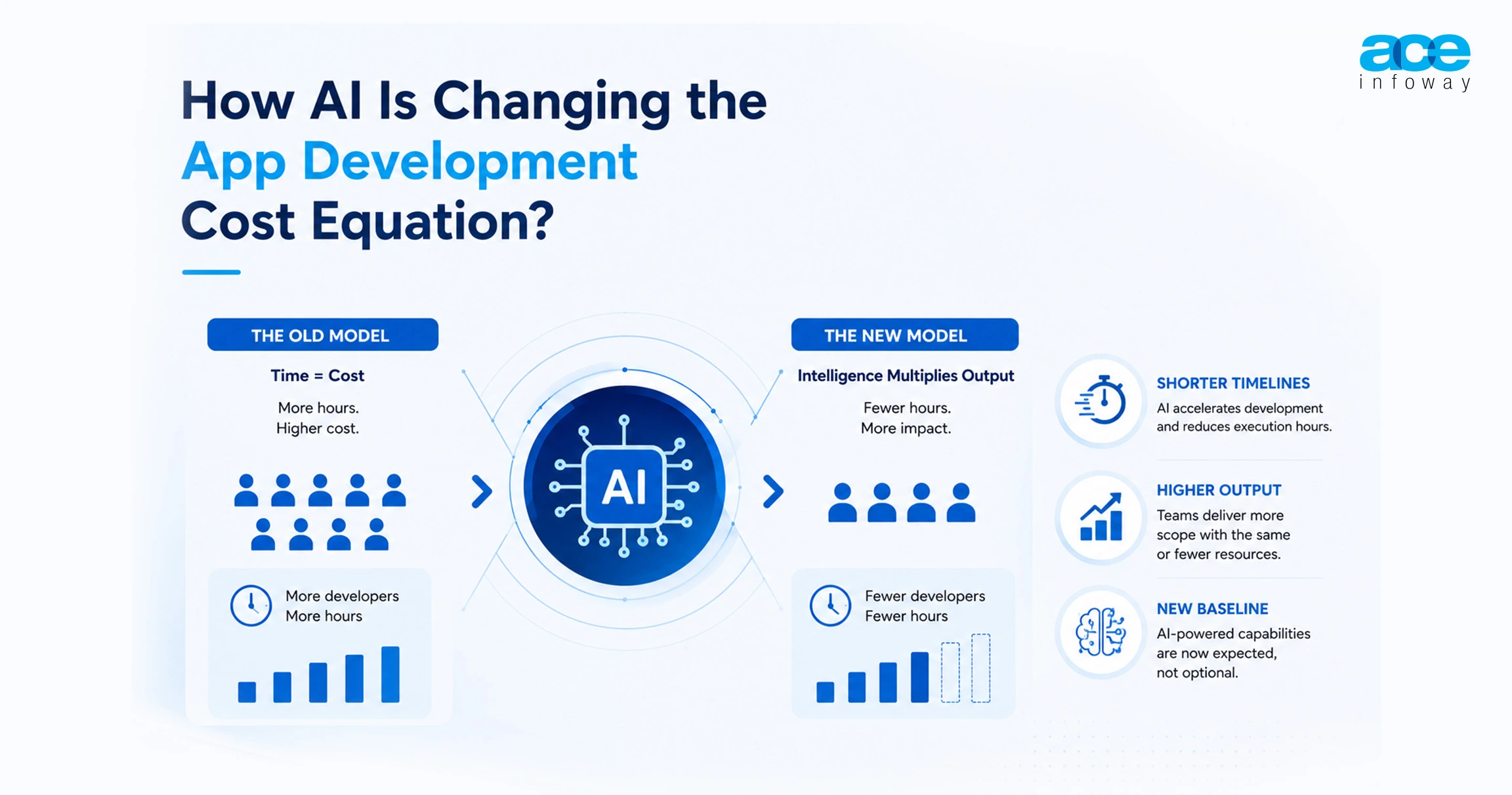
McKinsey’s analysis puts the direct productivity impact of AI on software engineering at 20 to 45% of current annual spending on the function, meaning a team that once required eight developers to deliver a project on deadline may now deliver the same scope with five, or deliver 40% more scope with the same eight. Neither outcome leaves your cost model unchanged.
That shift hits your budget in two directions simultaneously. On one side, it compresses development timelines, which lowers the hours billed for execution work. On the other hand, it raises the baseline expectation for what a finished product looks like, because your competitors are building more, faster, with the same spend.
The second shift is structural, not cyclical. Gartner predicts that 40% of enterprise applications will include task-specific AI agents by the end of 2026, up from under 5% in 2025. That’s not a feature update.
It’s a redefinition of what “complete” means for an enterprise application. An app that doesn’t include some degree of autonomous task execution is increasingly being positioned as a prior-generation product, regardless of when it was built.
What does this mean for the app creation price?
Two things, pulling in opposite directions.
On one side, AI-assisted development tools compress timelines. Boilerplate code, unit test generation, documentation, and code review AI handles a meaningful chunk of this now. Projects that took six months two years ago are shipping in four to five months with AI-augmented teams. That lowers billable hours on routine work and reduces overall app development cost for straightforward builds.
On the other side, building AI features into an app raises cost. A basic chatbot using existing APIs adds $20,000 to $50,000 to your budget. A custom ML model trained on proprietary data adds $80,000 to $200,000 or more in initial build, plus ongoing retraining and monitoring overhead. Neither figure is avoidable if the feature is real.
AI is lowering the floor for simple apps while raising the ceiling for ambitious ones. Budget planning that ignores either direction produces the wrong number.
Teams with strong AI and data engineering services built into their development process deliver faster, ship cleaner code, and avoid the painful AI retrofit that organizations face when they treat intelligence as a future add-on rather than a foundational design choice.
The Hidden Costs Most App Cost Estimates Miss
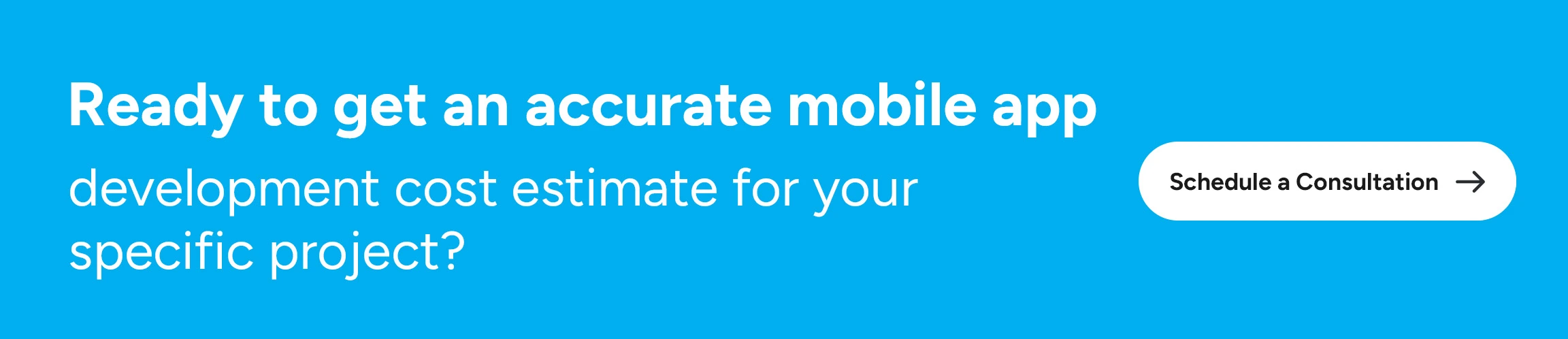
The build cost is only part of what you will actually spend. Four cost categories are left out of more estimates than they should be.
App Maintenance Cost: Post-launch maintenance costs 15-20% of the original build cost per year. On a $100,000 app, that is $15,000 to $20,000 annually in OS compatibility patches, security updates, performance fixes, and minor feature iterations. Companies that plan launch budgets carefully often have nothing left for the following year.
Third-Party Services and Licensing: APIs, payment processors, mapping services, analytics tools, push notification infrastructure all of it carries usage fees. Depending on scale, these run $500 to $5,000+ per month. Budget for them before you spec the features that depend on them, not after.
App Store Fees and Compliance: Apple charges $99 per year for App Store access. Google’s fee is a one-time $25. But compliance setup for regulated apps, HIPAA for healthcare, PCI-DSS for payments, and GDPR for European users can run $10,000 to $50,000 in initial implementation, with recurring audit costs on top.
Infrastructure and Hosting: Cloud infrastructure for a mid-scale app runs $500 to $5,000 per month on AWS, GCP, or Azure, depending on traffic volume, storage, and compute demands. Architect your infrastructure model before you choose your tech stack, not after the launch call.
iOS App Development Cost vs Android App Development Price
The iOS vs Android decision touches app development cost in three specific ways.
First, iOS development tends to move faster for consumer apps. Apple’s ecosystem is tightly controlled, which limits device and OS variation. Android development adds QA time because screen sizes, OS versions, and manufacturer customizations vary widely. For an equivalent feature set, Android QA typically adds 15 to 25 %more testing hours to the total project.
Second, iOS users in North America and Western Europe show consistently higher average revenue per user for monetized apps. If your model depends on in-app purchases or subscription revenue, iOS often justifies a higher investment in custom mobile app development, because the monetization return follows.
Third, cross-platform development reshapes both calculations. Flutter and React Native now produce near-native performance on both platforms from a shared codebase. For dual-platform coverage, this cuts app development costs by 30 to 40% versus two separate native builds. For most B2B and internal enterprise apps, cross-platform is the right default unless there is a specific technical reason to go native.
Businesses approaching enterprise application development should base their platform decision on actual user behavior data, not on platform instinct or internal developer preferences. Where your users are matters more than which stack your team likes.
What Custom Mobile App Development Pricing Actually Includes?
When Ace Infoway scopes a custom mobile app development project, the estimate is broken down into seven distinct work streams. Any quote that does not show this breakdown is not a quote. It is a number.
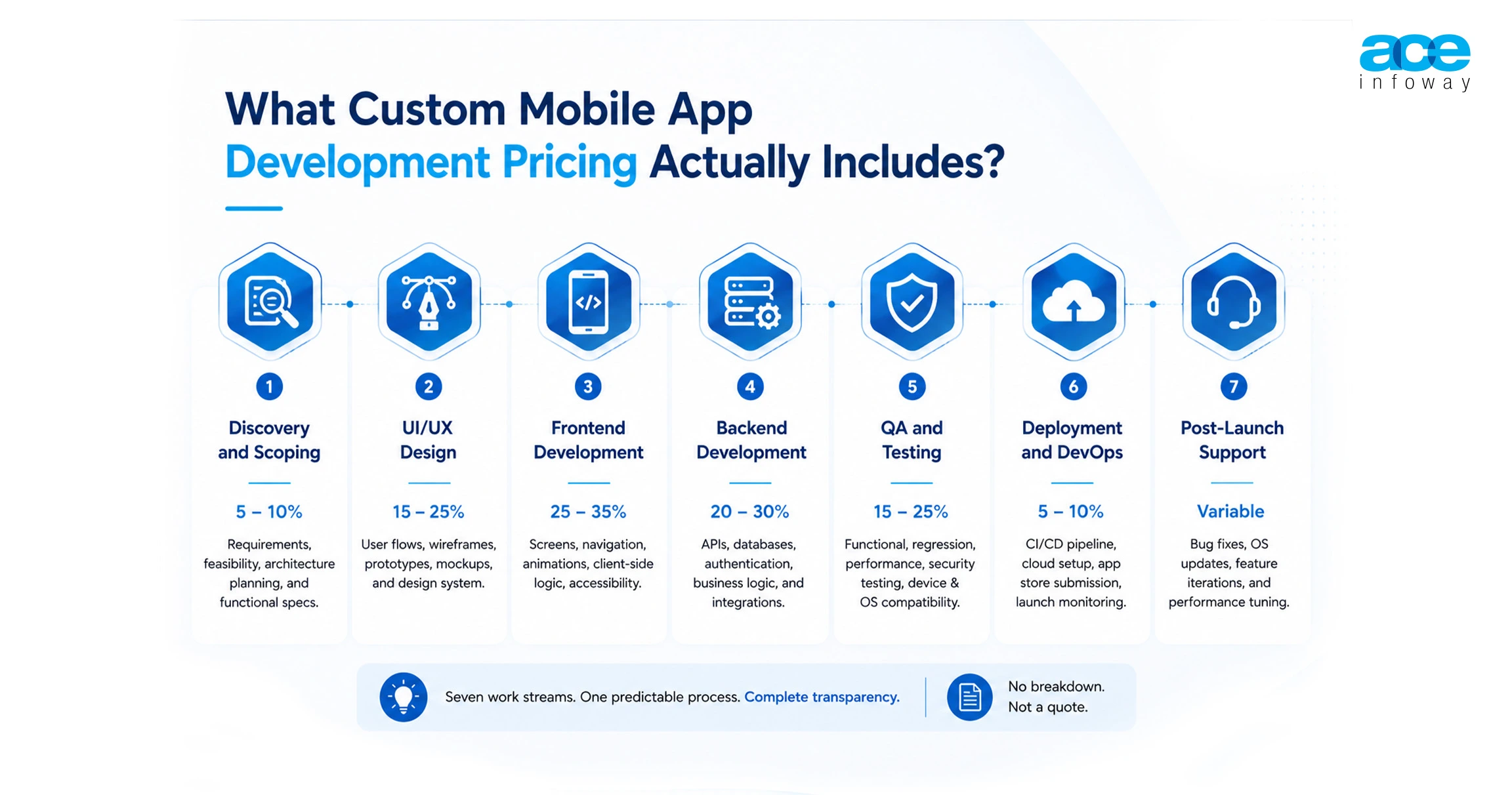
Discovery and Scoping (5 to 10% of total cost): Requirements workshops, technical feasibility review, architecture planning, and a functional specification document. Skipping discovery is the most reliable predictor of budget overrun.
- UI/UX Design (15 to 25%): User flows, wireframes, high-fidelity mockups, interactive prototypes, and a full design system. For consumer-facing apps, this is not a line item to compress.
- Frontend Development (25 to 35%): Everything the user sees and taps: screens, navigation, animations, client-side logic, accessibility.
- Backend Development (20 to 30%): APIs, databases, authentication, business logic, all server-side functionality. Third-party system integrations live here, and they cost more than people expect.
- QA and Testing (15 to 25%): Functional testing, regression cycles, performance testing, security testing, device and OS compatibility. For apps handling financial or health data, penetration testing is not optional.
- Deployment and DevOps (5 to 10%): CI/CD pipeline, cloud infrastructure configuration, App Store submission, launch monitoring.
- Post-Launch Support (variable): Bug fixes, OS update compatibility, feature iterations, performance tuning. Usually structured as a monthly retainer, though the scope varies.
Understanding this split lets you evaluate any estimate you receive with clarity. If a vendor quotes you a single number without this breakdown, you have no basis for comparison.
How Does Ace Infoway Approach App Development Costs?
Ace Infoway has been shipping software products since 1997. Not proposals. Not wireframes. Products. That distinction matters when you are trying to understand what mobile app development cost actually means in practice, not on a pricing sheet.
Our custom mobile app development engagements run on a phased delivery model. We scope in sprints, price transparently, and surface scope changes before they become invoice surprises three months in. For businesses that need both a mobile front-end and intelligent backend logic, our AI and data engineering services are built into the architecture from day one.
Teams building revenue-generating apps, subscription platforms, field sales tools, and demand forecasting systems routinely find that embedding AI-powered revenue intelligence into the app stack from the start is significantly cheaper than retrofitting it later. The retrofit tax is real. We have seen it add 40-60 to the original build cost when teams try to bolt AI onto a product not designed for it.
Frequently Asked Questions
How much does it cost to create an app in 2026?
The cost to create an app in 2026 ranges from $25,000 for a simple single-platform MVP to over $500,000 for a complex enterprise mobile platform with AI features, multi-system integrations, and compliance requirements. Most mid-complexity business apps fall between $60,000 and $150,000. The exact app development cost depends on your feature set, platform choice, backend architecture, design scope, and development team location.
What is the difference between iOS app development cost and Android app development price?
iOS app development costs typically range from $30,000 to $250,000, while Android app development pricing usually falls between $35,000 and $280,000. The biggest difference comes from testing complexity. Android development often requires additional QA effort because of device fragmentation across screen sizes, operating systems, and hardware configurations.
What is included in custom mobile app development pricing?
Custom mobile app development pricing typically includes discovery and requirements gathering, UI/UX design, frontend development, backend and API engineering, QA testing, deployment and DevOps setup, and post-launch support. More advanced projects may also include AI integrations, cloud infrastructure, analytics, and enterprise security implementation.
What is the ongoing app maintenance cost after launch?
App maintenance costs generally run between 15 to 20% of the original development cost annually. For example, a $100,000 application may require $15,000 to $20,000 per year for OS updates, security patches, performance optimization, bug fixes, monitoring, and ongoing feature improvements.
How does AI affect mobile app development cost?
AI impacts mobile app development costs in multiple ways. AI-powered features such as recommendation engines, voice assistants, predictive analytics, and automation increase engineering complexity and infrastructure requirements. At the same time, AI-assisted coding tools, automated testing, and development accelerators help reduce repetitive work, improve efficiency, and shorten delivery timelines for experienced development teams.