








|
Getting your Trinity Audio player ready...
|
Table of Contents
Cloud computing is the foundation of modern digital strategy. According to a report by GlobeNewswire, with a CAGR of 16% from 2023 to 2032, the global cloud computing market is expected to be valued at USD 2321.1 Billion by 2032.
As businesses scale, modernize applications, and respond to evolving customer demands, one question keeps surfacing about multi-cloud vs hybrid cloud.
The stakeholders are often stuck between which approach actually aligns with your business goals. While these two models are often compared head-to-head, the real decision is about defining an IT strategy that supports flexibility, control, business goals, the organization’s needs, and long-term growth.
The hybrid cloud vs multi cloud discussion usually highlights technical differences, but the bigger picture lies in outcomes.
This blog explains the difference between multi-cloud and hybrid cloud, how each model operates, their key advantages and trade-offs, and how to choose the cloud approach that best aligns with your business goals.
What Is Cloud Computing?

Cloud computing is the backbone of modern digital transformation. It enables businesses to access computing resources such as servers, storage, databases, networking, and applications. Instead of investing heavily in physical data centers and maintaining complex infrastructure, organizations can instantly provision resources from cloud service providers based on real-time demand.
Businesses can scale workloads up or down within minutes, deploy applications globally, and experiment with new technologies without long-term infrastructure commitments. This flexibility is the reason cloud has become central to conversations around hybrid cloud vs multi cloud strategies, where organizations design architectures that align with performance, security, and business objectives rather than rigid infrastructure limitations.
Businesses that want to turn cloud strategy into execution often rely on an expert cloud development services provider to build scalable, secure, and future-ready cloud environments.
Private Cloud vs Public Cloud: Understanding the Core Differences
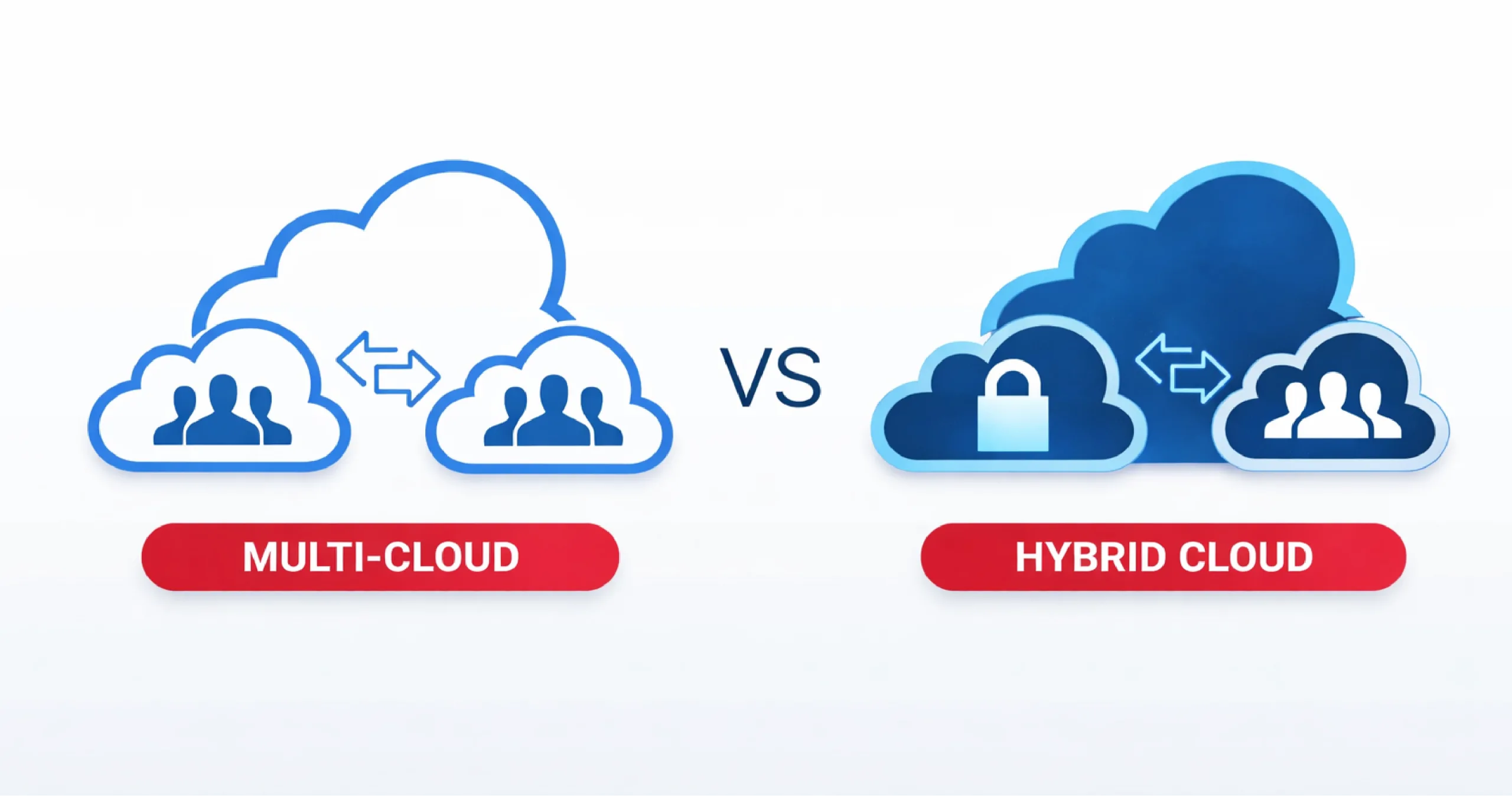
Before diving deeper into multi cloud vs hybrid cloud strategies, it’s important to clearly understand the difference around private cloud vs public cloud. These two cloud models form the foundation of most modern cloud architectures, and the right balance between them often determines how flexible, secure, and scalable your IT environment can be.
A public cloud is built for speed and elasticity. Providers like AWS and Azure offer shared computing resources that businesses can access on a pay-as-you-go basis or through discounted usage plans. This model makes it easy to scale workloads up or down without upfront infrastructure investment.
A private cloud, on the other hand, is designed for control and customization. It can be hosted on-premises or managed by a third-party data center, giving organizations full authority over configurations, performance tuning, and security policies. This level of control is ideal for sensitive workloads. Scaling is typically slower, and maintaining the infrastructure requires higher investment and operational effort.
What Is Multi-Cloud Computing?
To understand multi cloud vs hybrid cloud, it’s important to start with what multi-cloud actually means. What is multi-cloud computing? In simple terms, it’s a strategy where businesses use multiple public cloud platforms, often from different providers, to run different workloads. One cloud might power databases, another might support application development, while a third handles identity management or analytics.
This approach gives organizations freedom of choice. Instead of adapting their applications to a single provider’s limitations, they select cloud services based on performance, pricing, geographic reach, or specialized capabilities. When comparing hybrid cloud vs multi cloud, multi-cloud stands out for its flexibility and resilience. By distributing workloads across multiple clouds, businesses reduce dependency on one vendor and improve overall system reliability.
Benefits of Multi-Cloud Computing
- Better performance: Applications load faster when workloads are distributed across multiple public clouds. By placing services closer to end users, businesses reduce response times and improve overall application experience.
- Greater flexibility and vendor freedom: Multi-cloud allows organizations to choose the best services from different providers instead of being locked into a single ecosystem. This flexibility becomes a key differentiator in the hybrid cloud vs multi cloud decision.
- Enhanced security through workload separation: Sensitive data can be isolated or handled differently across cloud environments, reducing exposure while maintaining operational efficiency.
- Cost optimization and pricing leverage: Businesses can compare pricing models, shift workloads based on cost efficiency, and negotiate better terms, making cloud spending more predictable.
- Higher reliability and uptime: If one cloud provider experiences an outage, workloads can fail over to another. This redundancy significantly improves service availability.
- Stronger disaster recovery capabilities: Data replication across multiple cloud platforms minimizes the risk of data loss and accelerates recovery during disruptions.
- Lower latency for global users: With data centers spread across regions, users experience faster access and reduced network delays.
- Faster innovation cycles: Teams can adopt cutting-edge tools from different providers, encouraging experimentation and faster adoption of emerging technologies.
What Is a Hybrid Cloud?
A hybrid cloud model combines public cloud services with private cloud or on-premises infrastructure, creating a unified environment where data and applications can move between both. This approach is particularly useful for businesses that can’t or don’t want to move everything to the public cloud at once.
In the multi cloud vs hybrid cloud discussion, hybrid cloud is often chosen when control and compliance are top priorities. Sensitive workloads, legacy systems, or regulated data remain in a private environment, while public cloud resources handle scalable or less critical operations. This balance allows organizations to modernize gradually without disrupting existing systems.
Hybrid cloud deployments are common among enterprises with significant on-premises investments. They provide flexibility, support compliance requirements, and enable cost optimization by extending private infrastructure with public cloud capacity only when needed.

Benefits of Hybrid Cloud Deployment
- Improved security and tighter control: Critical workloads and sensitive data remain within private or on-premises environments, while public clouds handle scalable operations, an advantage often highlighted in multi-cloud vs. hybrid cloud comparisons.
- On-demand scalability without disruption: Hybrid cloud allows businesses to scale resources during peak demand without overhauling existing infrastructure.
- Balanced cost efficiency: Organizations optimize spending by running core workloads privately and using public cloud resources only when additional capacity is required.
- Consistent and seamless performance: Workloads are intelligently distributed between environments, ensuring smooth operations and minimal latency.
- Greater operational flexibility: Businesses retain full control over where applications and data reside, adapting quickly to compliance or performance needs.
- Extended value from existing infrastructure: Legacy systems and on-premises investments remain relevant while integrating with modern cloud services.
- Reliable disaster recovery options: Hybrid models support backup and recovery across private and public environments, strengthening business continuity.
Hybrid Cloud vs Multi Cloud: Core Differences
When evaluating cloud strategies, the debate around hybrid cloud vs multi cloud often creates confusion, not because the models are similar, but because they solve different business problems. Both approaches aim to improve flexibility and scalability, yet their architecture, workload behavior, and risk profiles vary significantly. Understanding these differences helps organizations design cloud environments that align with performance goals, compliance needs, and long-term growth plans.
Below is a clear explanation of multi cloud vs hybrid cloud:
Architecture and Design Approach
A hybrid cloud combines public cloud services with private cloud or on-premises infrastructure into a unified environment. This architecture allows businesses to keep sensitive workloads under direct control while extending capacity through the public cloud. Hybrid adoption has grown steadily as organizations modernize without abandoning existing infrastructure.
In contrast, a multi-cloud strategy focuses exclusively on using multiple public cloud providers. While multi-cloud can exist within a hybrid setup, it doesn’t require on-premises infrastructure. This distinction is central to the hybrid cloud vs multi cloud discussion.
Workload Distribution and Interoperability
In hybrid environments, workloads often move between on-premises systems and the cloud, especially for legacy applications that can’t be fully migrated. This requires strong integration and orchestration tools to maintain performance and reliability.
Multi-cloud workloads are distributed across different public clouds. While this improves flexibility, it often demands additional tools to manage interoperability, monitoring, and governance across providers, an important consideration in multi cloud vs hybrid cloud planning.
Vendor Lock-in Considerations
Vendor lock-in is a common concern in cloud adoption. Hybrid cloud environments may increase dependency on a single public cloud provider, especially when paired with proprietary services.
Multi-cloud strategies reduce this risk by allowing organizations to shift workloads between providers. This freedom is one of the key advantages often highlighted in hybrid cloud vs multi cloud comparisons.
Pricing and Cost Optimization
Hybrid cloud costs depend on both on-premises investments and public cloud usage. While predictable, this model can require upfront infrastructure spending.
Multi-cloud offers more pricing flexibility. Organizations can mix reserved instances for stable workloads with pay-as-you-go pricing for dynamic needs, often resulting in better cost optimization, an advantage in many multi cloud vs hybrid cloud use cases.
Availability and Business Continuity
Availability in hybrid cloud environments relies on both internal infrastructure and the public cloud provider. Any failure on either side can impact performance.
Multi-cloud environments typically deliver higher availability. By distributing workloads across multiple cloud providers, businesses reduce downtime risks and strengthen resilience.
Data Storage and Management
Hybrid cloud storage blends private, on-premises systems with public cloud storage. This offers greater control over sensitive data but can add complexity when moving data between environments.
Multi-cloud storage distributes data across public providers, improving scalability and flexibility while reducing dependency on any single vendor, making it attractive for organizations with fewer data residency constraints.
Security and Compliance
Security is a deciding factor in the hybrid cloud vs multi cloud decision. Hybrid environments allow deeper customization of security controls, which is ideal for regulated industries.
Multi-cloud security relies on provider-native controls. While customization may be limited, major providers comply with standards like GDPR and HIPAA, making multi-cloud viable for many use cases.
Flexibility and Adaptability
Hybrid clouds excel at integrating legacy systems with modern cloud platforms, offering controlled flexibility.
Multi-cloud environments shine in service diversity. Organizations can choose best-in-class tools from different providers and adapt quickly to changing business needs, one of the defining strengths in the multi cloud vs hybrid cloud choice-making.
Many enterprises modernize their digital platforms during cloud transitions, as demonstrated in our Sitecore redesign and migration solutions, where cloud architecture played a key role in performance and scalability improvements.
Choosing Between Hybrid Cloud and Multi-Cloud for Your Organization
Selecting the right cloud strategy starts with clarity around your business priorities, technical constraints, and long-term growth plans. To make an informed decision, it’s essential to understand what a hybrid cloud is, what multi-cloud computing is, and how each model aligns with real-world operational needs. Below is a structured guideline to help you decide:
Choose Hybrid Cloud If:
- You depend on on-premises infrastructure: When mission-critical workloads require tighter control, a hybrid setup allows private cloud or on-premises systems to coexist with public cloud services.
- Security and compliance are non-negotiable: Organizations in highly regulated sectors often prefer hybrid models to keep sensitive data within controlled environments while still leveraging cloud scalability.
- You want a phased cloud transition: Hybrid cloud supports gradual modernization, letting teams migrate applications step by step without disrupting legacy systems.
- Low latency is a business requirement: Workloads that demand real-time processing benefit from keeping certain operations closer to the source, reducing delays and performance bottlenecks.
Choose Multi-Cloud If:
- You want to avoid vendor dependency: Understanding what multi-cloud computing is helps here; it enables organizations to distribute workloads across multiple providers and stay flexible.
- You need best-fit cloud services: Different providers excel in different areas, and a multi-cloud approach lets you choose the strongest platform for each workload.
- Your operations span multiple regions: Multi-cloud environments make it easier to meet regional data regulations by selecting providers with local availability.
- High availability matters most: By running workloads across more than one cloud, businesses reduce the risk of downtime caused by a single provider outage.
- Cost efficiency is a priority: Comparing pricing models across providers allows smarter resource allocation and better budget control.
When to Combine Both?
A hybrid multi-cloud strategy can be the ideal choice when organizations need the control of private infrastructure alongside the flexibility of multiple public clouds. This approach supports complex workloads, balances risk, and provides room to scale without locking into a single ecosystem.
By evaluating your workloads, compliance needs, and performance expectations, you can determine whether hybrid cloud, multi-cloud, or a combination of both will best support your organization’s goals.
Conclusion
The real value of cloud strategy isn’t just in choosing multi cloud vs hybrid cloud, but in how well that choice supports long-term adaptability. As markets shift faster and digital expectations rise, organizations need cloud environments that can evolve without disruption. Whether balancing private cloud vs public cloud or aligning innovation with compliance, the right approach unlocks resilience, speed, and smarter decision-making.
Our team translates complex cloud strategies into scalable, business-ready solutions. With deep expertise across hybrid cloud vs multi cloud architectures, Ace Infoway helps organizations move confidently from planning to measurable outcomes. Contact us to learn more about our cloud services and how we can help you have an advanced and scalable cloud solution.
FAQ
What is the main difference between multi cloud vs hybrid cloud?
Multi cloud vs hybrid cloud differs in structure. Multi-cloud uses multiple public cloud providers, while a hybrid cloud integrates public cloud with private or on-premises infrastructure to balance control and scalability.
Is hybrid cloud better than multi-cloud for regulated industries?
In many cases, yes. Hybrid cloud vs multi cloud comparisons often favor hybrid models for healthcare and finance because sensitive data can stay in private environments while still using public cloud flexibility.
How do Agile teams measure productivity and success?
Teams track performance using metrics such as velocity, cycle time, lead time, and sprint goal completion. These indicators help teams understand their delivery speed and identify improvement areas. Consistent measurement ensures better planning, transparency, and predictable outcomes.
Why should businesses rethink private cloud vs public cloud decisions now?
Rising data regulations, AI workloads, and global expansion are changing requirements. Revisiting private cloud vs public cloud strategies ensures alignment with modern performance, security, and scalability demands.
Does hybrid cloud improve business continuity?
Yes. Hybrid cloud environments allow workloads to shift between private and public resources, improving resilience and reducing downtime during outages or demand spikes.
Can small businesses use multi-cloud strategies?
Absolutely. Multi cloud vs hybrid cloud decisions aren’t size-dependent. Small businesses often adopt multi-cloud to avoid vendor lock-in and access specialized services at competitive prices.