








|
Getting your Trinity Audio player ready...
|
Table of Contents
Software teams are designed to build, iterate, and deliver exceptional products. In reality, however, progress rarely moves in a straight line. Priorities shift without warning. Business goals evolve. Technical dependencies emerge at inconvenient moments. What starts as a clear vision can quickly dissolve into misalignment, delays, and constant course corrections.
This gap between strategy and execution is one of the most common and costly challenges in modern product development. This is why strong execution frameworks and expert-driven Product Engineering practices become critical for building scalable, resilient digital solutions. That is precisely where software process methodologies create measurable impact.
The right structure does far more than define workflows. It establishes a consistent decision-making model, clarifies ownership, and introduces predictable delivery rhythms. Instead of reacting to chaos, teams operate within a system designed for adaptation, transparency, and continuous improvement. Well-chosen software development process methodologies act as an operational backbone, ensuring that planning, collaboration, and delivery remain synchronized even as conditions change.
What Are Software Development Methods?
At its core, software creation is about following a disciplined system that transforms ideas into reliable, scalable solutions along with writing strong code. This is exactly where software development methods play a defining role. These methods provide structured approaches for planning, building, testing, delivering, and maintaining software, ensuring that teams operate with clarity rather than improvisation.
Well-defined methods shape how requirements are gathered, how tasks are organized, how risks are controlled, and how collaboration flows between technical and business stakeholders. Without such structure, even highly skilled teams can struggle with missed deadlines, scope creep, and inconsistent quality.
It is important to recognize that no single method universally fits every project. Different products, industries, and team dynamics demand different approaches. Some projects benefit from highly sequential models, while others require adaptive, feedback-driven cycles.
Selecting among software development methods typically depends on several practical considerations such as business objectives, architectural and design preferences, deployment strategies, and long-term maintenance expectations.
When evaluating software development methods, organizations typically consider several key factors:
- The strategic and operational needs of the business
- The development team’s design and architectural preferences
- The technique used to release software into production
- The method’s ability to support ongoing updates and maintenance
Ultimately, selecting an appropriate method is a strategic decision that shapes collaboration, delivery speed, and long-term product evolution.
Why the Right Software Development Methodology Makes a Difference?
The methodology behind a project influences far more than workflow preferences, as it directly affects delivery timelines, budget stability, collaboration efficiency, and product quality.
When software development process methodologies are carefully aligned with project requirements, teams gain structure, iterations remain purposeful, and releases progress with fewer disruptions. Decision-making feels grounded rather than reactive with improved communication and predictable execution.
Misalignment, however, introduces compounding challenges. Inconsistent cycles, redundant efforts, and uncontrolled scope shifts often emerge when the chosen methodology fails to reflect project realities. These inefficiencies rarely stay isolated; they expand into delays, rising costs, and delivery uncertainty.
At Ace Infoway, selecting the right development approach begins with technical due diligence rather than assumptions. We evaluate project complexity, scalability expectations, compliance constraints, and integration demands to determine the most effective framework. This deliberate assessment ensures transparency, operational stability, and measurable progress across the entire development lifecycle.
Key Benefits of Software Development Methodologies
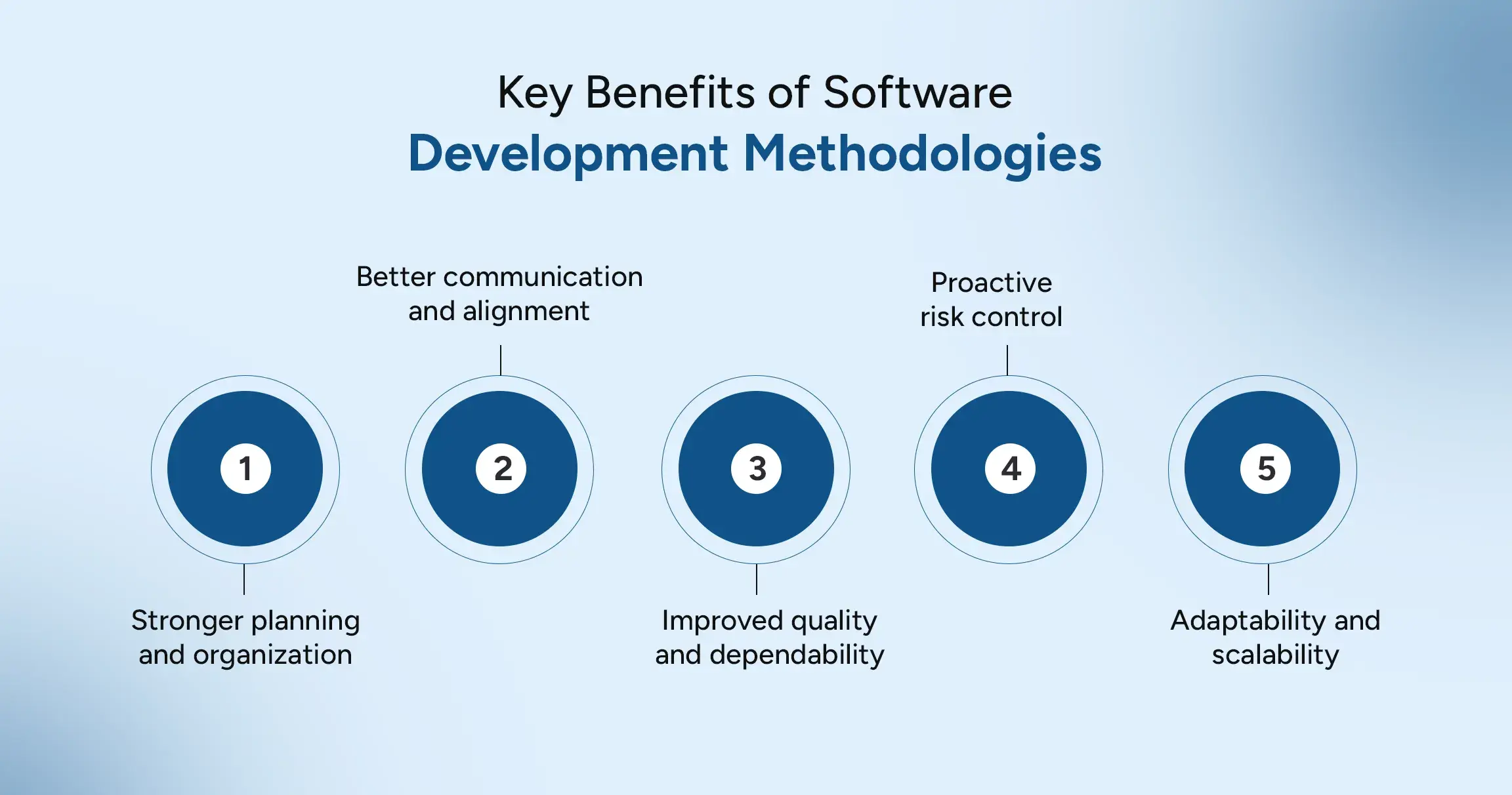
Software process methodologies serve as structured systems that shape how teams plan, execute, and govern the creation of software products.
Regardless of the model, well-implemented software development methods bring measurable advantages that directly influence project outcomes:
- Stronger planning and organization: Clear structures improve estimation accuracy, define deliverables, and align resources, reducing delays and budget instability.
- Better communication and alignment: Defined workflows encourage consistent collaboration between teams and stakeholders, minimizing misunderstandings and decision gaps.
- Improved quality and dependability: Standardized testing, validation, and review practices lead to more stable, reliable software.
- Proactive risk control: Milestones and iterative evaluations help identify issues early, preventing costly disruptions.
- Adaptability and scalability: Flexible methodologies enable controlled responses to changing requirements without derailing project objectives.
Methodology selection becomes even more critical in transformation-driven projects like Re-development Web Portal and Mobile Applications, where balancing legacy constraints with modern user expectations requires both flexibility and structured execution.

Different Types of Software Development Methodologies
Modern product development relies on carefully selected software process methodologies to manage complexity, accelerate delivery, and maintain quality.
Below are some of the most widely adopted software development process methodologies and how they differ in practice.
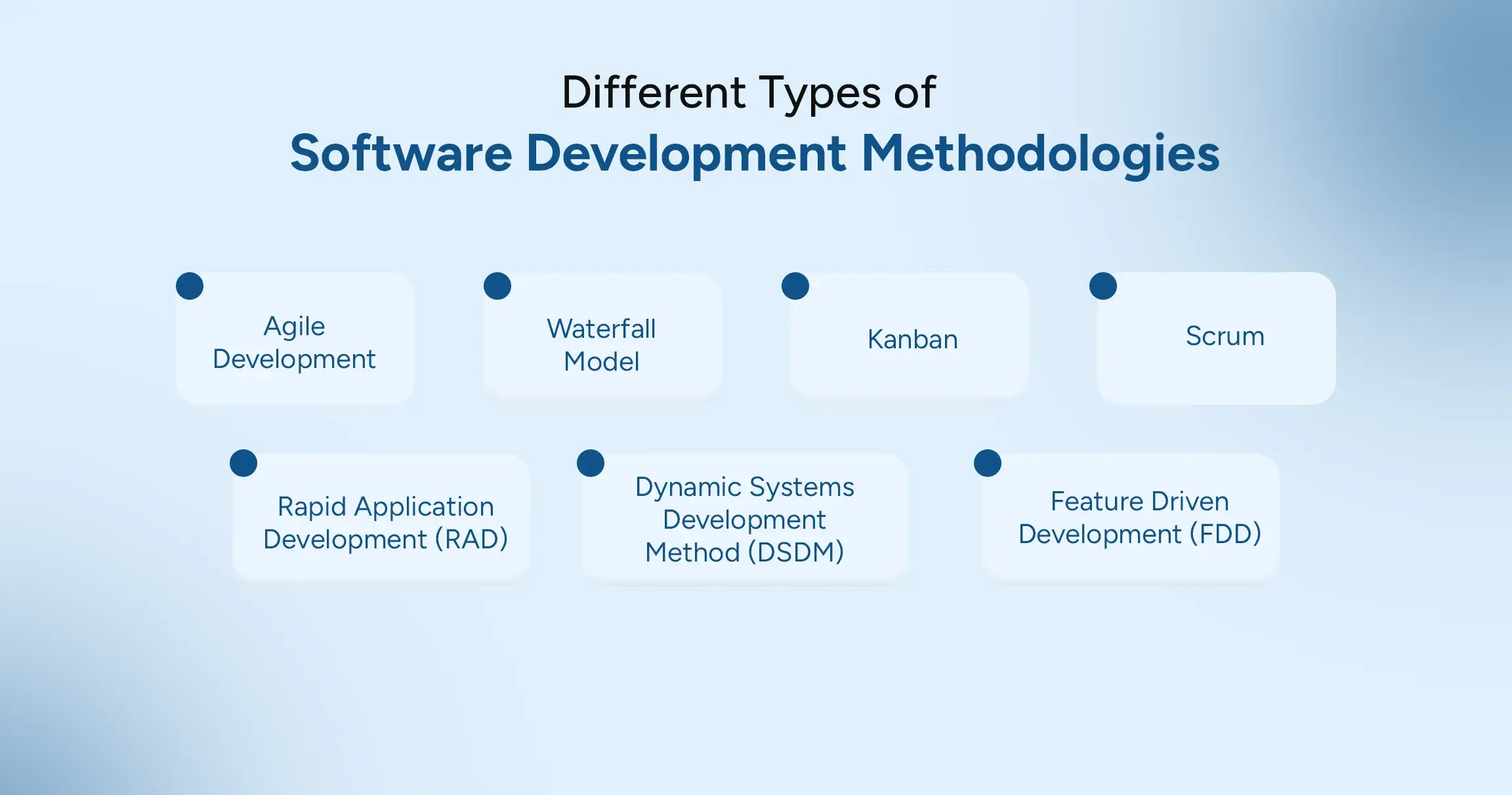
Agile Development
Agile represents one of the most influential shifts in software development methods, prioritizing adaptability, incremental delivery, and close stakeholder collaboration. Rather than treating requirements as fixed, Agile embraces continuous refinement through iterative cycles. Work progresses in short sprints, enabling teams to release functional improvements frequently while incorporating feedback throughout the lifecycle.
Read more: Agile & Scrum – Key benefits
Ideal For:
Projects with evolving requirements, fast-changing markets, and teams that benefit from continuous feedback and iterative progress.
Waterfall Model
The Waterfall model follows a sequential, highly structured path where each phase progresses logically into the next. Requirements, design, implementation, and testing occur in clearly defined stages. This methodology emphasizes planning accuracy and comprehensive documentation, making deviations less common once execution begins.
Ideal For:
Projects with well-defined, stable requirements and environments demanding strict controls or regulatory compliance.
Kanban
Kanban focuses on workflow visualization and continuous task movement rather than fixed iterations. Work items flow through defined stages on a visual board, with work-in-progress limits preventing overload. This model optimizes efficiency by stabilizing throughput and reducing bottlenecks.
Ideal For:
Teams handling continuous streams of work, maintenance-heavy environments, and projects requiring operational flexibility.
Scrum
Scrum is a structured Agile framework designed for iterative development within fixed-length sprints. Defined roles, ceremonies, and artifacts create accountability and rhythm. By emphasizing short feedback loops, Scrum supports continuous improvement while maintaining operational discipline.
Ideal For:
Complex projects requiring frequent reassessment, collaborative teams, and environments valuing incremental progress.
Rapid Application Development (RAD)
RAD emphasizes speed through rapid prototyping, reusable components, and high user involvement. Development cycles are shortened by prioritizing working models over extensive upfront planning, allowing functionality to evolve through iterative refinement.
Ideal For:
Projects demanding quick validation, UI-driven applications, and scenarios where user feedback is critical.
Prototype Model
The Prototype Model centers on building an early working version to clarify requirements and reduce uncertainty. Feedback-driven iterations progressively refine the solution, ensuring alignment before full-scale development investment.
Ideal For:
Projects with unclear or evolving requirements, innovation-heavy solutions, and user-centric systems.
Dynamic Systems Development Method (DSDM)
DSDM blends Agile flexibility with strong governance controls, emphasizing business value delivery within fixed time and budget constraints. Prioritization techniques and active stakeholder participation guide decision-making.
Ideal For:
High-stakes projects where governance, predictability, and business alignment are equally critical.
Feature Driven Development (FDD)
FDD organizes development around delivering small, client-valued features. Iterations remain short and structured, enabling progress tracking through feature completion milestones.
Ideal For:
Large-scale systems, feature-focused products, and teams requiring structured incremental delivery.
Understanding these software development methods allows organizations to align execution models with project realities.

Key Considerations When Selecting a Software Development Methodology
Choosing among various software development methods directly shapes how efficiently a team operates, how risks are handled, and how predictable delivery becomes. The effectiveness of any approach depends heavily on context. A methodology that performs exceptionally well for one project may create friction in another. This is why evaluating software development process methodologies requires a practical, project-driven perspective rather than preference or trend.
Several factors consistently influence which framework will produce the best outcomes:
Project Size and Complexity
Larger, technically intricate initiatives often demand structured coordination and risk control, while smaller efforts may benefit from lightweight, adaptive approaches.
Project Timelines and Release Expectations
Timelines directly shape process demands. Projects with aggressive deadlines or frequent release expectations typically benefit from rapid iteration cycles. Longer engagements with phased milestones may align better with sequential planning and controlled transitions between stages.
Team Expertise and Composition
Methodologies impose different operational expectations. Highly collaborative frameworks demand disciplined, cross-functional teams, while structured models can provide clarity for teams operating within defined roles and responsibilities.
Stakeholder Involvement
Projects requiring continuous feedback and validation naturally pair with interaction-heavy models. Limited stakeholder engagement may favor methodologies emphasizing upfront definition and controlled execution.
Risk and Uncertainty Levels
High-risk initiatives often demand iterative validation and early issue detection. Lower-risk projects may prioritize predictability and stable execution flows.
Technological Landscape
Rapidly changing or experimental technologies typically require flexible approaches capable of absorbing change without disruption.
Budget Structure
Budget rigidity or flexibility influences tolerance for iteration, rework, and scope evolution.
Tooling and Infrastructure
Existing tools, infrastructure, and delivery pipelines often dictate which frameworks can be implemented effectively.
Balanced evaluation across these factors leads to more stable execution and better long-term outcomes.
Conclusion
Software project management rarely fail because of technology alone. More often, challenges arise from misaligned execution models, unclear workflows, or processes that cannot adapt as realities change. This makes methodology selection less of a procedural choice and more of a strategic lever for long-term delivery stability. The right approach shapes decision velocity, team confidence, and the ability to scale without operational friction.
At Ace Infoway, we view software development process methodologies as business enablers rather than rigid frameworks. Our teams evaluate project dynamics, risk profiles, and growth expectations to craft execution strategies that remain resilient under change. This ensures every engagement is structured for predictability, efficiency, and measurable outcomes.
If you are planning a new product or optimizing an existing one, contact us to explore the right development approach for your goals.
FAQ
What is software development methodology, and why is it important?
A software development methodology defines how teams plan, build, test, and deliver software. It provides structure, reduces uncertainty, and clarifies collaboration models. Without a methodology, projects often struggle with inconsistent workflows and unpredictable outcomes. Proper alignment improves efficiency and quality.
How do software development methods affect project timelines?
Different software development methods influence how work is sequenced and reviewed. Iterative models enable frequent releases, while linear models follow phased progress. The impact on timelines depends on project complexity and feedback cycles. Choosing appropriately improves schedule reliability.
Are software development process methodologies relevant for small projects?
Yes, even smaller initiatives benefit from defined software development process methodologies. Lightweight frameworks can provide clarity without introducing unnecessary overhead. They help prioritize tasks, control scope, and maintain delivery discipline. Structure improves efficiency regardless of scale.
Can a project switch methodologies mid-development?
Transitioning between methodologies is possible but requires careful planning. Changes may affect workflows, documentation, and team responsibilities. Poorly managed transitions can disrupt progress. Strategic adjustments, however, may improve alignment when project conditions evolve.
How do software development methods impact team collaboration?
Methodologies determine communication frequency, decision cycles, and feedback mechanisms. Collaborative models encourage continuous interaction, while structured models formalize checkpoints. Team dynamics and organizational culture influence which approach works best.