








|
Getting your Trinity Audio player ready...
|
Table of Contents
Enterprises have spent the last ten years locking the front door of their apps. Logins got stronger, and firewalls got smarter. The problem? The valuable data no longer stays behind that door.
Once a customer signs up, their details start traveling into reports, dashboards, backups, laptops, and, now, AI tools. Each copy is a new place where data can leak, and most of those places never got the same protection as the app itself.
Accenture’s State of Cybersecurity Resilience 2025 found that 77% of organizations lack the essential data and AI security practices needed to protect their models, data pipelines, and cloud infrastructure. Without effective data engineering best practices, users’ information can be exposed to cyberattacks.
This guide explains where modern applications actually leak data, which controls close those gaps, and which data engineering best practices keep information safe.
What Does Data Security Mean Once Data Leaves the App?
Think of your application as a shop counter. Customers hand over their information there, and the counter is well guarded. But the information doesn’t stay at the counter. It moves to the storeroom, the accounts team, outside partners and, more and more, AI assistants.
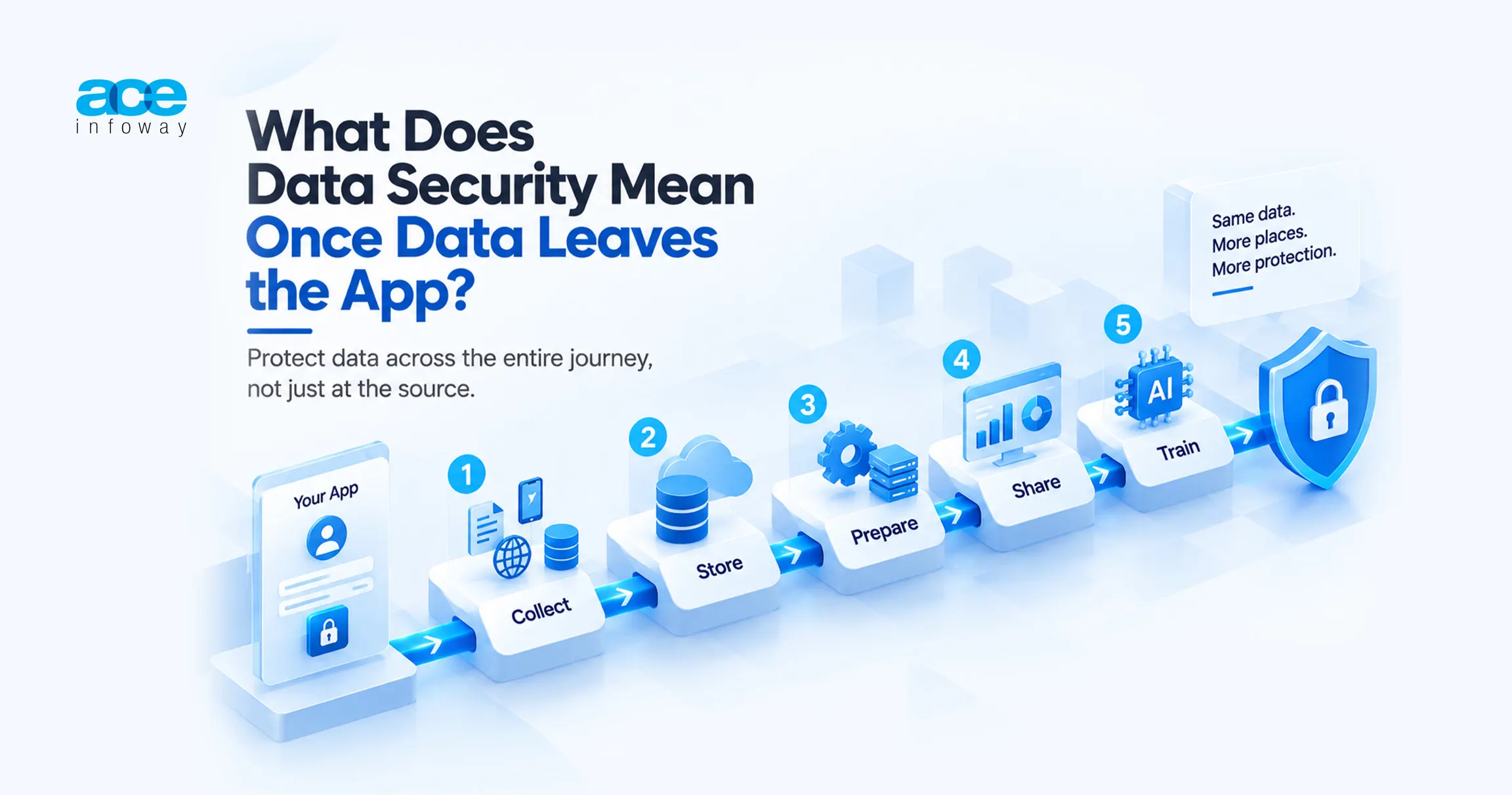
Data security for modern applications means protecting information along that entire journey, not only at the counter. Data teams call this journey a data pipeline: the route data takes from where it is collected to where it is used. The easiest way to picture it is five stops.
- Collect: data enters from apps, websites, forms, devices, and partner systems.
- Store: it lands in cloud storage or a central database.
- Prepare: teams clean it, combine it, and reshape it so it can be analyzed.
- Share: it feeds dashboards, reports, partner tools, and other apps.
- Train: it teaches AI models and powers AI assistants.
Every touchpoint across your system where data is verified creates a fresh copy, and every fresh copy starts with its own default settings, which are usually far looser than the app’s. That is why modern data engineering best practices focus on the whole journey, not just the destination.
Where Does a Modern Data Pipeline Leak?
Most leaks come from ordinary shortcuts, not clever hacking.
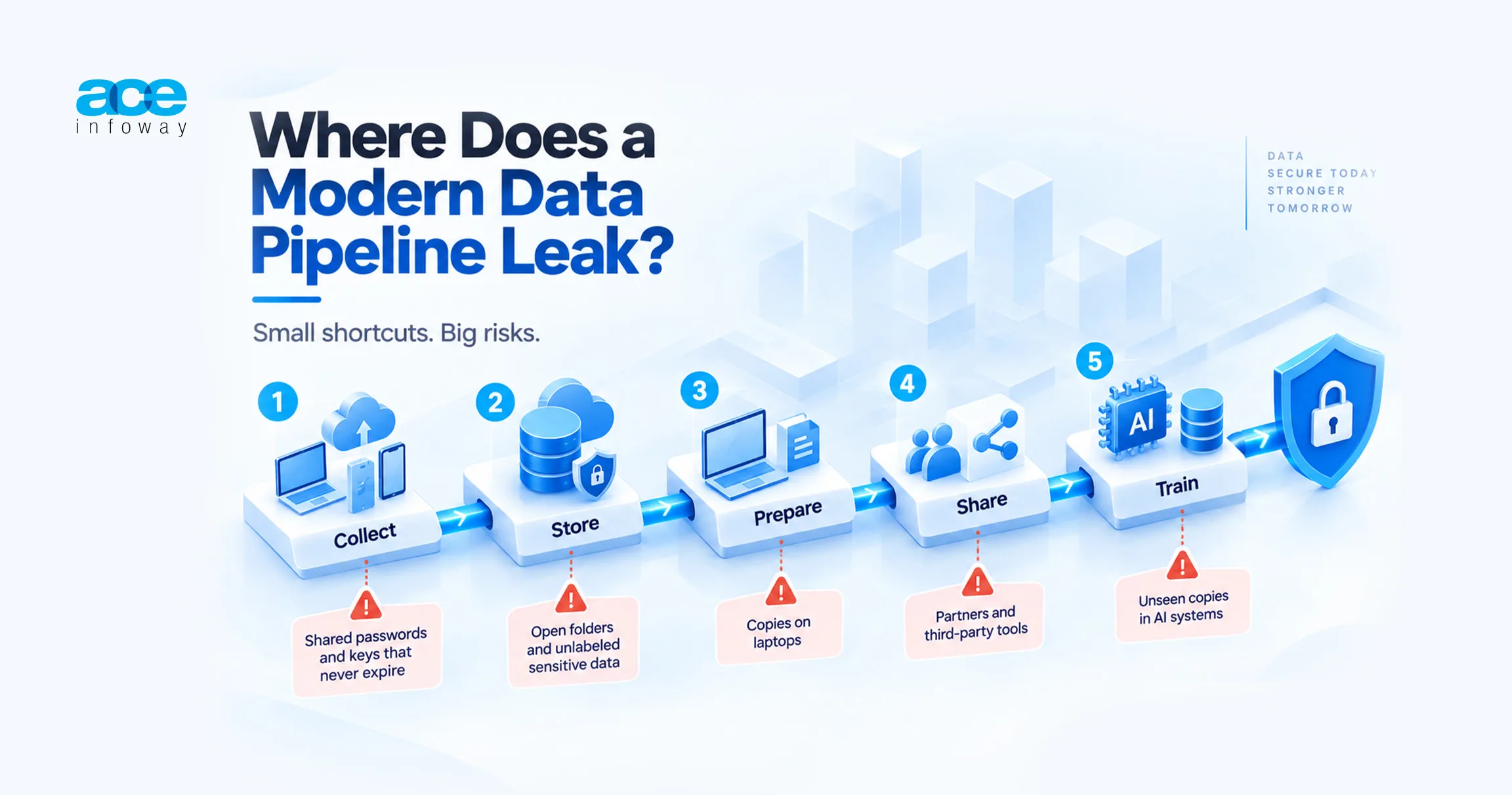
At the collect stop: shared passwords and keys that never expire
The systems that pull data use logins and digital access keys. When those keys never expire, or one password is shared across several tools, a single stolen login can open everything behind it. Keys that expire on their own are one of the simplest data engineering best practices to adopt.
At the store stop: open folders and unlabeled personal data
Cloud storage folders are often readable by far more people than need them. Worse, many companies don’t know which folders hold names, phone numbers, or payment details. That’s why labeling sensitive data is where most data engineering best practices begin.
At the prepare stop: copies on laptops
Analysts often download data to work faster. Every download is a copy outside your control, sometimes on a personal device. Sound data engineering best practices keep analysts working on protected copies instead.
At the share stop: partners and third-party tools
When data flows into marketing platforms, vendors or partner systems, it enters someone else’s environment. From that moment, your security is only as strong as theirs, so data engineering best practices include clear rules on what may leave the company.
At the train stop: a whole new set of copies
AI adds copies you may not even see: training datasets, the searchable “memory” an AI assistant uses and the prompts employees type in. According to a Gartner survey released in September 2025, 29% of cybersecurity leaders said their organizations had faced an attack on enterprise generative AI application infrastructure in the previous 12 months.
This is exactly why data engineering best practices now start at the first stop, not the last.
Why Has AI Changed the Risk for Everyone?
Before AI, a leak usually meant someone broke into a database. Now data can slip out through a chatbot’s answer or an employee pasting a customer list into a free AI tool.
Shadow AI, meaning AI tools employees use without approval, is the costliest version of this. Forbes reported in October 2025 that breaches in environments with heavy shadow AI use cost $670,000 more than normal on average.
At the same time, Accenture’s 2025 research shows that only 22% of organizations have clear policies and training for generative AI use. Approved AI tools and usage rules belong in your data engineering best practices, not just your HR handbook.
The data underneath AI is often not ready either. Gartner found in February 2025 that 63% of organizations either don’t have, or aren’t sure they have, the right data management practices for AI.
Gartner expects 60% of AI projects without AI-ready data to be abandoned through 2026. It also predicts that by 2027, more than 40% of AI-related data breaches will come from improper use of generative AI across borders.
So AI isn’t a separate problem. It’s the same data, copied into new places faster than the controls can follow. Applying data engineering best practices early is what keeps AI projects both safe and alive.
The Seven Data Security Risks Every Business Should Know
Each risk below is a gap that data engineering best practices are designed to close.
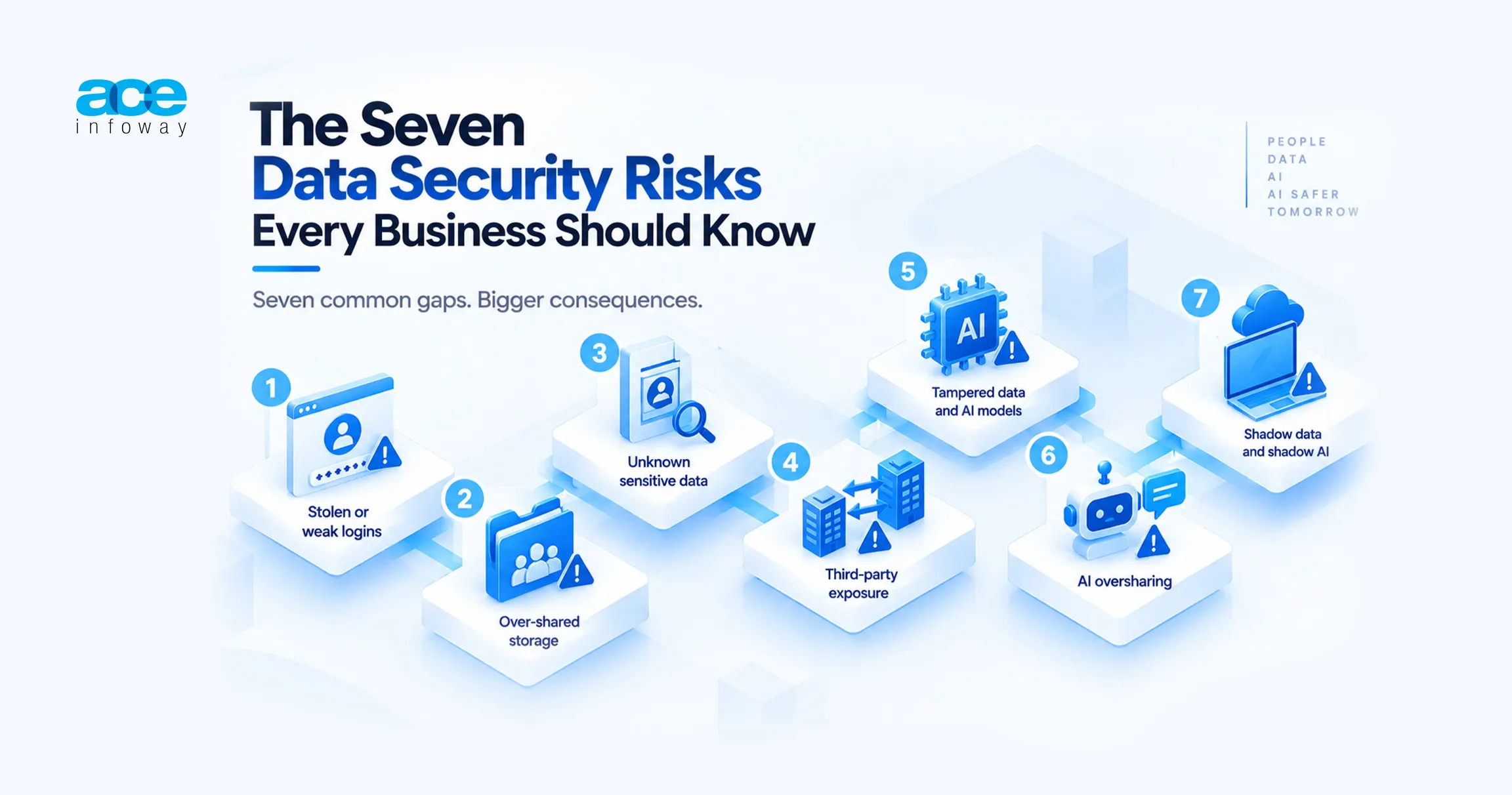
- Stolen or weak logins. One compromised password, with no second verification step, can expose an entire data store.
- Over-shared storage. Folders and databases are open to more people than actually need them.
- Unknown sensitive data. You can’t protect personal data you haven’t found and labeled.
- Third-party exposure. Data sent to vendors and partners inherits their weaknesses.
- Tampered data and AI models. Poisoned training data or a malicious model downloaded from a public website can change how your AI behaves or open a hidden backdoor.
- AI oversharing. An AI assistant can reveal confidential information in its answers if it can reach data the user shouldn’t see.
- Shadow data and shadow AI. Copies and tools that live outside approved systems, where nobody is watching.
Which Controls Actually Reduce Data Security Risk?
The table below matches each control to the risk it answers and the stage where it belongs.
Each row is one of the data engineering best practices turned into a concrete control your team can act on.
| Control | What it means in plain words | Risk it answers | Pipeline stop |
| Multi-factor sign-in and short-lived keys | A second proof of identity, plus access keys that expire on their own | Stolen or weak logins | Collect |
| Sensitive data discovery | Tools that scan and label where personal or confidential data lives | Unknown sensitive data | Store |
| Tokenization and masking | Swapping real values for stand-ins, so copies are safe by default | Over-shared storage, laptop copies | Collect, Prepare |
| Encryption | Scrambling data so it’s unreadable without a key | Theft of stored or moving data | Every stop |
| Role-based access | People see only the rows and columns their job needs | Over-shared storage, AI oversharing | Store, Share |
| Lineage and audit logs | A record of where data came from, where it went and who touched it | Third-party exposure, shadow data | Every stop |
| Verified data and model sources | Checking outside datasets and AI models before anyone uses them | Tampered data and models | Train |
| AI usage policy and approved tools | Clear rules, plus safe AI tools employees are allowed to use | Shadow AI | Train |
Most organizations still have gaps here. Accenture’s 2025 report found that only 25% fully use encryption and access controls to protect sensitive data, and just 28% build security into transformation projects from the start.
The companies that do get it right see results: Accenture’s most security-ready group is 69% less likely to face advanced attacks.
Spending alone won’t close the gap. Gartner forecasts worldwide information security spending of $213 billion in 2025, yet most pipelines stay exposed. What matters is where controls are placed, and that’s what data engineering best practices decide.
Data Engineering Best Practices for Secure Modern Applications
The controls above are the “what.” The following data engineering best practices are the “how”: the order a data team should follow so security is built in from day one instead of added later. Each one ends with a simple test you can use to check progress.
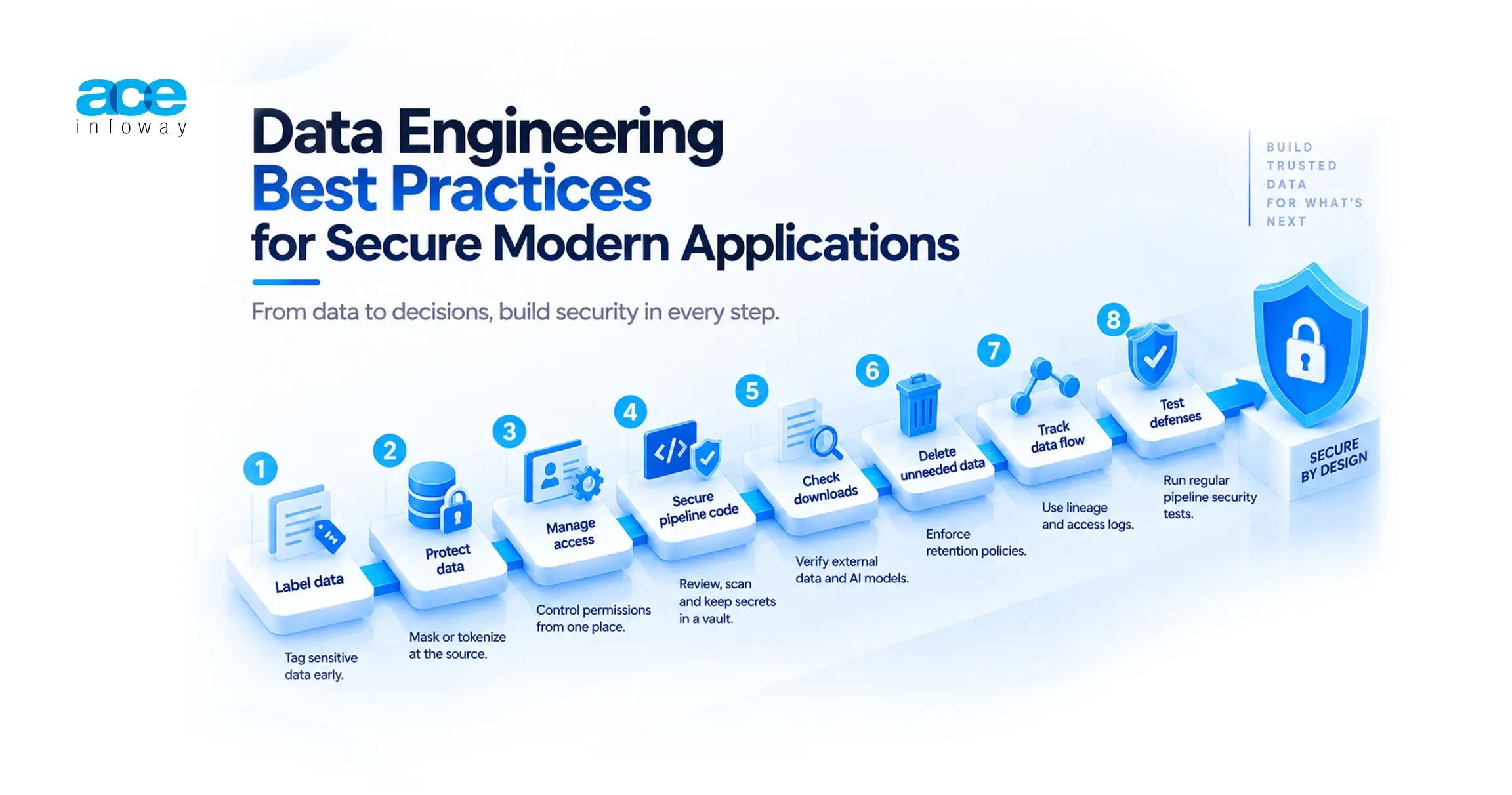
1. Label data before anyone uses it
Scan new data for personal and confidential details and tag it before it reaches analysts or AI. Every other item in these data engineering best practices depends on this one. You’ve done this when no new dataset becomes available without a sensitivity label.
2. Protect data the moment it arrives
Mask or tokenize personal details at the collection stage, so every later copy is safe from birth. You’ve done this when analysts can do their jobs without ever seeing a raw card or ID number.
3. Manage access from one place
Control permissions through one central catalog instead of separate settings in every tool. Of all data engineering best practices, this one saves the most admin time. You’ve done this when removing someone’s access takes one change, not ten.
4. Treat pipeline code like app code
Review every change, scan for passwords left in code, and keep secrets in a secure vault. You’ve done this when no password appears in any code file or system log.
5. Check everything you download
Verify outside datasets and AI models before they touch your systems. You’ve done this when every external model and dataset has a recorded source and a passed security check.
6. Delete what you no longer need
Data you don’t keep can’t leak, which makes this the cheapest of all data engineering best practices. You’ve done this when every dataset has a retention date that is enforced automatically.
7. Track where data goes
Lineage and access logs turn “what was exposed?” from a weeks-long investigation into a quick lookup. You’ve done this when you can answer “who accessed this customer’s data last month?” in minutes.
8. Test your defenses on a schedule
Run practice attacks on the pipeline, not just the website. Testing is how you prove your data engineering best practices actually work. You’ve done this when pipeline security tests run as often as app security tests.
None of these data engineering best practices require a big-bang project. Start with the first two, because they make every later step easier and cheaper.
Who Owns Data Security Inside Your Company?
Data security usually fails in the handoffs, not inside any one team. A clear split of ownership, backed by shared data engineering best practices, helps.
- Data engineering owns the collect, store, and prepare steps, plus access rules and lineage.
- Data science owns the quality and origin of training data.
- Machine learning operations (MLOps) owns AI models, their approval, and their monitoring once live.
- Security owns identity, threat monitoring and incident response.
Leaders already know the stakes. In a Deloitte survey released in October 2025, 67% of corporate and private equity leaders named data security as a leading concern in adopting generative AI. McKinsey’s State of AI Trust in 2026 research found that 72% of respondents see cybersecurity as a highly relevant AI risk, yet fewer are actively mitigating it. Shared data engineering best practices close that gap by giving every team the same rulebook.
How Mature is Your Data Security Today?
Most businesses sit at level one or two. Be honest about yours.
- Level 1, app only: security stops at the login screen. Data copies downstream are unprotected.
- Level 2, storage locked: data is encrypted and folders are restricted, but nobody knows where sensitive data lives.
- Level 3, governed: core data engineering best practices are in place. Data is labeled, access is managed centrally, and every copy can be traced.
- Level 4, AI-ready: data engineering best practices extend to AI. Training data and AI models are verified, AI tools are approved, and data leaving the company is controlled.
Three questions reveal your real level in five minutes. Can you list every place your customers’ personal data is stored? Can you remove one person’s access everywhere with a single change?
Do you know which AI tools your employees used last week? If any answer is no, adopting data engineering best practices at the collect and store stages is your next step.
Conclusion
Application security grew up, but data security, and the data engineering best practices behind it, didn’t keep pace. The data moved into pipelines, partner tools, and AI systems, and the controls stayed behind at the login screen.
The fix isn’t another firewall. It’s knowing where every copy of your data lives, protecting it the moment it arrives, and following data engineering best practices at every stop, including the AI ones. Businesses that do this ship AI features faster.
FAQs
1. What are the biggest data security risks in modern applications?
The biggest risks are stolen logins, over-shared storage, unlabeled personal data, third-party exposure, tampered AI data, and shadow AI. Most of them sit in the data pipeline behind the app, not in the app itself, which is why data engineering best practices matter as much as app security.
2. How do you secure a data pipeline?
Label sensitive data as it arrives, mask personal details early, manage access from one central place, encrypt data everywhere, and keep a log of where data travels. Following data engineering best practices in that order protects every copy the pipeline creates.
3. What are data engineering best practices for data security?
Data engineering best practices for data security include labeling sensitive data early, masking personal details at collection, managing access centrally, verifying outside data and AI models, deleting old data, and tracking where data travels.
4. How does AI change data security?
AI creates new copies of sensitive data in training sets, AI assistants, and employee prompts, often without the usual controls. Securing AI means verifying the data and models you use, approving AI tools, and applying data engineering best practices before data reaches any AI system.