








|
Getting your Trinity Audio player ready...
|
Table of Contents
Customers rarely experience a digital product through one isolated interaction.
They may discover a business through search, compare alternatives on mobile, visit a website, speak with sales, complete a purchase, and later contact support.
Each interaction creates a small part of the overall experience. However, teams often analyze these interactions separately across analytics, CRM, product, marketing, and support systems.
That separation makes it difficult to understand where the experience actually breaks down.
A customer journey map brings these interactions into one structured view. It connects customer goals, behaviors, expectations, questions, friction points, and business touchpoints across the journey.
The purpose is not to create another attractive diagram.
The real value comes from using journey insights to identify experience gaps, prioritize improvements, and make better product and eCommerce decisions.
Salesforce’s latest State of the Connected Customer research surveyed more than 16,000 consumers and business buyers worldwide. The research found that 73% of customers expect companies to understand their unique needs and expectations.
For digital teams, that expectation makes customer understanding an operational requirement rather than simply a UX exercise.
What Is Customer Journey Mapping?
Customer journey mapping is the process of visualizing how customers interact with a business across different stages, channels, and touchpoints.
A journey map combines behavioral information with customer context. It can show what customers are trying to accomplish, what influences their decisions, where they experience friction, and what happens after each interaction.
This makes journey mapping different from simply documenting website pages or application screens.
Customer Journey Map vs User Journey Mapping
User journey mapping generally focuses on a specific task or interaction within a digital product.
Customer journey mapping has a wider scope because it can cover discovery, evaluation, purchase, onboarding, product usage, support, retention, and interactions across multiple channels.
| Aspect | Customer Journey Mapping | User Journey Mapping |
| Scope | Entire customer relationship | Specific task or product flow |
| Channels | Multiple channels and touchpoints | Usually product-focused |
| Context | Customer goals and business relationship | User goals and task completion |
| Primary focus | Overall experience | Usability and interaction |
| Typical output | Experience opportunities | Product or UX improvements |
Understanding this distinction helps teams choose the right mapping approach instead of applying one framework to every digital problem.
Customer Journey Map Stages: What Should You Actually Capture?
There is no universal structure for customer journey map stages.
A SaaS product, B2B platform, marketplace, and online retailer can have completely different customer behaviors and decision processes.
The stages should therefore represent meaningful changes in customer intent.
Discovery and Evaluation
The journey can begin when customers recognize a problem, search for information, or encounter a potential solution.
Customers may compare providers, read reviews, examine product information, watch demonstrations, or speak with sales representatives.
The important question is what customers need to understand before they are comfortable progressing.
Conversion and First Value
Conversion represents an important decision, but it is not the end of the journey.
A new SaaS customer still needs to complete onboarding and experience meaningful product value.
An eCommerce customer still needs accurate order information, delivery communication, and a satisfactory post-purchase experience.
The map should therefore connect conversion with what happens immediately afterward.
Retention and Expansion
Later stages can involve repeat purchases, renewals, upgrades, support, cross-selling, referrals, or re-engagement.
These interactions provide valuable context for understanding whether the original experience created enough confidence for continued engagement.
A strong customer journey map therefore considers the relationship beyond the initial transaction.
How to Create a Customer Journey Map Step by Step
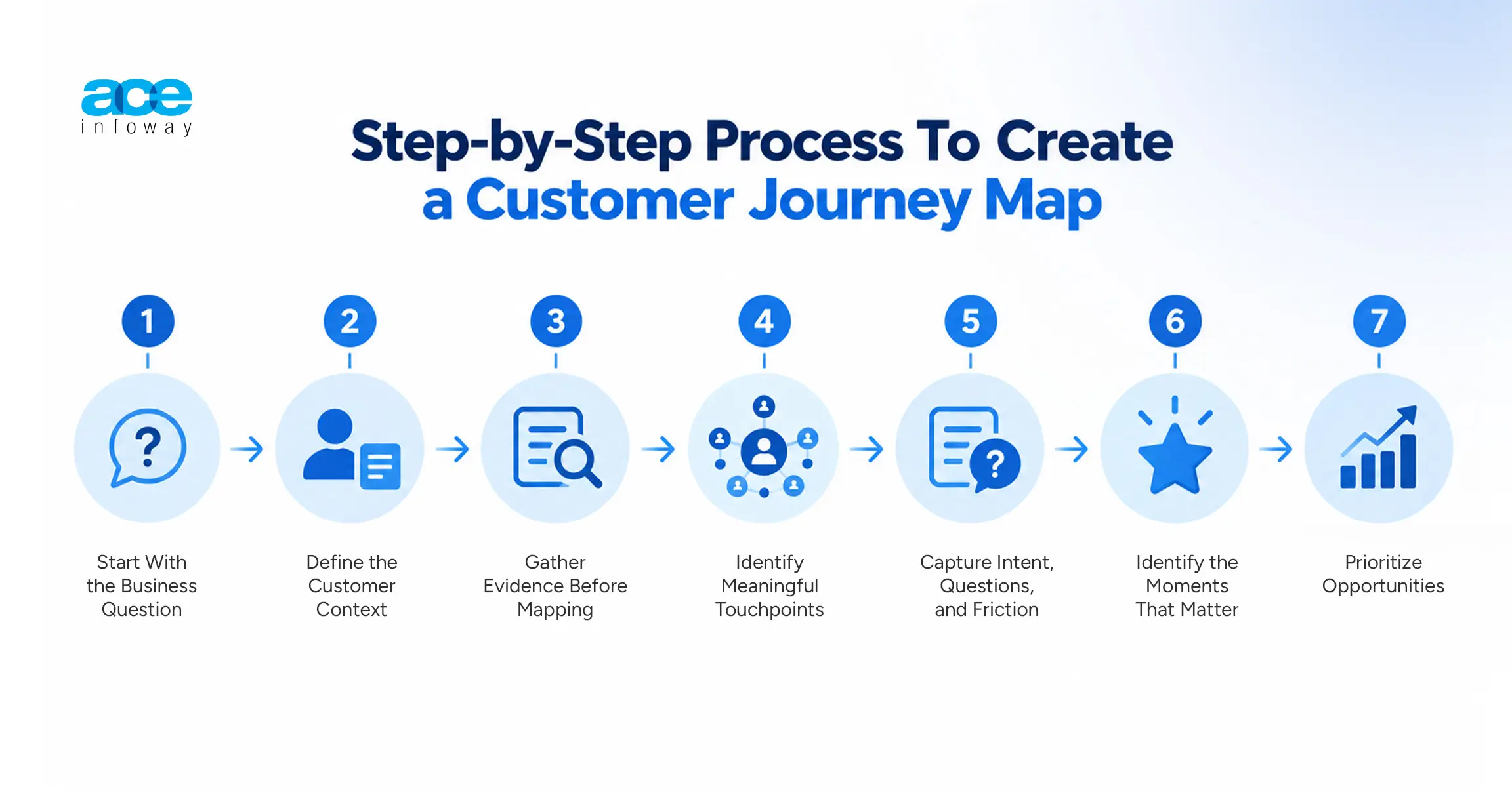
A practical customer journey mapping process should start with a business question rather than a blank diagram.
The objective is to understand a meaningful customer problem and connect the resulting insight with a decision the organization can act upon.
Start With the Business Question
Every mapping exercise should establish what the team wants to understand.
The question might involve declining conversions, onboarding friction, low product adoption, inconsistent experiences, or declining repeat purchases.
A focused objective keeps the map useful and prevents teams from documenting unnecessary interactions.
Define the Customer Context
The journey should be connected to a specific customer segment.
Different customers can have different motivations, expectations, decision processes, technical knowledge, and reasons for abandoning a journey.
A customer journey map persona should therefore represent a meaningful customer group supported by actual research.
A B2B buyer evaluating enterprise software will naturally follow a different journey from a first-time eCommerce shopper comparing products on a mobile device.
Gather Evidence Before Mapping
The strongest customer journey mapping steps combine qualitative and quantitative evidence.
Teams can examine analytics, customer interviews, surveys, support conversations, sales feedback, reviews, product data, and behavioral patterns.
The purpose is to distinguish what customers actually experience from what internal teams assume they experience.
What Evidence Should Teams Bring?
Before building the map, teams should bring evidence that explains both behavior and context:
- Behavioral data showing where customers progress, hesitate, return, or abandon.
- Customer feedback revealing questions, expectations, frustrations, and unmet needs.
- Operational information showing handoffs, delays, support issues, or process dependencies.
- Business data connecting experience problems with conversion, retention, adoption, or revenue.
Identify Meaningful Touchpoints
The next stage is identifying interactions that influence customer progression.
These can include search, product discovery, application usage, checkout, sales conversations, notifications, delivery, customer support, account management, or renewal.
Teams should identify touchpoints that meaningfully influence customer decisions or experience.
Capture Intent, Questions, and Friction
Each stage should explain what customers are trying to accomplish and what could prevent them from progressing.
This provides more useful context than simply labeling an interaction as positive or negative.
For example, repeated searches for product specifications may indicate that existing product content does not answer an important purchase question.
Identify the Moments That Matter
Not every touchpoint carries equal importance.
A pricing decision, product comparison, first successful task, checkout interaction, delivery update, or support experience can have disproportionate influence on the next stage.
These moments deserve deeper investigation because improvements can affect multiple downstream outcomes.
Prioritize Opportunities
A journey map can reveal more problems than a team can realistically address.
Teams should therefore evaluate opportunities based on customer impact, business importance, evidence, frequency, and implementation effort.
This transforms customer journey mapping from a visualization activity into a practical prioritization framework.
Customer Journey Map Example: From Touchpoints to Decisions
A customer journey map example becomes valuable when it demonstrates how observations lead to decisions.
Consider a B2B software company selling a workflow platform.
| Journey Stage | Customer Experience | Observed Friction | Potential Business Response |
| Discovery | Customer researches solutions | Differentiation is unclear | Refine positioning and content |
| Evaluation | Customer compares providers | Integration information is limited | Improve technical documentation |
| Trial | Customer starts using the product | Configuration requires effort | Simplify onboarding |
| Adoption | Customer uses core workflows | Advanced features remain unused | Improve contextual guidance |
| Support | Customer needs assistance | Resolution requires multiple interactions | Improve self-service |
| Renewal | Customer evaluates value | Business outcomes are difficult to demonstrate | Improve reporting and value communication |
This b2b customer journey map shows why teams should not automatically treat conversion as the only important outcome.
A renewal problem may originate much earlier through weak onboarding, limited education, or unclear product value.
How to Build an eCommerce Customer Journey Map
An eCommerce customer journey often crosses more channels and decision points than a traditional purchase funnel suggests.
Customers can discover products through search engines, marketplaces, social platforms, advertising, recommendations, comparison content, email, or direct traffic.
Connect Discovery With Product Evaluation
The journey should examine what happens between discovering a product and deciding whether it is worth purchasing.
Navigation, search, filtering, recommendations, product information, reviews, pricing, availability, and comparison capabilities can all influence this transition.
A useful eCommerce customer journey map examines the information customers need before they are ready to purchase.
Examine the Purchase Experience
Checkout should be viewed as a sequence of decisions rather than a single conversion event.
Customers may evaluate shipping information, delivery estimates, payment options, account requirements, discount codes, unexpected costs, and error messages.
Mapping these interactions helps teams investigate why customers hesitate instead of treating every abandoned checkout as the same problem.
Extend the Journey Beyond Purchase
The post-purchase experience can influence whether customers trust a business enough to return.
Order tracking, delivery communication, returns, support, product education, and follow-up communication therefore belong within the broader journey.
Adobe’s 2025 research analyzed more than one trillion visits to U.S. retail websites, illustrating the scale and complexity of modern digital retail behavior.
For eCommerce teams, this reinforces the need to understand customer behavior across the broader shopping experience rather than focusing only on checkout.
Touchpoints Worth Examining
Depending on the business model, an eCommerce customer journey map may connect:
- Search, social, advertising, marketplace, and referral discovery
- Category navigation, filtering, recommendations, product pages, and comparison
- Cart, checkout, payment, shipping selection, and order confirmation
- Delivery, returns, customer support, review requests, and repeat-purchase experiences
The specific touchpoints should depend on the journey being investigated.
Customer Journey Map Template: What Should It Include?
A practical customer journey map template should make it easy to connect customer experience with evidence and action.
| Element | What to Capture |
| Persona | Customer context and characteristics |
| Stage | Meaningful phase of the journey |
| Goal | What the customer wants to accomplish |
| Touchpoint | Interaction with the business |
| Action | What the customer actually does |
| Question | Information the customer needs |
| Pain Point | Source of friction |
| Emotion | Customer sentiment or confidence |
| Evidence | Research and behavioral data |
| Opportunity | Potential improvement |
| Owner | Team responsible for action |
| KPI | Measure used to evaluate change |
A free customer journey map template can be useful for an initial workshop or smaller team.
However, complex organizations may need a customized framework reflecting their customer segments, business model, technology environment, and measurement structure.
The best template is therefore not necessarily the most detailed one.
It is the one that helps teams move consistently from customer evidence to practical decisions.
Customer Journey Mapping Best Practices
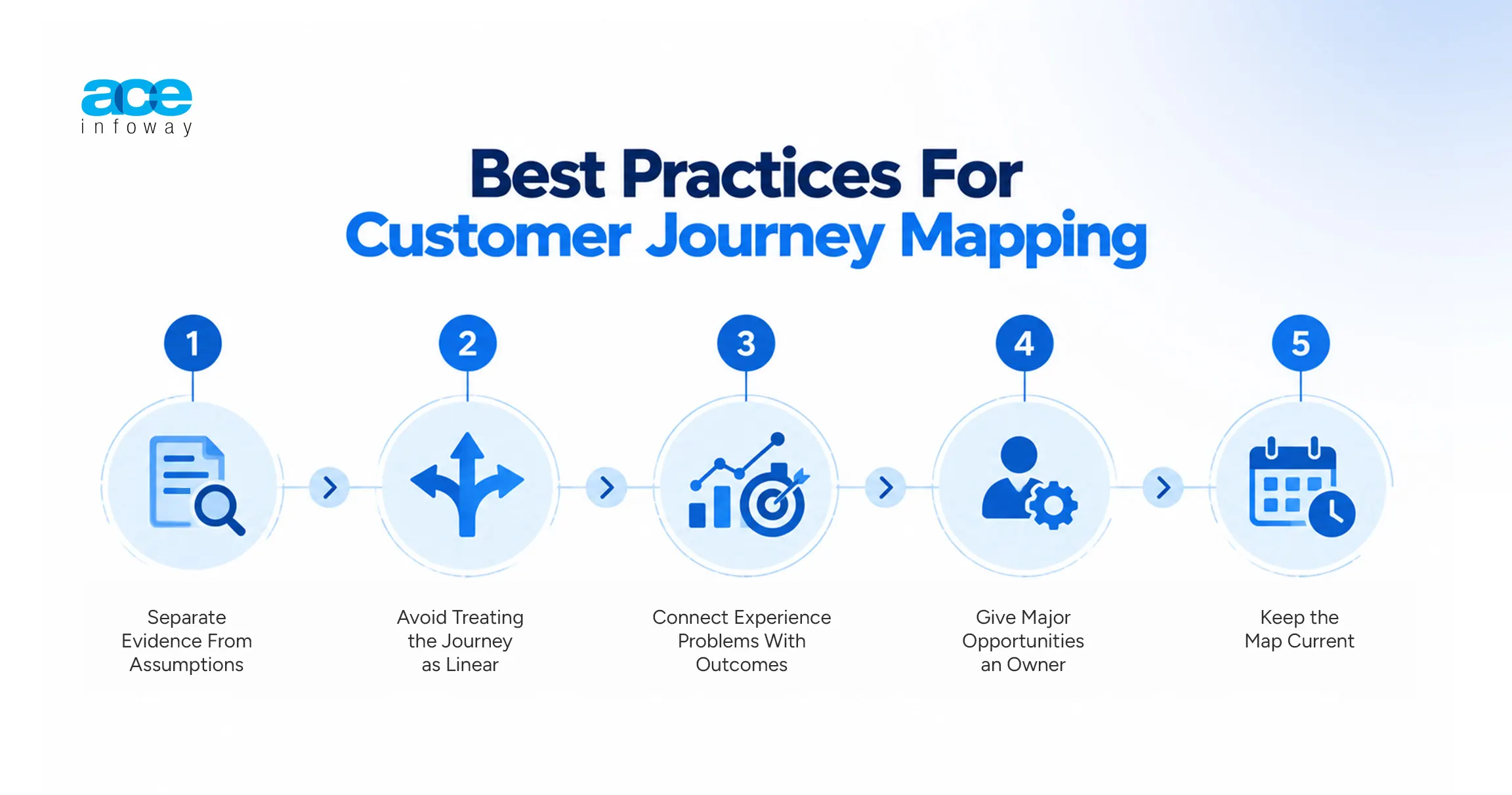
The quality of a journey map depends more on the evidence and reasoning behind it than its visual presentation.
Separate Evidence From Assumptions
Customer interviews, analytics, support data, and stakeholder opinions should not automatically be treated as equivalent evidence.
Separating observation from interpretation helps teams understand what they know and what still requires validation.
Avoid Treating the Journey as Linear
Customers can revisit previous stages, switch devices, compare alternatives, pause decisions, and interact with multiple channels.
A realistic journey should accommodate these behaviors when they materially affect the experience.
Connect Experience Problems With Outcomes
A pain point becomes more useful when teams understand its potential business impact.
For example, onboarding friction may affect activation, while unclear product information may affect conversion.
This connection helps teams prioritize improvements without treating every experience issue as equally important.
Give Major Opportunities an Owner
Journey mapping can produce valuable observations without creating implementation.
Assigning ownership to important opportunities creates a bridge between customer research and product, commerce, marketing, or operational work.
Keep the Map Current
Customer journeys change as products, pricing, channels, technology, and expectations evolve.
Teams should therefore revisit their maps when meaningful changes alter how customers interact with the business.
These customer journey mapping best practices help prevent the map from becoming a static research artifact.
How Ace Infoway Can Help With Customer Journey Mapping
Customer journey mapping becomes more valuable when customer insights can be connected to the digital products, commerce systems, data platforms, and experiences behind them.
Ace Infoway combines digital product engineering, UX capabilities, data expertise, eCommerce experience, integration, and technology consulting to help businesses act on those insights.
Digital Experience Consulting
Our team helps businesses examine important customer interactions, identify experience gaps, and establish practical priorities aligned with product and business objectives.
Customer Journey Analysis
Our teams can combine behavioral information, customer feedback, analytics, and business requirements to create a more evidence-driven understanding of customer experiences.
Digital Product Engineering
Journey insights can be translated into improvements across onboarding, workflows, navigation, account experiences, personalization, and other product interactions.
eCommerce Experience Optimization
For commerce businesses, we can examine the broader eCommerce customer journey across discovery, evaluation, purchase, fulfillment, post-purchase engagement, and repeat interactions.
Data and Analytics Integration
We help connect customer-facing systems with analytics platforms, CRM environments, product data, APIs, and other enterprise systems to provide stronger behavioral context.
Product Integration and Modernization
Once journey gaps are identified, engineering teams can implement new workflows, APIs, integrations, personalization capabilities, dashboards, and digital experiences.
Continuous Digital Optimization
Customer journey insights should continue influencing digital decisions after implementation.
Ace Infoway supports this ongoing evolution through product engineering, analytics, modernization, experimentation, AI capabilities, and digital transformation initiatives.
Conclusion
Customer journey mapping is not valuable because it produces a polished visual representation of the customer experience.
Its real value comes from making hidden experience gaps visible enough to influence product, eCommerce, technology, and operational decisions.
When journey insights are connected with behavioral data and digital engineering capabilities, organizations can move beyond describing customer problems toward systematically improving the experiences behind them.
Ace Infoway helps businesses connect these insights with digital products, eCommerce platforms, data systems, integrations, and modern technology capabilities.
Contact us to turn customer journey insights into connected digital experiences and measurable business outcomes.
FAQs
What is customer journey mapping?
Customer journey mapping is the process of visualizing how customers interact with a business across different stages, channels, and touchpoints. A customer journey map connects customer goals, actions, expectations, friction, and business interactions to identify opportunities for improving the overall experience.
What should a customer journey map include?
A customer journey map can include the customer persona, journey stages, goals, actions, touchpoints, questions, pain points, emotions, supporting evidence, opportunities, ownership, and KPIs. The structure should be adapted to the specific customer segment and business question.
How do you create an eCommerce customer journey map?
An eCommerce customer journey map should examine discovery, product evaluation, comparison, purchase, checkout, fulfillment, post-purchase interactions, and repeat engagement. Combining customer research with behavioral data helps teams identify friction and connect experience improvements with measurable commercial outcomes.
What is the difference between a customer journey map and a user journey?
A customer journey map generally covers the broader relationship between a customer and a business across channels and stages. User journey mapping typically focuses on how a person completes a particular task or interaction within a website, application, or digital product.
When should businesses use customer journey mapping software?
Businesses can consider customer journey mapping software when journeys become complex, multiple teams need to collaborate, customer data needs to be connected, or maps require frequent updates. Smaller teams can often begin with a customer journey map template before adopting specialized software.