









|
Getting your Trinity Audio player ready...
|
Table of Contents
The financial stakes of unplanned downtime are increasing in 2026. The cost of equipment failure has reached such a level that the top 500 companies worldwide lose an estimated $1.4 trillion annually. This is why businesses no longer rely on reactive maintenance.
Preventive maintenance involves servicing equipment on schedule, either based on time or usage, with an aim of preventing problems from arising rather than repairing them once they arise.
The following article presents a closer look at what preventive maintenance entails in terms of the figures, three different ways of carrying out preventive maintenance, and the way forward for an actual preventive maintenance program.
What is Preventive Maintenance?
Preventive Maintenance (PM) is a proactive equipment care strategy for businesses, identifying issues early and preventing failures. Different from scheduled tasks and reactive maintenance. No longer waiting for failure to occur, but taking charge of the entire scenario.
The Difference Between Scheduled Care and Guesswork
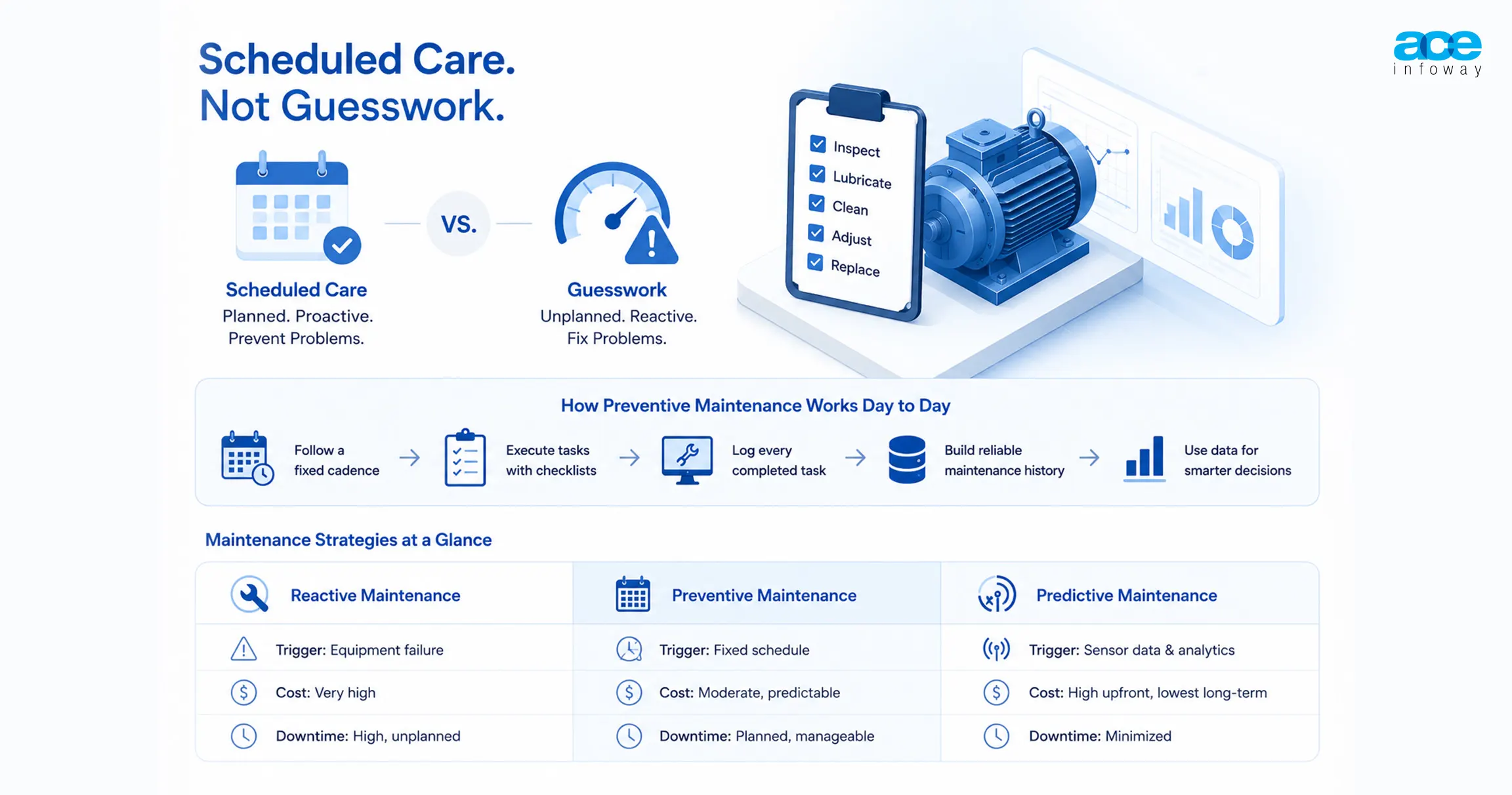
Preventive maintenance is a process carried out according to a schedule, not when there is a problem. Maintenance activities carried out on a regular basis such as weekly, monthly, or every 500, 1,000 or 5,000 operational hours, all with their own checklist.
How Does Preventive Maintenance Work Day to Day?
The facilities team doesn’t sit around waiting for an alarm. Works off fixed cadence tied to manufacturer’s specs and asset’s actual duty cycle, then logs every finished task into system that builds real maintenance history over time.
That history is evidence-based for every budget conversation that comes after. Skip logging step, and the whole program turns into a checklist nobody trusts anymore.
Preventive Maintenance vs. Reactive Maintenance vs. Predictive Maintenance
Here is a clear comparison of the three primary maintenance strategies to help differentiate their triggers, costs, and technology requirements.
| Reactive vs Preventive vs Predictive Maintenance Comparison | |||
| Feature | Reactive Maintenance | Preventive Maintenance | Predictive Maintenance |
| Primary Trigger | Equipment failure (run-to-failure) | Scheduled intervals based on time or usage | Real-time asset condition and sensor data |
| Cost Profile | Minimal upfront cost but highest emergency repair expenses | Predictable maintenance costs with reduced repair expenses | Higher initial investment with the lowest long-term maintenance costs |
| Downtime Impact | High and unplanned, often disrupting operations | Planned downtime during scheduled maintenance | Minimal downtime by detecting issues before failure |
| Technology Required | Basic maintenance records or work orders | CMMS and maintenance scheduling software | IoT sensors, AI analytics, condition monitoring, and CMMS integration |
| Ideal Use Case | Non-critical, low-cost assets where failure has minimal impact | Assets with predictable wear patterns and routine service needs | Critical, high-value assets where unexpected failures are costly |
Benefits of Preventive Maintenance: What the Numbers Actually Show
Ask a plant manager why they haven’t formalized a maintenance program, and the honest answer is rarely “I don’t believe in it.” It’s “I can’t prove ROI to whoever signs the check.”
Lower Repair and Downtime Costs
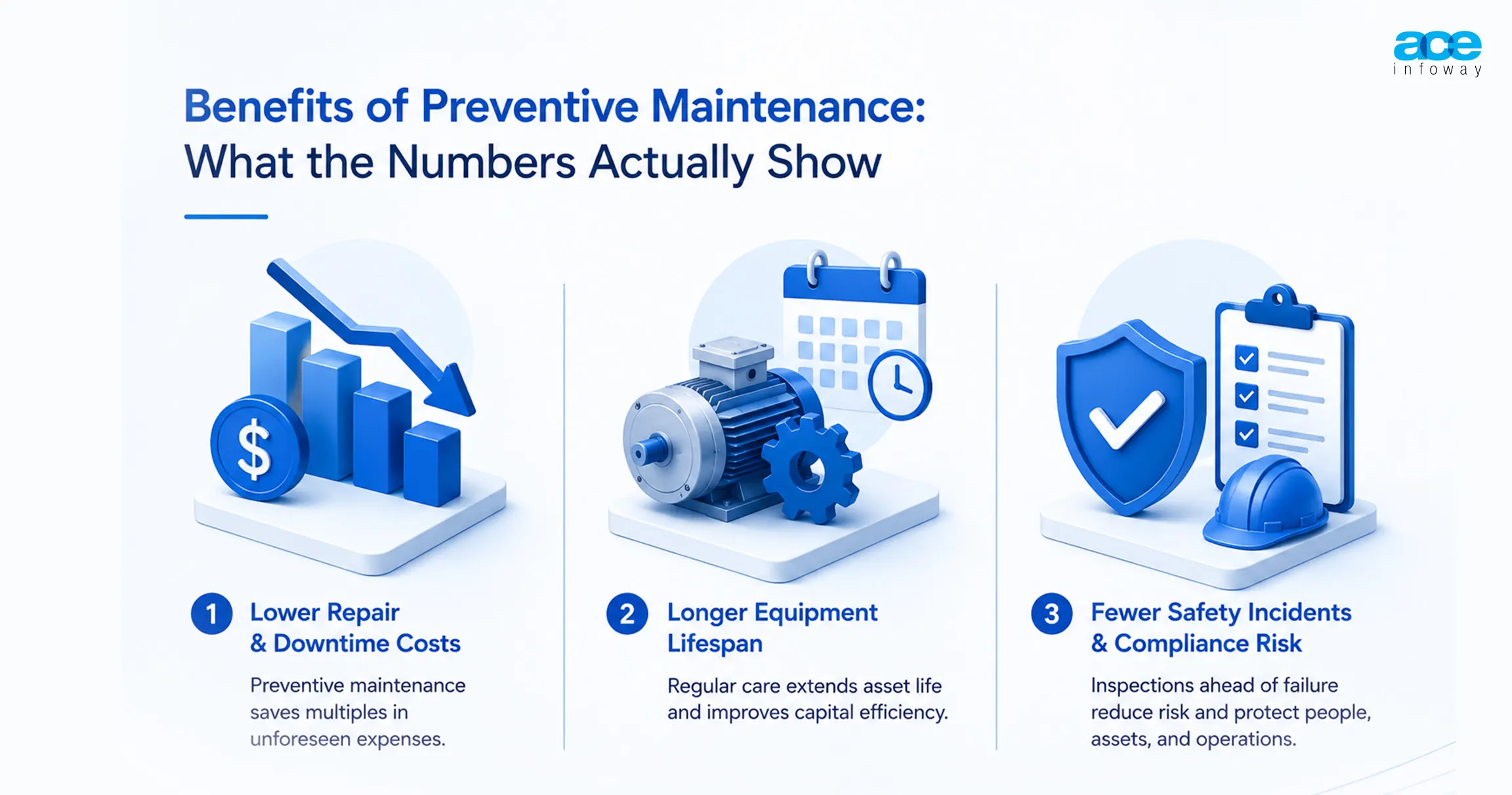
Preventive maintenance programs lower overall maintenance costs and reduce downtime versus reactive approaches. Every dollar spent on preventive or predictive maintenance saves multiples in unforeseen expenses. That ratio alone makes the maintenance budget line start looking like a revenue line.
Longer Equipment Lifespan
Regular preventive maintenance extends equipment life significantly. A machine that lasts twice as long doesn’t just defer capital expense. It rewrites the depreciation schedule your finance team is planning against.
Fewer Safety Incidents and Compliance Risk
Equipment failure caused nearly half of the roughly $50 billion in annual downtime losses Deloitte attributes to industrial manufacturers. A worn belt or unlubricated joint isn’t only a productivity problem.
It’s a safety incident sitting on the timeline; nobody’s watching. Preventive maintenance puts inspection ahead of failure instead of behind it, which is the whole point.
Types of Preventive Maintenance and Preventative Maintenance Systems
Three recognized types exist. Modern preventative maintenance systems, CMMS and EAM platforms running facilities today run all three from one interface.
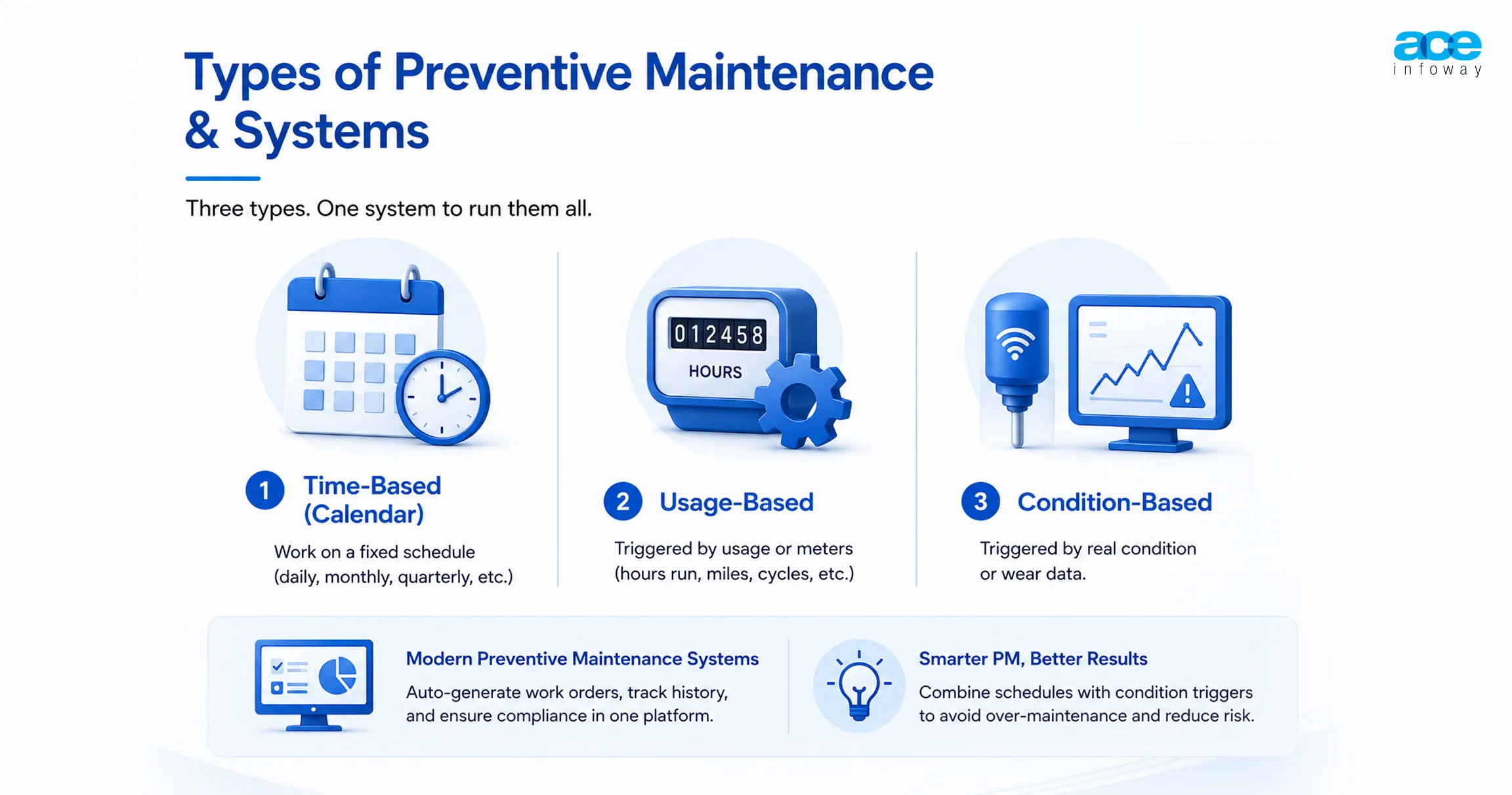
Time-Based (Calendar) Maintenance
Fixed-schedule maintenance runs daily, monthly, quarterly, or annually, regardless of how hard asset actually worked that period. Replacing the HVAC filter every 3 months is standard.
Usage-Based Maintenance
Triggers off meter or usage data instead of date on calendar. Rotating vehicle tires every set number of miles is a classic case; the same logic applies to any asset with a usage counter attached: hours run, cycles completed, units produced.
Condition-Based Maintenance
Triggered by measured wear or degradation data. This is where preventive maintenance starts bleeding into predictive territory. Modern preventive maintenance systems auto-generate work orders on schedule and log full asset histories for compliance, removing manual tracking that used to cause PM programs to collapse under their own paperwork.
Part vendors tend to skip: purely calendar-based PM risks over-maintaining assets, because most failures just don’t follow neat schedules. Better systems blend fixed calendars with condition-based triggers.
A program built entirely on time intervals is guessing. Just has better paperwork than the alternative.
Asset Management Preventive Maintenance: Where PM Fits Inside a Bigger Strategy
Preventive maintenance without an asset management context is a task-list-wearing strategy’s clothes. Effective asset management preventive maintenance programs align with international standards, set clear KPIs, classify assets by criticality, and digitize tracking before ever layering in preventive and predictive maintenance.
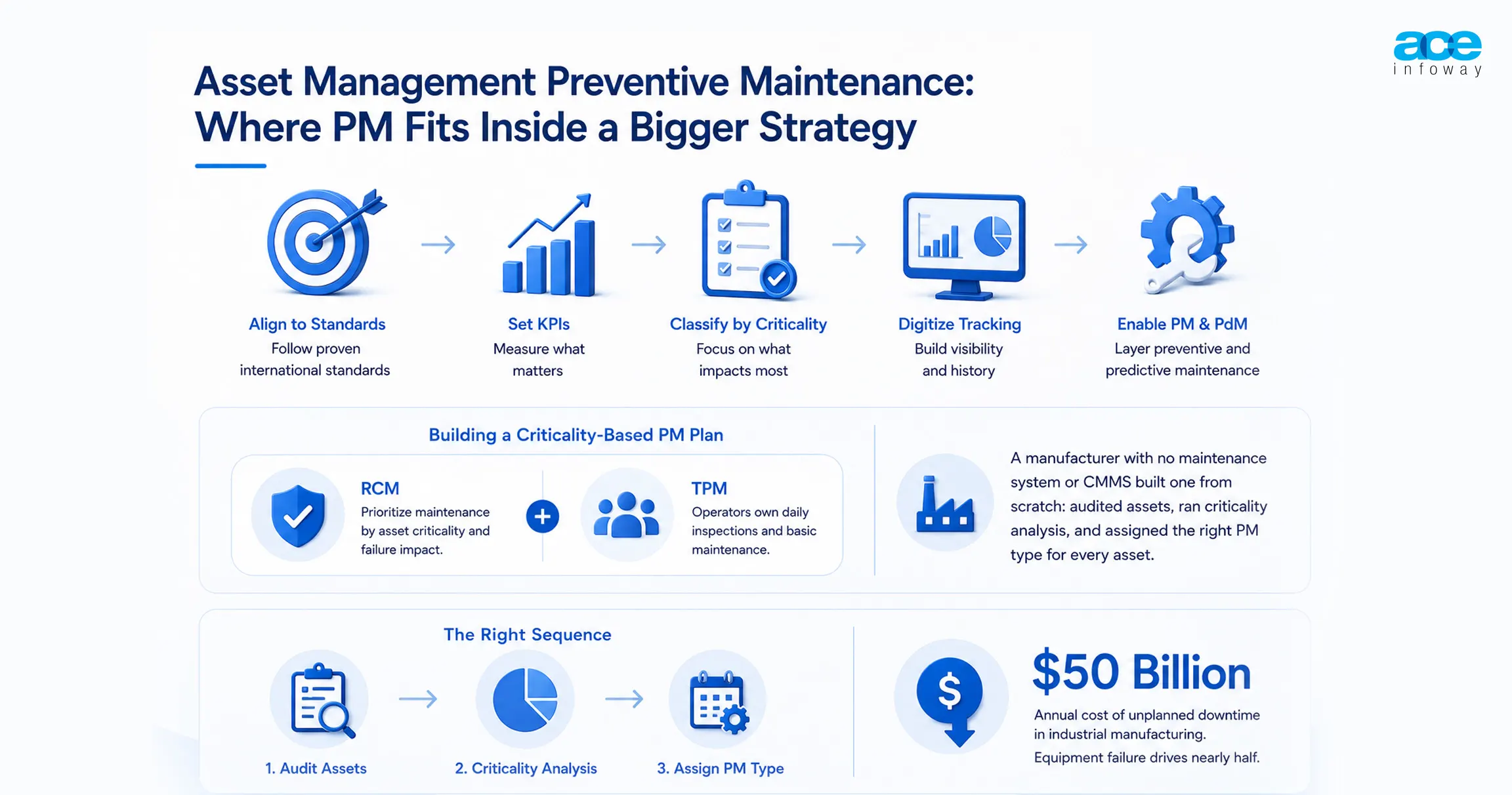
Building a Criticality-Based Asset Management Preventive Maintenance Plan
Two frameworks dominate here. Reliability-Centered Maintenance (RCM) prioritizes maintenance by asset criticality and failure impact. Total Productive Maintenance (TPM) shares maintenance responsibility with operators who run their own daily inspections.
One large oil and gas equipment manufacturer had no systematic maintenance program and no CMMS at all. Built one from nothing: auditing every asset, running criticality analysis, then assigning the correct PM type per asset.
Audit first. Criticality analysis second. PM type assignment third. That sequence is the actual difference between the maintenance program and the maintenance wish list.
Unplanned downtime costs industrial manufacturers roughly $50 billion annually, with equipment failure behind nearly half of it. Asset management preventive maintenance is a mechanism that turns that number from industry statistic into line item you can actually shrink.
Preventive Maintenance Strategies and Best Practices
Transitioning a preventive maintenance (PM) program from a rough idea into a high-performing, operational system requires a structured roadmap. Here is how to build a scalable program that actually works on the floor:
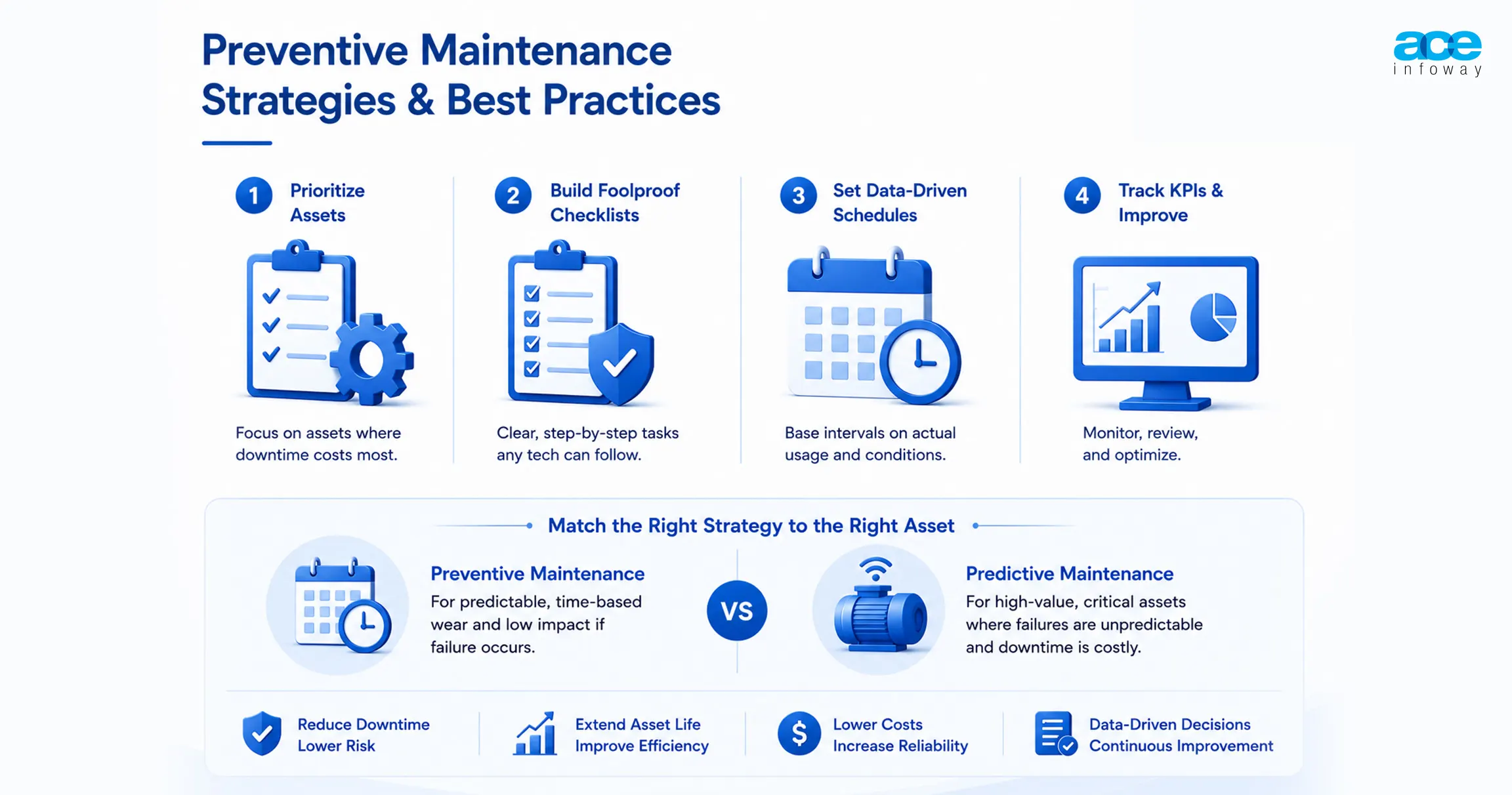
1. Prioritize Assets by Criticality
Do not treat every machine equally. Rank your equipment based on the true cost of downtime and active warranty terms, rather than just the initial purchase price. Your most critical, revenue-generating assets should always command the top priority for your budget and engineering hours.
2. Build Foolproof PM Checklists
A maintenance checklist should be so comprehensive and clear that a newly hired technician can execute it flawlessly without supervision.
First, centralize all vital equipment data: make, model, serial numbers, OEM manuals, and historical work orders. Then, build standardized, step-by-step instructions that cover the five core maintenance
pillars:
- Inspection
- Lubrication
- Cleaning
- Adjustment
- Replacement
3. Establish Realistic, Data-Driven Schedules
Ditch generic industry templates copied from the internet. Your maintenance intervals must be dictated by the equipment’s actual operational duty cycle and real-world working conditions. A machine running 24/7 in a high-dust environment demands a vastly different schedule than the exact same model operating eight hours a day in a climate-controlled room.
4. Track KPIs and Continuously Optimize
A static maintenance plan is a failing maintenance plan. Monitor your core Key Performance Indicators (KPIs) and formally review performance on a quarterly or annual basis.
- Outsource routine, non-specialized PM tasks to free up internal technical bandwidth.
- Protect your training department; continuous upskilling is vital as machinery becomes more digitized.
- Revise the overarching plan annually to eliminate redundant tasks and adjust schedules for aging assets.
The Strategic Balance: Matching Strategy to the Asset
Mature, high-efficiency organizations rarely rely on just one methodology. Instead, they assign maintenance strategies based on risk and failure profiles:
- Deploy Preventive Maintenance for assets with predictable, time-based wear patterns and a low financial impact if a failure occurs.
- Deploy Predictive Maintenance (using IoT sensors and real-time analytics) for high-value, mission-critical equipment where failures are unpredictable and the cost of unplanned downtime is catastrophic.
Best Maintenance Management Software (CMMS): What to Evaluate Before You Buy
Vendor sprawl is a real obstacle, not a shortage of options. CMMS platforms range from free single-technician apps to expensive enterprise systems. “Just pick a CMMS” is useless advice at that range.
What to Look for in Preventative Maintenance Systems?
Five capabilities separate a system that survives contact with a real facility from one that gets abandoned within a year: mobile-first work order execution, AI-assisted PM scheduling and fault-pattern detection, automated work-order generation on schedule, full asset history and compliance documentation, and genuine offline mobile execution.
Skip that last one, and the platform will fail exactly when technician needs it most, mid-shift, in the basement, no signal.
Off-the-Shelf CMMS vs. a Custom-Built Maintenance Platform
Choosing between an off-the-shelf CMMS and a custom-built maintenance platform comes down to trading the immediate, cost-effective deployment of a standardized product for the limitless flexibility and tailored workflows of a proprietary system.
| Off-the-Shelf CMMS vs Custom-Built Maintenance Platform | ||
| Feature | Off-the-Shelf CMMS | Custom-Built Maintenance Platform |
| Upfront Cost | Lower initial investment with predictable subscription-based (SaaS) pricing. | Higher upfront investment for custom development, testing, and deployment. |
| Implementation Time | Typically deployed within days or weeks. | Requires months or longer for design, development, and rollout. |
| Customization | Limited to vendor-supported features, workflows, and configurations. | Fully tailored to your organization’s workflows, processes, and business requirements. |
| Maintenance & IT Support | Vendor manages updates, security patches, bug fixes, and technical support. | Requires an internal IT team or external development partner for ongoing maintenance and support. |
| System Integrations | Pre-built integrations for common business systems but limited flexibility for legacy platforms. | Custom APIs enable seamless integration with proprietary equipment, legacy software, and enterprise systems. |
| Scalability | Easy to add users and locations, but constrained by the vendor’s roadmap and platform capabilities. | Can scale to support evolving business needs, though infrastructure management remains your responsibility. |
| Competitive Advantage | Provides standardized capabilities that many competitors also use. | Creates a proprietary platform that can deliver unique operational efficiencies and long-term competitive differentiation. |
Not sure whether your asset mix justifies a custom build or a standard CMMS subscription? Book a Consultation
Building Your Preventive Maintenance Program
Promise here isn’t complicated: fewer breakdowns, lower cost, longer asset life. What’s harder to sit with is how much of that gap is probably already sitting in a spreadsheet nobody’s opened since last year.
Teams ready to move off spreadsheets and legacy tools don’t need another generic CMMS pitch. They need a partner who’s actually built these systems before. That’s the conversation to have with Ace Infoway’s product engineering team before the next budget cycle locks in another year of reactive spend.
Frequently Asked Questions
What is an example of preventive maintenance?
Changing an HVAC filter every three months is a time-based example of preventive maintenance. Rotating vehicle tires after a set number of miles is a usage-based example. Both follow scheduled intervals rather than waiting for equipment to fail.
What are the types of preventive maintenance?
The three primary types of preventive maintenance are time-based maintenance (performed on a calendar schedule), usage-based maintenance (triggered by operating hours or production cycles), and condition-based maintenance (triggered by equipment condition). Modern CMMS platforms can manage all three approaches from a single system.
What is the difference between preventive and predictive maintenance?
Preventive maintenance follows a fixed schedule based on time or equipment usage. Predictive maintenance relies on real-time sensor data, condition monitoring, and analytics to identify issues before failures occur. While predictive maintenance reduces unnecessary maintenance, it requires a higher upfront investment in IoT and analytics technologies.
How do you create a preventive maintenance schedule?
Start by identifying and prioritizing critical assets, then gather equipment information and create detailed maintenance task checklists. Next, define maintenance intervals based on operating hours, environmental conditions, and manufacturer recommendations. Prioritizing critical equipment first is essential, as skipping this step is one of the most common reasons preventive maintenance programs fail.
Is preventive maintenance worth the cost?
Yes. Preventive maintenance consistently reduces unexpected breakdowns, lowers repair costs, extends equipment lifespan, and improves operational reliability. For most organizations, the long-term savings and reduced downtime significantly outweigh the cost of implementing a preventive maintenance program.