









|
Getting your Trinity Audio player ready...
|
Table of Contents
React holds 44.7% of global developer usage. Yet, year after year, Svelte tops developer satisfaction surveys. Something doesn’t add up. The reason is simple. Popularity and the right fit for your project are two different things.
React dominates because it got there first and never gave teams a compelling reason to leave. Svelte keeps winning satisfaction surveys because developers who use it actually enjoy it. This Svelte vs React comparison breaks down Svelte vs React across performance, developer experience, ecosystem depth, and real-world use cases.
Not to declare a winner, but to give you a decision framework when choosing between Svelte vs React that actually holds up under your project’s constraints.
The Fundamental Difference: Compiler vs Runtime
Every practical difference between Svelte vs React stems from a single architectural decision.
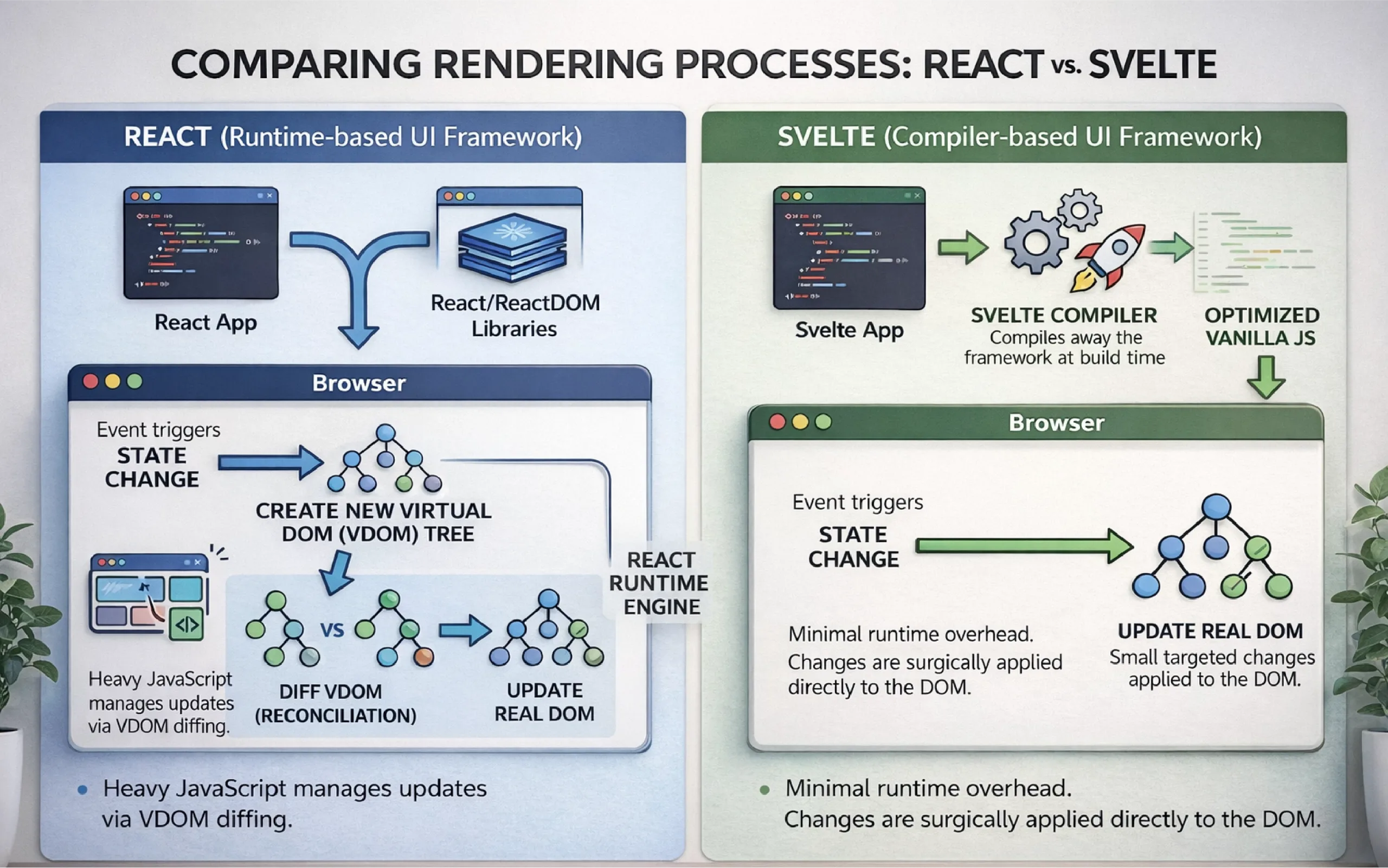
React ships a virtual DOM runtime to the browser. Every React app includes the React and ReactDOM libraries, totaling roughly 44KB gzip, before your application code even starts.
When the state changes, React diffs the virtual DOM, identifies what changed, and updates the real DOM accordingly. That process is efficient. But it runs in the browser on every update, on every user’s device.
Svelte takes the opposite approach. It’s a compiler. When you build a Svelte app, it transforms your components into optimized, framework-free vanilla JavaScript. The browser runs plain JS that directly updates the DOM when state changes; the core Svelte runtime clocks in at around 1.6KB.
That architectural gap is what drives every other trade-off in this Svelte vs React comparison. Neither approach is universally better. But understanding the difference helps you stop arguing about syntax and start evaluating what actually matters for your specific project.
Svelte vs React Performance and Bundle Size

For most web projects, both frameworks are fast enough. That caveat matters. But on the metrics that directly affect user experience, Svelte has a genuine, measurable edge.
Svelte apps load faster on average than equivalent React builds, according to performance benchmarks. The reason ties back to the compiler. Svelte ships only the code your app actually uses, with no framework overhead sitting on top. On HTTP Archive data from 2025, the median website ships 450KB of JavaScript. A Svelte equivalent of the same React app can be 10 times smaller.
Where this matters most: mobile-first products, apps targeting emerging markets or low-bandwidth users, eCommerce platforms where load speed ties directly to conversion, and embedded widgets where every kilobyte costs money.
That said, React has closed the gap at the infrastructure level. React Server Components (RSCs), now mature as of 2025, enable hybrid rendering, dramatically reducing client-side JavaScript in data-heavy enterprise apps. This is one of the reasons many organizations investing in React JS Development Services continue to rely on React for scalable, enterprise-grade platforms. For a large SaaS dashboard or a complex CRM, the performance difference between a well-optimized React app and a Svelte equivalent narrows considerably.
Svelte wins on raw performance out of the box. React can match it with effort. The question is whether your team wants to work harder to be fast or start fast by default.

Developer Experience: Svelte’s Cleaner Syntax vs React’s Flexibility
Developers who switch from React to Svelte often describe the same sensation: the feeling of removing weight they didn’t know they were carrying.
Svelte syntax requires roughly 40% fewer lines of code than equivalent React. Components encapsulate HTML, CSS, and JavaScript in a single file, in a structure that feels close to standard web markup. There’s no JSX to explain. No mental model shift required. If you know HTML and JavaScript, you’re most of the way there.
Most frontend developers understand React’s hooks model by now. But the friction is real: dependency arrays in useEffect, Rules of Hooks, the decision between useState and useReducer, and the whole external state management ecosystem that teams have to navigate. None of that is inherently bad. It reflects React’s flexibility. But flexibility has a cost, and that cost is cognitive load.
State management is built into Svelte. Stores and Runes handle most use cases without pulling in a third-party library. React’s Context API handles simple cases but struggles with complex, frequently-updating state, which is why most serious React projects eventually adopt an external library.
Ecosystem and Hiring: React’s Dominant Advantage
Nearly three-quarters of Fortune 500 companies run React in production. The ecosystem covers virtually every use case, right from UI component libraries, state management, testing, forms, animations, and mobile. For almost any integration you need, there’s a React package with production mileage behind it.
Svelte’s community has grown fast. GitHub stars jumped from 32,000 in 2019 to over 80,000 by mid-2025. Developer usage grew from 8% to 20% in two years, according to State of JS surveys. That’s an impressive trajectory. But the talent pool is still significantly smaller than React’s. Finding senior Svelte developers for a large team is measurably harder.
The ecosystem gap between Svelte vs React shows up in integrations, too. If your project needs a rich text editor, a complex charting library, a drag-and-drop system, or a data grid with enterprise-level features, you’ll almost certainly find a React-ready package first. Svelte may require you to wrap a vanilla JS library, adapt something yourself, or wait for a community port.
For a startup with a small senior team building a greenfield, this is a manageable trade-off. For a mid-size engineering organization that regularly hires, it’s a strategic constraint that has to be factored into the decision.
When to Choose React, and When to Choose Svelte?
Choosing between Svelte vs React depends on your business requirements.
So, choose React when:
- You’re building a large enterprise app with complex, deeply interconnected state across dozens of components
- Your team needs to hire regularly and quickly. React developers are far easier to source and onboard
- You need React Native for cross-platform mobile development alongside your web app
- Your project depends on third-party libraries that exist only in the React ecosystem
- You’re extending or maintaining an existing React codebase
Choose Svelte when:
- Performance is a primary constraint: mobile-first audience, emerging markets, or eCommerce, where speed converts
- You’re building an MVP or startup product and want to ship faster with less boilerplate
- Your team is small, senior, and willing to own a slightly smaller ecosystem
- Bundle size is a business metric, not just a technical preference
- You’re building interactive data visualizations, widgets, or embedded UIs where load speed matters
Real-world companies make both choices. Netflix, Airbnb, Shopify, and Slack run React for large-scale consumer products with broad team access requirements.
Apple, IKEA, Bloomberg, and Spotify have used Svelte for performance-critical interfaces and lightweight components where speed and simplicity outweighed ecosystem breadth. Neither is wrong. Both have earned their place in serious production systems.

Conclusion
The Svelte vs React debate won’t resolve cleanly because it shouldn’t. They solve slightly different problems with different trade-off profiles. React gives you the largest talent pool, the richest ecosystem, and a decade of enterprise trust. Svelte gives you faster load times, cleaner code, and a developer experience that teams consistently rate higher.
The framework that wins isn’t the one with the better benchmark. It’s the one that fits the size of your team, the nature of your product, and your ability to hire for it over the next three years. If you’re unsure which fits your project, that’s exactly where Ace Infoway comes into the picture.
We simplify web app development for your projects with more than 27 years of experience in delivering high-performance solutions. Connect now to schedule a consultation with our experts.
FAQ
Why is Svelte often faster and lighter than React?
React uses a Virtual DOM and ships a runtime library to the browser to track state changes. Svelte is a compiler that transforms your code into highly optimized vanilla JavaScript at build time, eliminating framework overhead and updating the real DOM directly.
Can Svelte handle large-scale enterprise applications, or is it just for startups?
Svelte absolutely scales, powering high-traffic web experiences for companies like Apple, Bloomberg, and Spotify. The real constraint for enterprises isn’t Svelte’s capabilities, but rather the smaller hiring pool and a less extensive ecosystem of complex third-party libraries than React.
How does state management in Svelte compare to React Hooks?
React Hooks offer immense flexibility but require navigating complex dependency arrays and deciding on external libraries like Redux. Svelte bakes state management directly into the framework (especially with Svelte 5’s Runes), drastically reducing boilerplate and cognitive load.
Now that React Server Components (RSCs) are mature, does Svelte still have a bundle size advantage?
Yes, but the gap has narrowed since mature RSCs allow React to offload heavy JavaScript to the server. Still, Svelte delivers microscopic bundle sizes and blazing client-side speed by default, without requiring complex server-side orchestration to achieve it.