








|
Getting your Trinity Audio player ready...
|
Table of Contents
In 2026, launching an eCommerce app isn’t just about listing products and adding a checkout button. That part is easy. The real challenge is building something that won’t break the moment your traffic doubles, your catalog expands, or customer expectations shift again. And this becomes crucial if you are looking to leverage the massive eCommerce market, which is estimated to reach $5 trillions by 2031.
Today, an app has to do more than sell. It needs to recommend intelligently, process payments without friction, protect customer data, stay compliant, and plug into half a dozen other systems behind the scenes. You can start small. But what you end up spending on building an eCommerce app depends on how far you plan to go. Your revenue model, tech stack, AI capabilities, integrations, and long-term support all shape the eCommerce development cost.
Where most businesses go wrong is trying to save costs in places that later become expensive problems. Cutting corners early often means rebuilding later. A better approach is being deliberate about how you build and who you build with.
In this article, you will get a complete guide to eCommerce app development costs, including key factors that affect them and strategies to optimize them. But first, let’s get straight to your answer- the eCommerce app development cost in 2026 will be between $20,000 and $400,000+.
Now, let’s break it down!
How Much Does eCommerce Application Development Cost: A Breakdown!
Building an eCommerce app in 2026 may seem less expensive with the advent of AI and vibe coding. However, if you think that AI-assisted eCommerce development will reduce the cost, you need to think hard.
An eCommerce app has several elements, and developing each one to ensure a seamless customer experience requires a strategic development plan. It’s not like you just hire a bunch of AI-assisted developers and your app is ready. You need to consider the data security, compliance, infrastructure at scale, and most importantly, platform-specific capabilities.
eCommerce development costs scale significantly as you move from a lean MVP to an enterprise-ready commerce ecosystem.
Enterprise-grade solutions are engineered for scale, automation, and omnichannel growth:
- AI-powered personalization and search
- AR/VR virtual try-ons
- Multi-vendor and marketplace architecture
- Deep ERP, CRM, and supply-chain integrations
- High-availability, global scalability
This tier supports complex business models and long-term digital transformation
What Really Affects Ecommerce App Development Costs in 2026?
If you’re budgeting for an ecommerce app in 2026, you already know this: the numbers aren’t what they used to be.
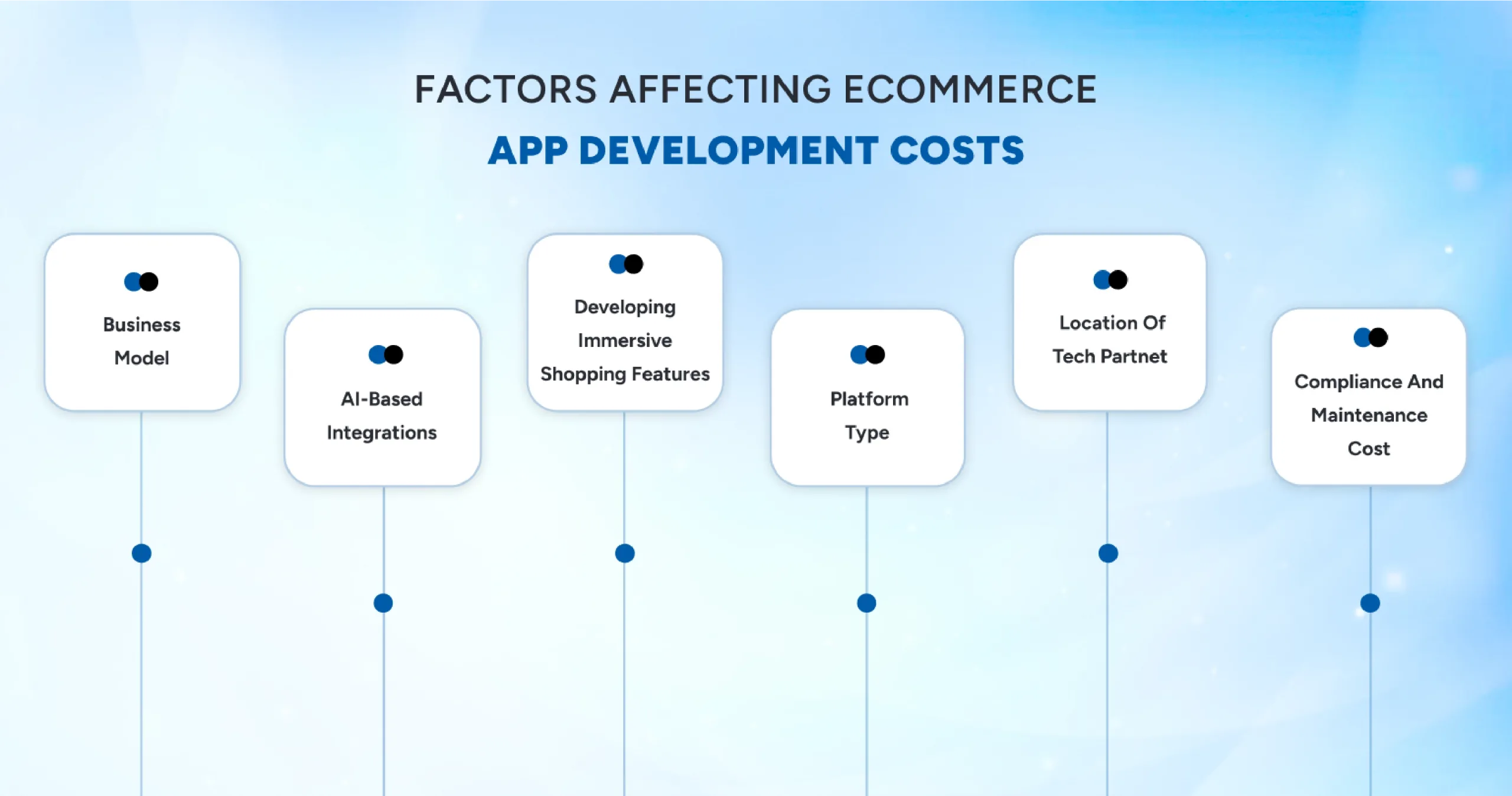
Yes, you can still build a lean MVP somewhere between $25,000 and $60,000. That’ll get you a working product, clean UI, payments, and basic integrations.
But the moment you start talking about advanced AI, immersive shopping experiences, complex workflows, or enterprise-grade security, the budget changes fast. Serious builds now regularly cross $500,000.
And it’s not because developers suddenly charge more. It’s because you’re no longer just building an app. You’re building a commerce engine.
Let’s look at what actually drives the cost.
1. Your Business Model Shapes Everything
Before features. Before design. Before the tech stack. Your business model decides how complicated the foundation will be.
B2C (Direct-to-Consumer)
This is usually the simplest starting point. The focus is on smooth browsing, clean checkout, personalization, and loyalty. If you’re selling directly to customers without complex pricing rules, this is typically the most affordable route.
B2B Commerce
Now things get heavier. Bulk pricing. Contract-based rates. Approval flows. Account hierarchies. ERP integrations. None of this is plug-and-play. Engineering hours increase because the underlying logic is more complex.
Multi-Vendor Marketplaces
These are expensive for a reason. Vendor onboarding, commission splits, dashboards, dispute handling, logistics coordination, payout management. You’re not just selling products. You’re managing an ecosystem.
2. AI Is No Longer “Nice to Have.”
A few years ago, AI was an add-on. Now it’s expected. Adding serious AI capabilities can increase development costs by 20% to 50%, depending on how deep you go.
Optimizing for AI Shopping Assistants
In 2026, your app doesn’t just serve users. It serves AI agents, too. That means structured product data, fast APIs, and tight backend optimization. If your system isn’t machine-readable and fast, you’ll lose visibility in AI-driven discovery. This work is critical.
Simple AI vs. Revenue-Driving Intelligence
A basic chatbot: $20,000–$45,000.
Predictive analytics, smart recommendations, demand forecasting: $80,000–$200,000+.
There’s a big difference between answering FAQs and using data to influence buying behavior.
3. Immersive Shopping: AR and 3D Experiences
Retailers are investing in immersive features for one main reason: fewer returns and higher buyer confidence. It directly impacts conversion rates and return costs.
4. Cross-Platform vs. Native: A Strategic Call
Your tech choice can either control your budget or double it. The mistake most businesses fall into is going native without a clear performance rationale. So, if you are estimating the eCommerce app development cost and are stuck between a cross-platform and a native approach, define the performance metrics. Check whether either approach aligns with it, then choose one.
5. Where Your Team Is Based Still Matters
Geography plays a big role in estimating the eCommerce app development cost, and you need to consider costing variations, especially for regulation-heavy markets. However, it’s not just about how cheap eCommerce app development costs; execution quality and project management are also important.
6. The Costs People Forget to Budget For
This is where many projects go off the rails.
Compliance and Data Governance
Aligning with AI regulations and privacy laws can add $15,000–$50,000 to the bottom line for smaller companies. At enterprise scale, governance programs can run much higher.
Ongoing Maintenance
Plan to spend 15–25% of your original development cost every year. Updates. Security patches. Infrastructure scaling. AI model retraining.
Skipping maintenance doesn’t save money. It just postpones problems. In 2026, building an ecommerce app isn’t about launching fast. It’s about building something that can scale, adapt, and compete.
Your total cost depends on:
- Business model complexity
- Depth of AI integration
- Immersive shopping features
- Platform choice
- Development location
- Compliance requirements
- Long-term maintenance strategy
You can start lean. But if you’re aiming for long-term growth, you need to think beyond launch. The smartest investments aren’t the ones that look impressive on paper. They’re the ones that directly move revenue, retention, and operational efficiency.

What are the Hidden Costs of eCommerce App Development?
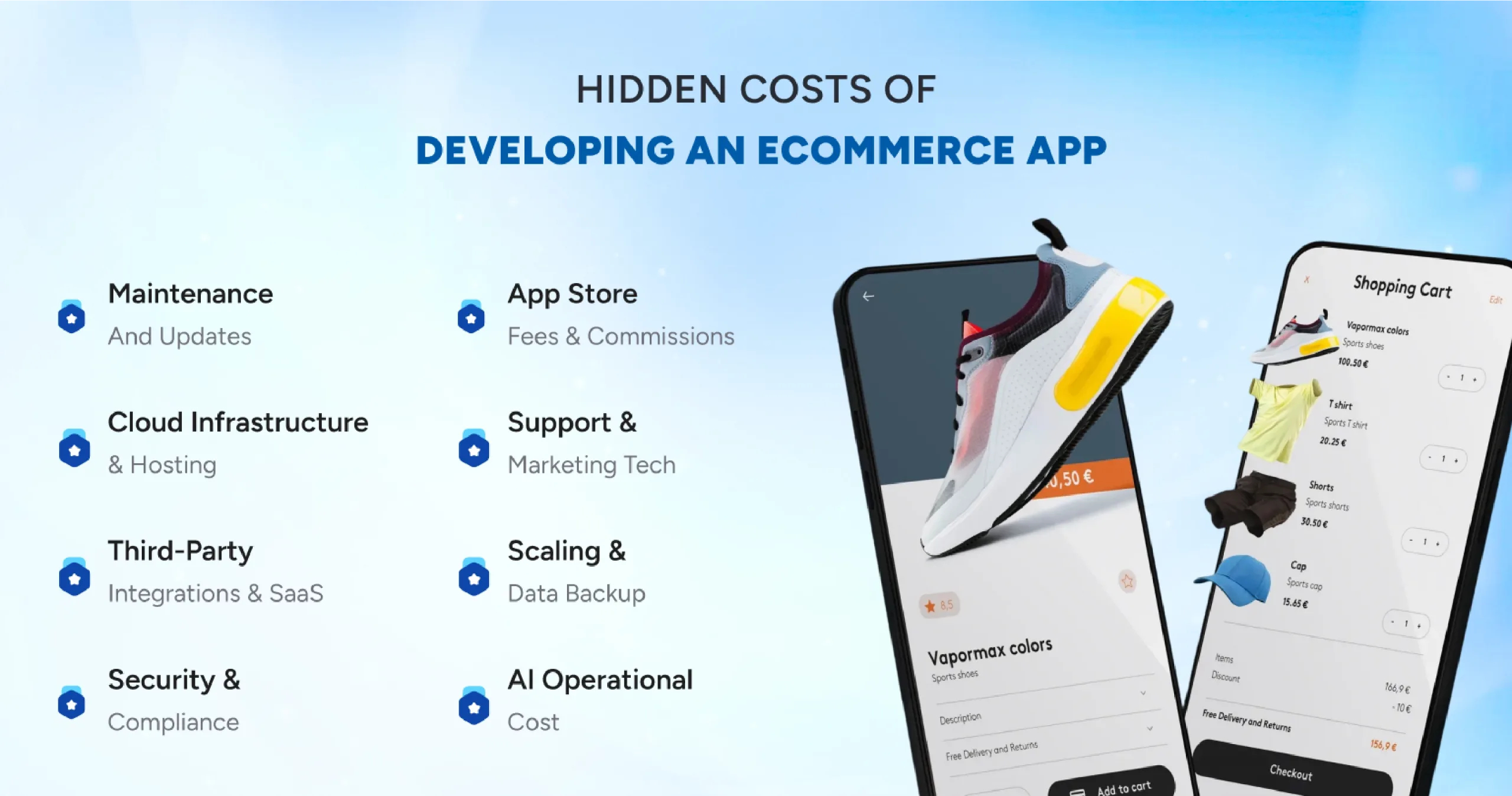
Developing an eCommerce app is not just about calculating the costs of the development or maintenance phase. What most businesses miss are the hidden costs of eCommerce app development projects. Some of the major hidden costs include infrastructure expenses, update costs, third-party integration costs, and security expenditures.
Here is a list of these costs and their impact on the total cost of ownership.
What are the Strategies to Optimize eCommerce App Development Cost?
Optimizing the eCommerce app development cost requires a strategic approach. So, if you are planning to develop an eCommerce app, your strategy needs to accommodate both scale and quality.
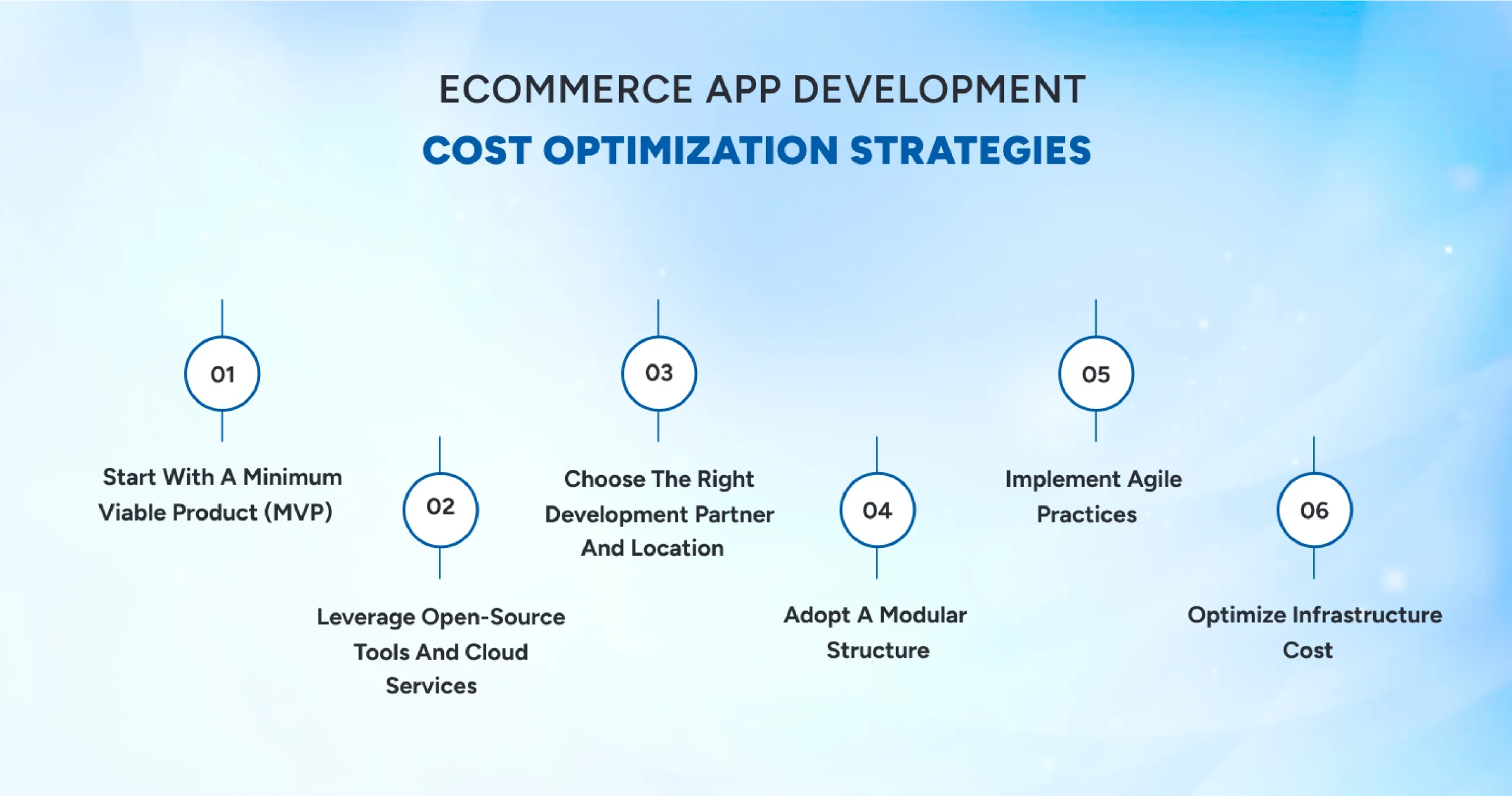
1. Start with a Minimum Viable Product (MVP)
Instead of building a fully featured app for your eCommerce business, you can focus on building an MVP. This includes core features like product browsing, shopping cart, secure checkout, and basic user accounts.
Building an MVP can help you not just launch faster but also practice the lean startup approach. This saves resources and eCommerce app development costs and ensures agility. You don’t just ship features. You validate the market, gather real user feedback, and ensure better customer experience with each iteration.
2. Leverage Open-Source Tools and Cloud Services
You can use open-source technologies to ensure better access to pre-built components without licensing fees. This reduces the eCommerce app development cost. Plus, it reduces dependence on a single technology.
Another key eCommerce app development strategy is to leverage cloud services. You don’t pay for any ideal instance. Rather, you page as you grow. This means optimal cloud costs. Plus, cloud services scale automatically during traffic spikes, reducing upfront infrastructure costs.
3. Choose the Right Development Partner and Location
A major factor that impacts eCommerce app development cost is the technical partner you choose and the location from which it belongs. Outsourcing your eCommerce app development to an experienced tech partner in regions like India can offer high-quality engineering at significantly lower cost.
This is also crucial in the age of AI, where speed and quality matter. For example, a tech partner like Ace Infoway can help you build eCommerce apps at pace with high-quality code standards. What this means is you get an end-to-end ecommerce app development solution without compromising on the speed or quality.
But the most important aspect of partnering with a tech partner like Ace Infoway is the transparency. You don’t get surprises; you get transparent costing.
4. Adopt a Modular Structure
What’s the most significant pet peeve for any eCommerce business in 2026? It’s technical debt. Established e-commerce platforms are now facing the impact of tech debt. However, to avoid technical debt, the best practice is to build a modular architecture from the beginning.
It allows you to easily maintain the app without risking disruptions while implementing changes more quickly. This is important because, as you scale, adapting to changing markets and integrating innovative technologies with legacy systems becomes complex.
5. Implement Agile Practices
An agile approach offers iterative development. This can help you integrate regular stakeholder feedback, reducing the risks and costs of more frequent code changes. It also helps you align business goals, prevent scope creep, and reduce resource waste on unwanted features.
Plus, you can implement automated testing frameworks alongside an agile approach. This helps you reduce testing cost, improve speed, and catch bugs early.
6. Optimize Infrastructure Cost
As your user base grows, your system’s ability to handle transaction volume decreases. This can lead to additional operational costs, especially if you factor in the database infrastructure required to handle high traffic.
The best way to cope with higher server costs is to implement efficient database queries, proper indexing strategies, and caching.
How Ace Infoway Can Help Optimize Your eCommerce App Development Cost?
Development costs are not just about the factors that affect them or the type of engagement model you choose. eCommerce development costs often increase because of slow hiring, unclear scope, communication gaps, or constant rework. That’s the part many teams underestimate.
Ace Infoway tries to remove those friction points. We can get a team started quickly on your project, often within 48 hours, so you’re not stuck in long recruitment cycles. You don’t carry the overhead of full-time hires either. No benefits, no payroll management, no onboarding delays.
If your roadmap changes, you’re not locked in. You can bring people in on an hourly, part-time, or full-time basis, depending on what you actually need. And if growth picks up or you’re heading into a high-demand season, scaling the team doesn’t turn into a three-month HR project.
If you really want to understand where the financial advantage shows up, it’s worth comparing this approach side by side with hiring in-house or going freelance, especially in terms of speed, scalability, predictability, and long-term stability.
So, if you are looking to build an eCommerce app, connect with Ace Infoway experts now.
FAQ
How much does it cost to build an eCommerce app in 2026?
eCommerce app development in 2026 ranges from $20,000 for a lean MVP to $400,000+ for an enterprise-grade platform with AI, AR, and multi-vendor capabilities. Your final number depends on business model complexity, tech stack, platform choice, team location, and how far you plan to scale post-launch.
What is the cheapest way to build an eCommerce app without sacrificing quality?
Start with a cross-platform MVP using Flutter or React Native, which can cut development costs by 20-40% compared to building separate native iOS and Android apps. Pair that with open-source backend tools, modular architecture, and a development team in a cost-efficient region like India, and you get a production-ready app without overbuilding on day one.
How long does it take to develop an eCommerce app?
A basic eCommerce app typically takes 2-4 months to build, while a mid-tier product with analytics, personalization, and multi-gateway payments runs 4-6 months. Enterprise builds with AI integrations, ERP connections, and custom architecture regularly take 9-12 months or longer, depending on scope and team size.
What hidden costs should I budget for when building an eCommerce app?
Beyond development, plan for cloud hosting, payment gateway fees (typically 2.9% + $0.30 per transaction), annual security audits, and app store fees. Annual maintenance adds another 15-25% of your original build cost every year, and skipping it turns deferred security issues into expensive emergency fixes.
Is it cheaper to outsource eCommerce app development to India?
Yes. Indian development teams typically charge $20-$70/hour versus $100-$250/hour in North America, which is a significant lever on total project cost. The savings only hold if your partner brings strong project management and transparent pricing; rework cycles from poor execution will quickly close the gap.