








|
Getting your Trinity Audio player ready...
|
Table of Contents
One digital touchpoint is no longer sufficient for any business to create a complete customer experience. It is possible that customers discover the brand or business through online search, comparison, interaction with an application, marketing campaigns, or other means.
So, when customers have options for multiple digital touchpoints, the digital experience has become more than just a website or mobile interface. It has become a connected journey customers experience across every digital interaction.
A modern DXP helps organizations bring content, customer data, applications, personalization, analytics, and delivery channels together to manage that journey more effectively.
The market is also moving in this direction. Gartner reported that the digital experience platform market surpassed $4 billion in revenue in 2024, with organizations increasingly prioritizing cloud, interoperability, and integration.
Composable architecture, API-first integrations, and MACH principles are changing how organizations build and scale digital platforms. Instead of relying on one system for every requirement, businesses can assemble capabilities around their specific customer and operational needs.
This shift also changes how companies think about a customer experience platform.
What Is a Digital Experience Platform?
A digital experience platform is an integrated technology environment that helps businesses create, manage, deliver, personalize, and optimize experiences across multiple digital channels.
A traditional website platform may primarily focus on publishing and managing web content. An experience platform takes a broader view by connecting content with customer information, business systems, analytics, search, personalization, commerce, and other technologies.
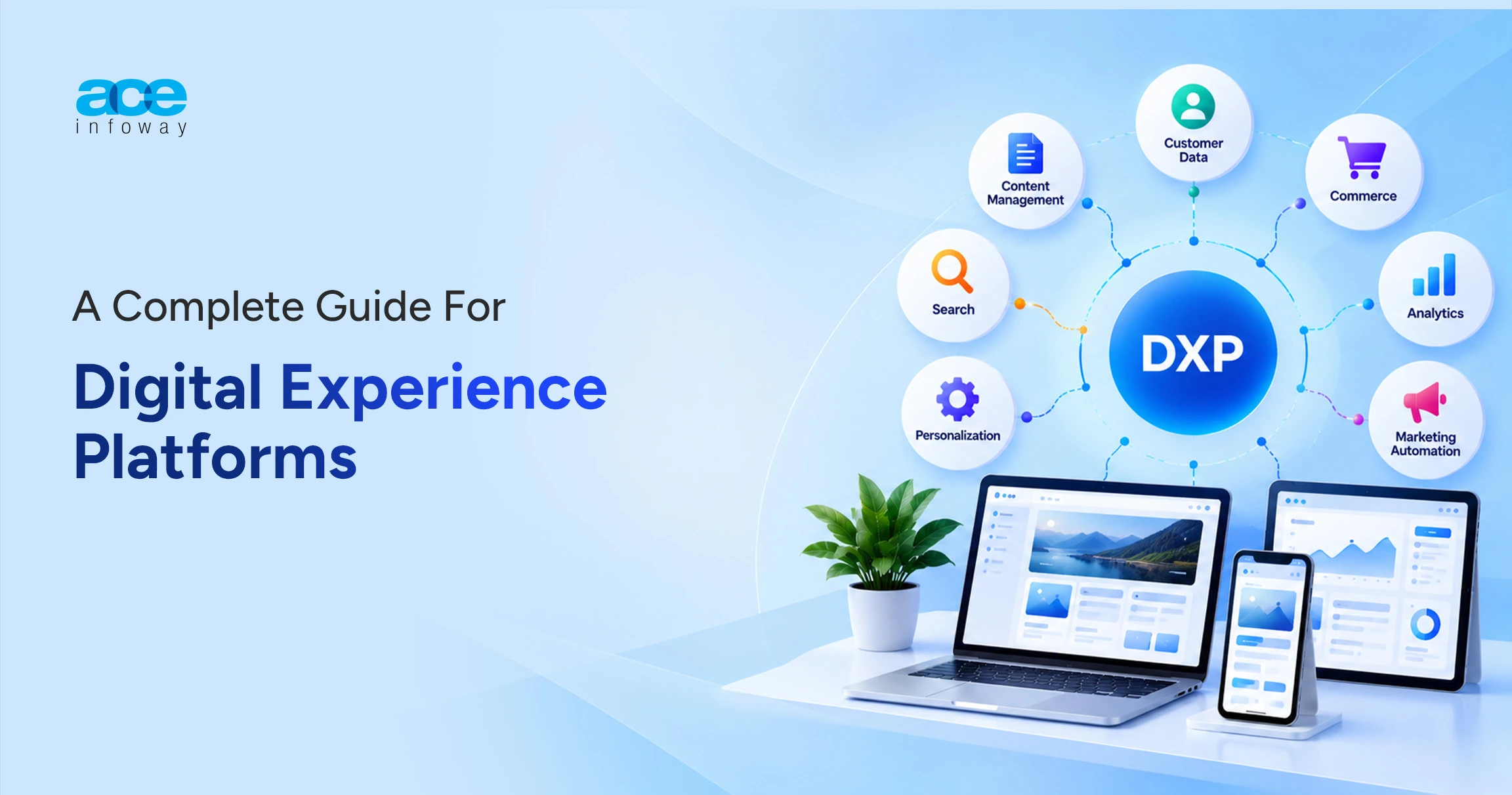
What Does a DXP Typically Connect?
A modern platform can act as the experience layer between customer-facing channels and enterprise systems.
Depending on the organization’s requirements, it may connect:
- Content management and digital asset management
- Customer data and profile systems
- Commerce platforms and product information
- Search and product discovery
- Marketing automation
- Personalization and recommendation engines
- Analytics and experimentation
- CRM and customer service systems
- Mobile applications and web properties
- Internal business applications and APIs
The important point is that an experience platform is valuable when those capabilities work together to remove friction from customer journeys and help business teams act on customer intent.
Why Businesses Are Moving Beyond Traditional Digital Stacks
Many organizations are not struggling because they lack technology. The bigger challenge is coordinating multiple systems, data sources, and business processes to deliver consistent digital experiences.
Technology Coordination: CMS, commerce, CRM, product information, analytics, and personalization platforms often operate independently, creating challenges when they need to work together.
- Disconnected Systems: Poor integration can lead to inconsistent content, duplicated customer data, slower development, and additional operational effort.
- Integration Complexity: Teams may spend significant time maintaining connections between platforms instead of improving customer experiences and business processes.
- Digital Experience Management: Managing modern customer journeys requires organizations to coordinate content, customer context, technology, and business processes across multiple systems.
- Flexible Architecture: Modern approaches such as composable, API-first, composed, and hybrid architectures allow businesses to structure their technology environments around specific requirements.
- Business-Specific Requirements: B2B enterprises, retailers, and regulated organizations have different priorities, making a single technology architecture unsuitable for every business.
- Architecture Alignment: The right digital architecture should support the organization’s business model, customer journey, and operational requirements rather than forcing teams into a fixed technology structure.
Digital Experience Platform Architecture Explained
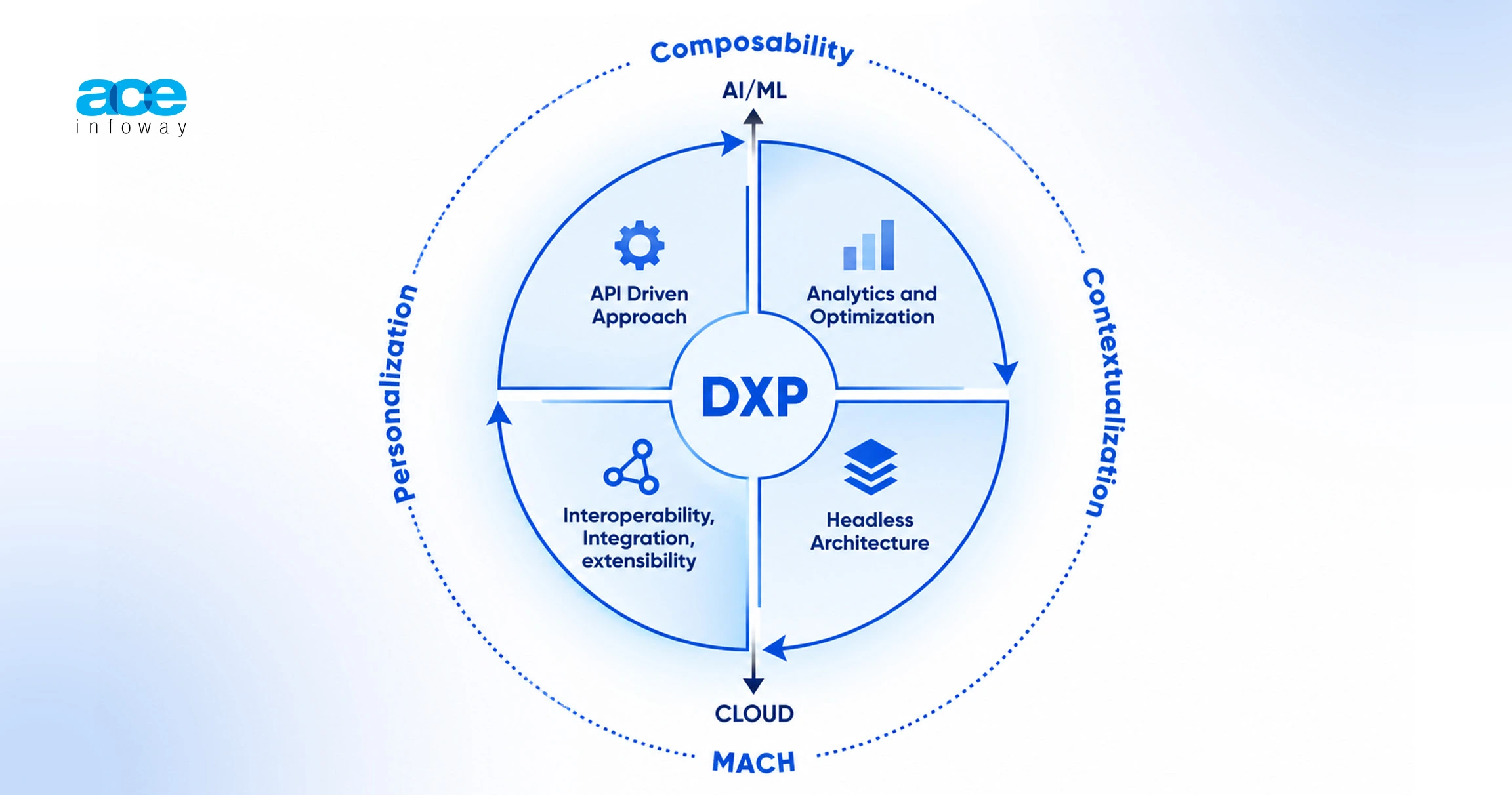
The architecture behind an experience platform determines how easily an organization can integrate systems, introduce new channels, personalize experiences, and adapt to changing business requirements.
A useful way to understand the architecture is through several connected layers.
- Experience Layer
This is where customers and users interact with the organization.
It can include:
- Websites
- Mobile applications
- Commerce storefronts
- Customer portals
- Self-service interfaces
- Digital kiosks
- Partner portals
- Emerging conversational and AI interfaces
The experience layer should remain focused on delivering fast, accessible, consistent interactions rather than owning every business function underneath.
- Content and Asset Layer
This layer manages the information customers actually consume.
It can include articles, product descriptions, landing pages, images, videos, technical documentation, promotional content, and structured content.
A strong content model becomes particularly important for search visibility.
Content should not simply exist for one webpage. Structured content can be reused across websites, applications, search experiences, personalization workflows, and other channels.
- Data and Intelligence Layer
Customer profiles, behavioral information, product data, transactional information, and analytics provide the context required for more relevant experiences.
This layer can help answer questions such as:
- Who is this customer?
- What have they previously interacted with?
- What products or services interest them?
- Where are they in the buying journey?
- What information should they see next?
- Which experience produces better business outcomes?
The goal is not to collect data simply because more data is available.
The goal is to make customer interactions more relevant and measurable.
- Integration Layer
The integration layer connects the experience ecosystem with enterprise applications.
APIs, event-driven integrations, middleware, and orchestration services can connect systems such as CRM, ERP, commerce, PIM, CDP, analytics, and marketing automation.
This layer becomes especially important when organizations adopt modular technology.
A well-designed integration approach allows businesses to replace or upgrade individual capabilities without rebuilding the entire experience ecosystem.
- Optimization Layer
Analytics, experimentation, personalization, search performance, and journey analysis help teams continuously improve experiences.
This layer creates the feedback loop.
A customer journey is launched, measured, analyzed, tested, and refined. Over time, the platform becomes more effective because business decisions are informed by actual customer behavior.
Monolithic vs Composable Architecture
One of the most important architectural decisions involves choosing between a tightly integrated suite and a more modular ecosystem.
A traditional suite can provide convenience. Many capabilities come from one vendor, integration can be relatively straightforward, and teams may have fewer individual technologies to manage.
However, organizations can become dependent on the platform’s roadmap, limitations, and implementation model.
A modular approach takes a different position.
Instead of expecting one vendor to provide every capability, the business selects technologies based on specific requirements and connects them through APIs and shared data models.
Where MACH Fits for Digital Experience?
MACH architecture, which includes Microservices, API-first, Cloud-native SaaS, and Headless, provides principles that support modular digital ecosystems.
It can help organizations create systems where individual capabilities can evolve independently while remaining connected through APIs.
However, adopting MACH simply because it is modern does not guarantee better business outcomes.
For a large organization operating multiple brands, regions, channels, and customer segments, modular architecture may provide significantly greater flexibility.
The question is therefore not whether composability is better.
DXP vs CMS: What Is the Difference?
The distinction between a DXP and CMS often causes confusion because both technologies can manage digital content.
A CMS primarily focuses on creating, organizing, managing, and publishing content.
A broader experience platform can incorporate content management while also connecting customer data, personalization, analytics, commerce, search, journey orchestration, and multiple delivery channels.
| Capability | Traditional CMS | Experience Platform |
| Content management | Strong | Strong |
| Website publishing | Strong | Strong |
| Omnichannel delivery | Limited to moderate | Strong |
| Customer data integration | Often requires integrations | Core capability or integrated |
| Personalization | Often add-on | Typically supported |
| Analytics and optimization | Often external | Integrated or connected |
| Commerce integration | Usually external | Commonly supported |
| Journey orchestration | Limited | Broader capability |
| API-first delivery | Depends on platform | Increasingly important |
| Enterprise integration | Varies | Central architectural concern |
The right decision depends on the complexity of customer journeys, number of channels, personalization requirements, integration needs, and long-term growth strategy.
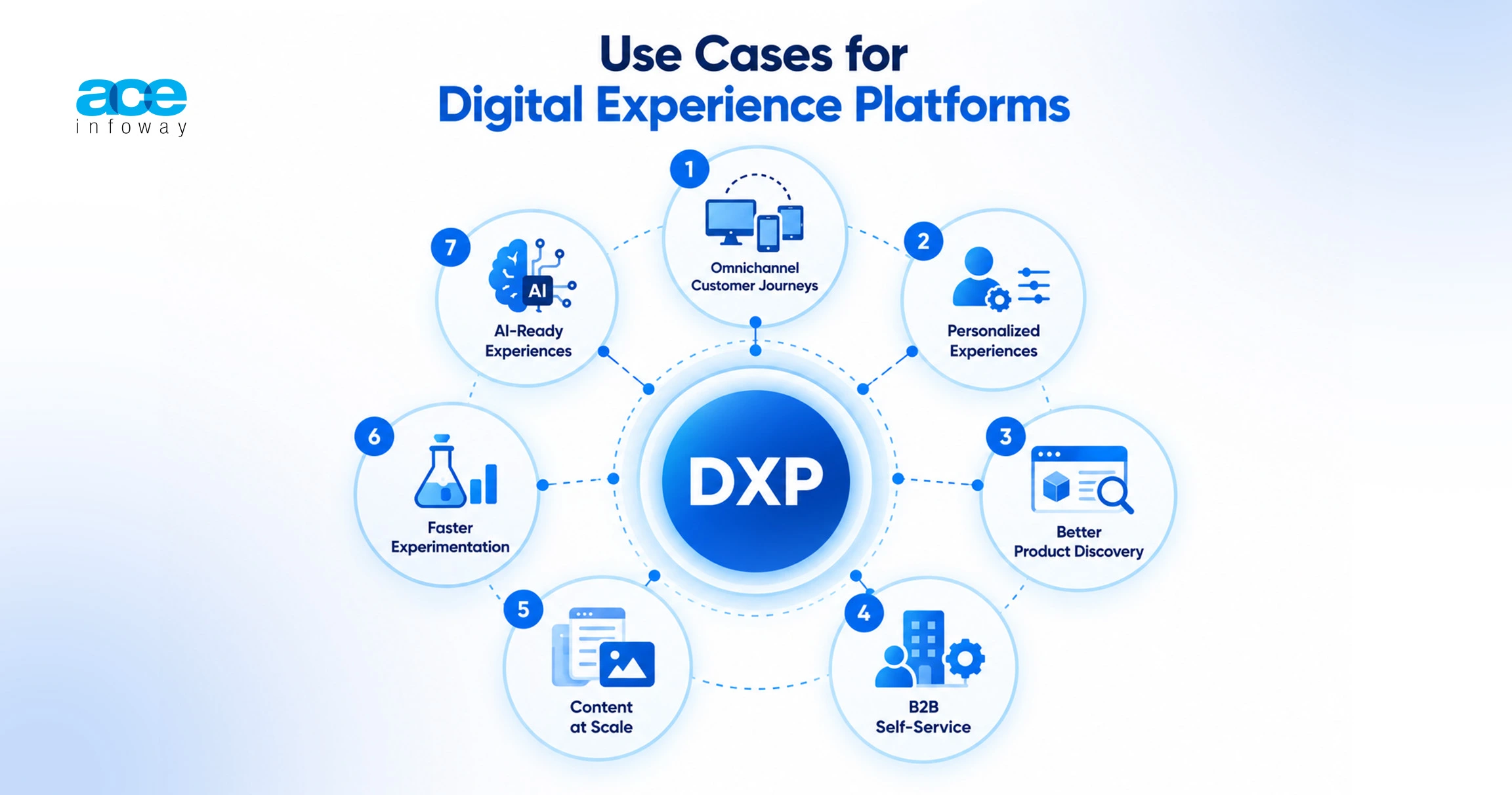
7 Business Use Cases for Digital Experience Platforms
The strongest reason to invest in an experience platform is not technology modernization. It is the ability to solve business problems that fragmented digital systems struggle to address across the customer journey.
1. Omnichannel Customer Journeys
Customers rarely follow a single path from discovery to purchase.
The shift is already visible in customer behavior. Gartner found that 51% of customer service journeys now begin on third-party platforms such as Google, YouTube, or ChatGPT, showing why organizations can no longer treat their own website as the only starting point for digital interactions.
A connected experience platform helps businesses maintain relevant customer context as people move between websites, mobile devices, sales interactions, portals, and other digital touchpoints.
Why Does This Matter?
- Consistent Experiences: Customers receive relevant information across channels without repeatedly starting the journey from scratch.
- Reduced Friction: Connected experiences can remove unnecessary steps and simplify navigation between digital touchpoints.
- Scalable Management: Organizations managing multiple properties can maintain greater consistency as channels and customer interactions expand.
2. Personalized Experiences
Personalization becomes more useful when content, customer information, behavioral signals, and business rules can work together. Instead of personalizing everything, organizations can focus on the interactions where relevance has the greatest impact.
Why Does This Matter?
- Greater Relevance: Different customer segments can receive content and experiences aligned with their needs and relationship with the business.
- Better Engagement: Relevant recommendations, messaging, and offers can make digital interactions more meaningful.
- Smarter Personalization: Businesses can prioritize high-value personalization opportunities instead of creating unnecessary complexity across every page.
3. Better Product Discovery
Large product catalogs require more than basic navigation. Customers need to find relevant products quickly, compare alternatives, understand specifications, and access supporting information before making a decision.
Why Does This Matter?
- Faster Discovery: Structured product information, search, filters, and recommendations help customers reach relevant products sooner.
- Stronger Product Context: Connected content can provide specifications, comparisons, use cases, and supporting information alongside products.
- Improved Visibility: Well-structured product and category information can also give search engines clearer context about the products a business offers.
4. B2B Self-Service
B2B customers increasingly expect digital convenience alongside human support. Experience platforms can connect account information, orders, documentation, availability, subscriptions, and support capabilities within secure customer environments.
Why Does This Matter?
- Lower Support Dependency: Customers can complete routine tasks without relying on sales or service representatives.
- Better Customer Access: Important account and product information becomes available through a centralized digital experience.
- Higher-Value Interactions: Sales and service teams can spend more time on complex requirements instead of repetitive requests.
5. Content at Scale
Enterprise organizations often produce similar content across regions, brands, products, and channels. A structured content approach makes reusable information easier to manage while supporting consistent digital experiences at scale.
Why Does This Matter?
- Reusable Content: Teams can create structured content once and distribute it across multiple digital experiences.
- Better Governance: Centralized structures make it easier to maintain consistency across markets, brands, and channels.
- Stronger Search Foundations: Connected content relationships can help organizations build deeper topic ecosystems rather than isolated pages.
Google’s guidance for AI search also emphasizes unique, helpful, reliable content while continuing to follow foundational SEO practices.
6. Faster Experimentation
Digital growth depends on continuous learning. Organizations need to test messaging, landing pages, navigation, recommendations, offers, and customer journeys without rebuilding large portions of their technology environment.
Why Does This Matter?
- Quicker Testing: Teams can experiment with individual experience components without disrupting the broader digital ecosystem.
- Continuous Optimization: Improvements can happen incrementally rather than waiting for major redesign projects.
- Better Learning: Frequent experimentation gives organizations more opportunities to understand what customers actually respond to.
7. AI-Ready Experiences
AI-driven search, assistants, recommendations, and conversational interfaces are changing how customers interact with digital information. Supporting these experiences requires more than adding an AI tool; the underlying information architecture must also be prepared.
Why Does This Matter?
- Structured Information: Well-organized content gives AI systems clearer relationships between products, services, topics, and business information.
- Connected Data: Reliable data and APIs make it easier to expose relevant information across emerging AI-driven experiences.
- Future Readiness: A flexible architecture allows organizations to adapt as AI interfaces and customer discovery behaviors continue to evolve.
AI visibility is therefore not simply an SEO problem. It increasingly depends on how effectively an organization structures, connects, and exposes its digital information.
A Practical Roadmap for DXP Implementation
Experience transformation becomes easier when organizations avoid trying to rebuild everything simultaneously.
A phased approach can reduce risk and create measurable milestones.
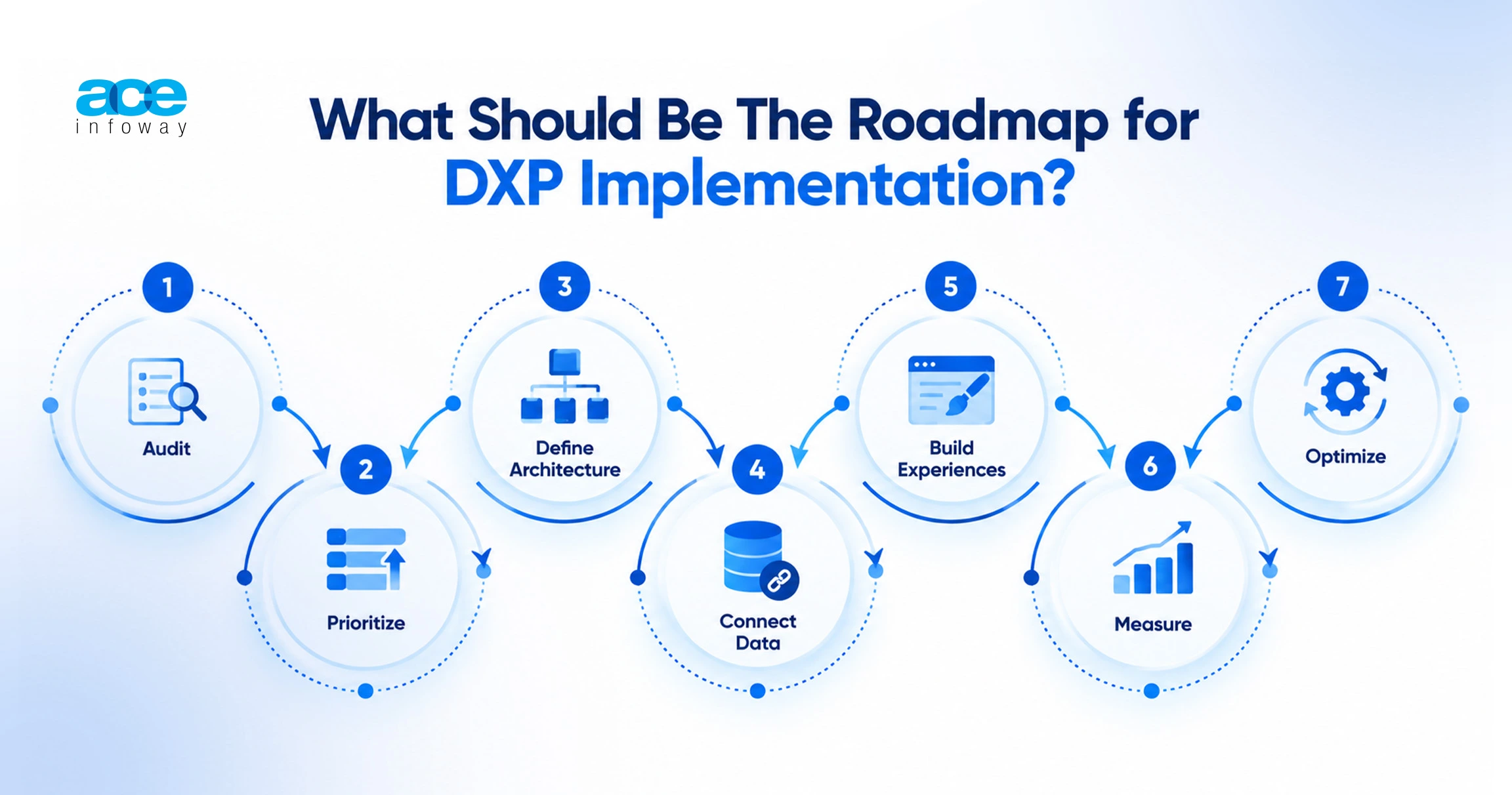
- Audit: Map the current customer journeys, technologies, integrations, content systems, data flows, and major experience gaps.
- Prioritize: Identify the journeys where better experiences can create the greatest commercial impact.
- Define Architecture: Determine which capabilities should remain centralized and which should become modular or replaceable.
- Connect Data: Establish reliable relationships between customer, content, product, transaction, and behavioral data.
- Build Experiences: Develop high-value journeys first rather than attempting a complete digital transformation in one release.
- Measure: Track conversion, engagement, search visibility, customer satisfaction, operational efficiency, and revenue-related metrics.
- Optimize: Use experimentation and analytics to continuously improve the experience.
Common Mistakes Businesses Make When Building a Digital Experience Platform
Even strong technology can produce disappointing results when the implementation strategy is weak.
Starting With Technology
Choosing a platform before understanding customer journeys can create expensive customization and unnecessary functionality.
Rebuilding Everything
A complete replacement is not always required. Existing systems may continue providing significant value when integrated properly.
Ignoring Content Architecture
A modern frontend cannot compensate for poorly structured, duplicated, outdated, or difficult-to-govern content.
Overengineering
Distributed systems introduce flexibility but also introduce operational complexity. Every additional service needs ownership, monitoring, security, and maintenance.
Measuring Launch Instead of Outcomes
A successful implementation is not defined by going live. It should be evaluated through business outcomes such as conversion, customer engagement, lead quality, content efficiency, search performance, and operational productivity.
How Ace Infoway Helps Businesses Build Better Digital Experiences
Experience transformation requires more than selecting software. It requires a clear understanding of how technology, data, content, integrations, and customer journeys need to work together.
Digital Experience Architecture
Our team evaluates your existing digital ecosystem to understand how platforms, applications, data, and customer journeys currently interact. We then design an architecture that aligns technology decisions with business priorities and future growth.
Platform Modernization
We help organizations modernize legacy platforms where outdated technology is limiting performance, flexibility, or customer experience. Our approach focuses on upgrading the areas that create the greatest business impact without assuming every existing system needs replacement.
Systems Integration
Our experts connect commerce platforms, CMSs, CRMs, product systems, analytics tools, and other business applications to create a more coordinated digital environment. We design integrations around reliable data flow, operational requirements, and the experiences customers expect across channels.
Custom Digital Development
When standard platforms cannot accommodate unique business requirements, we build custom digital solutions around specific workflows and customer needs. Our development approach extends existing technology where possible while introducing custom functionality where it creates meaningful value.
Experience Optimization
We analyze customer journeys and digital interactions to identify friction, inconsistencies, and opportunities for improvement. From interface enhancements to workflow optimization, our team focuses on changes that can strengthen engagement, conversion, and overall experience quality.
AI-Ready Digital Foundations
Our experts help organizations prepare their digital ecosystems for AI-driven experiences by improving content structures, data accessibility, APIs, and system connectivity. We create foundations that allow businesses to adapt as AI increasingly influences search, discovery, personalization, and customer interactions.
Conclusion
Digital experience platforms can help organizations connect fragmented systems, improve customer journeys, personalize interactions, and build more adaptable digital ecosystems.
The right approach, however, depends on aligning technology with specific business requirements rather than adopting platforms simply for modernization.
Ace Infoway helps businesses design, develop, integrate, and optimize digital solutions across evolving technology environments. Our team combines digital expertise with practical implementation experience to create scalable solutions aligned with business objectives.
Contact us to build a connected digital experience strategy designed around your business needs.
FAQs
1. What is a digital experience platform?
A digital experience platform is an integrated technology environment that helps organizations create, manage, deliver, personalize, and optimize digital interactions across multiple channels and customer journeys.
2. How is a DXP different from a CMS?
A CMS primarily focuses on managing and publishing content, while a broader experience platform can connect content with customer data, personalization, analytics, commerce, search, applications, and other enterprise systems.
3. Is composable architecture suitable for every business?
No. Composable architecture can provide flexibility and scalability, but it also introduces additional integration and operational requirements. Businesses should adopt it when those benefits justify the added complexity.
4. Can an experience platform improve SEO and AI search visibility?
It can provide stronger technical and content foundations for search visibility by supporting structured content, fast experiences, reusable content models, clear information architecture, and connected digital assets. However, platform selection alone does not guarantee search or AI visibility.
5. How should businesses approach experience platform implementation?
Businesses should begin by auditing customer journeys, content, technology, integrations, and business objectives. They can then prioritize high-value use cases, define the target architecture, implement incrementally, and measure improvements against commercial and customer experience outcomes.