








|
Getting your Trinity Audio player ready...
|
Table of Contents
It is sprint 14 of 2027, day eight. Your squad has merged 70 pull requests this sprint, against 40 before the coding assistants arrived, and every one carries a green check. The burndown chart looks like a ski slope.
Then the release candidate reaches staging. A payment edge case fails. A login redirect loops on one browser. Nobody can say which change caused it, because assistants wrote most of the code and two tired reviewers skimmed the rest.
Speed arrived on schedule. Proof did not. That gap, between merged velocity and verified velocity, is the real story of AI in agile and software testing.
And the gap is about to widen. Gartner predicts that 90% of enterprise software engineers will use AI code assistants by 2028, up from less than 14% in early 2024. Adoption will not wait for a testing plan. The teams that write one first are the ones whose speed will hold up in production.
Boards still celebrate sprint velocity.
The number that decides the outcome is verified velocity, the share of merged work that survives contact with production.
This guide answers three questions: which roles and ceremonies change, what a test strategy must look like when AI writes the code, and how to get ready with a six-step checklist before 2027.
What is AI in Agile and Software Testing, and How is it Different From Test Automation?
AI in agile and software testing means using machine learning models and AI agents to plan, build, test, and release software inside iterative delivery teams. Picture a squad where one assistant drafts the user stories, another writes the code, and a third agent runs regression overnight. Each of those tools exists today.
The difference from classic automation is simple. A script does what it is told. An AI-driven tool decides what to test, what to repair, and what to flag, which is why someone still has to check its decisions.
AI-Assisted vs AI-Augmented vs Agentic Testing
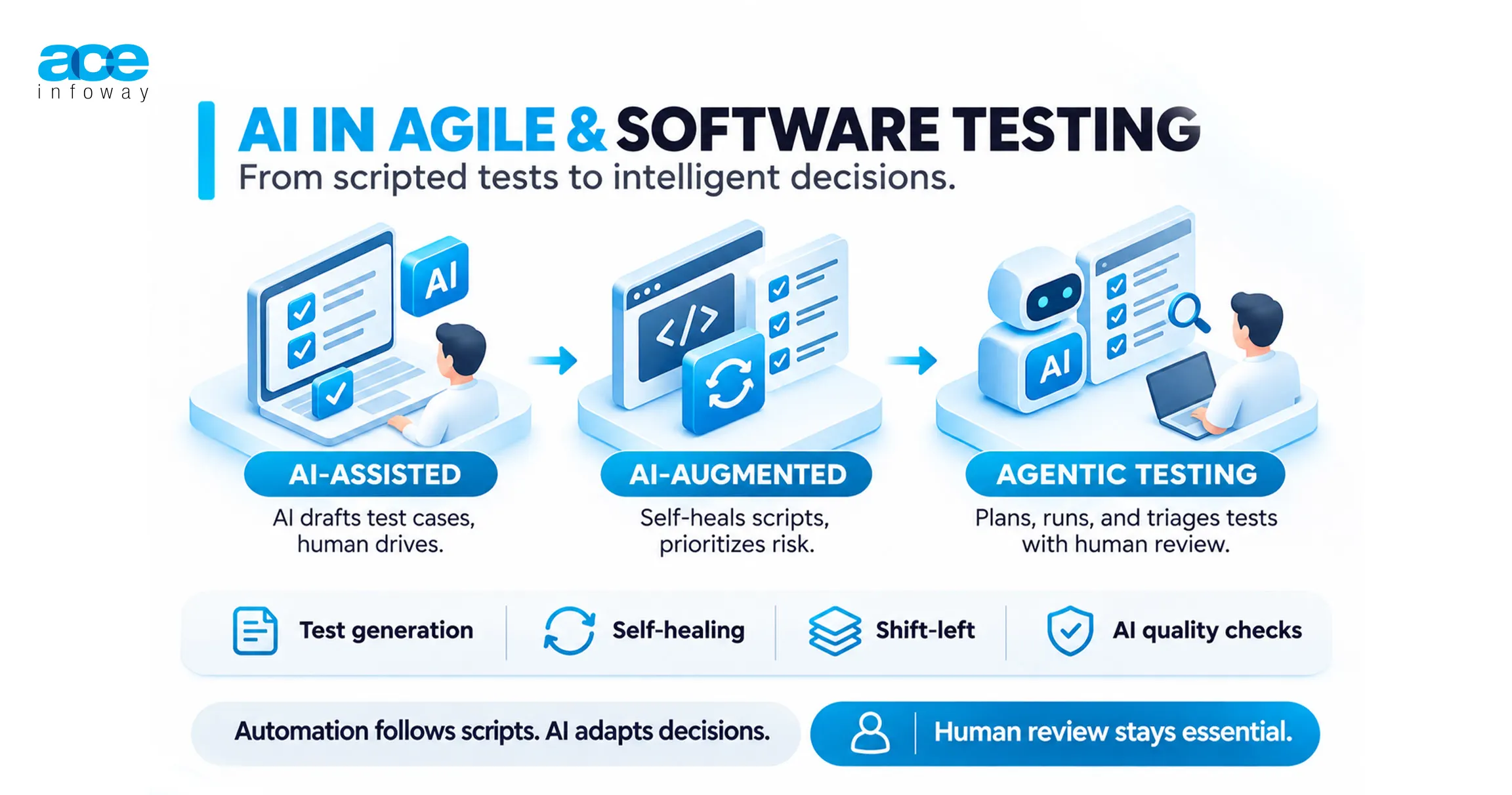
Three terms get used interchangeably, and they describe three levels of control.
| Testing Approaches Compared | ||
|---|---|---|
| Approach | Scope | Typical use |
| AI-assisted testing | A person drives, and AI drafts test cases or scripts on request | Writing tests from user stories |
| AI-augmented testing | Tools embed AI to self-heal scripts, rank risk, and cut flaky runs | Stabilizing a large UI regression suite |
| Agentic AI testing | An agent plans, runs, and triages tests using real tools such as browsers | One stable, low-risk user flow with a human reviewer |
Think of an orchestra. Assisted testing is spell-check for sheet music. Augmented testing is a section leader who retunes a violin mid-piece. Agentic testing is an ensemble that rehearses itself, which is exactly why someone still has to stand on the podium.
Related Terms Worth Knowing
Four more terms will surface in vendor pitches. AI test case generation drafts tests from stories and code changes. Self-healing test automation repairs broken locators when the interface shifts. Shift-left testing with AI starts tests and evaluations while requirements are still forming.
Testing the AI itself checks hallucination, accuracy, and drift in any feature that contains a model. Each describes a capability, not a product, so no single tool covers all four.
Which Roles and Ceremonies Change With AI in Agile and Software Testing?
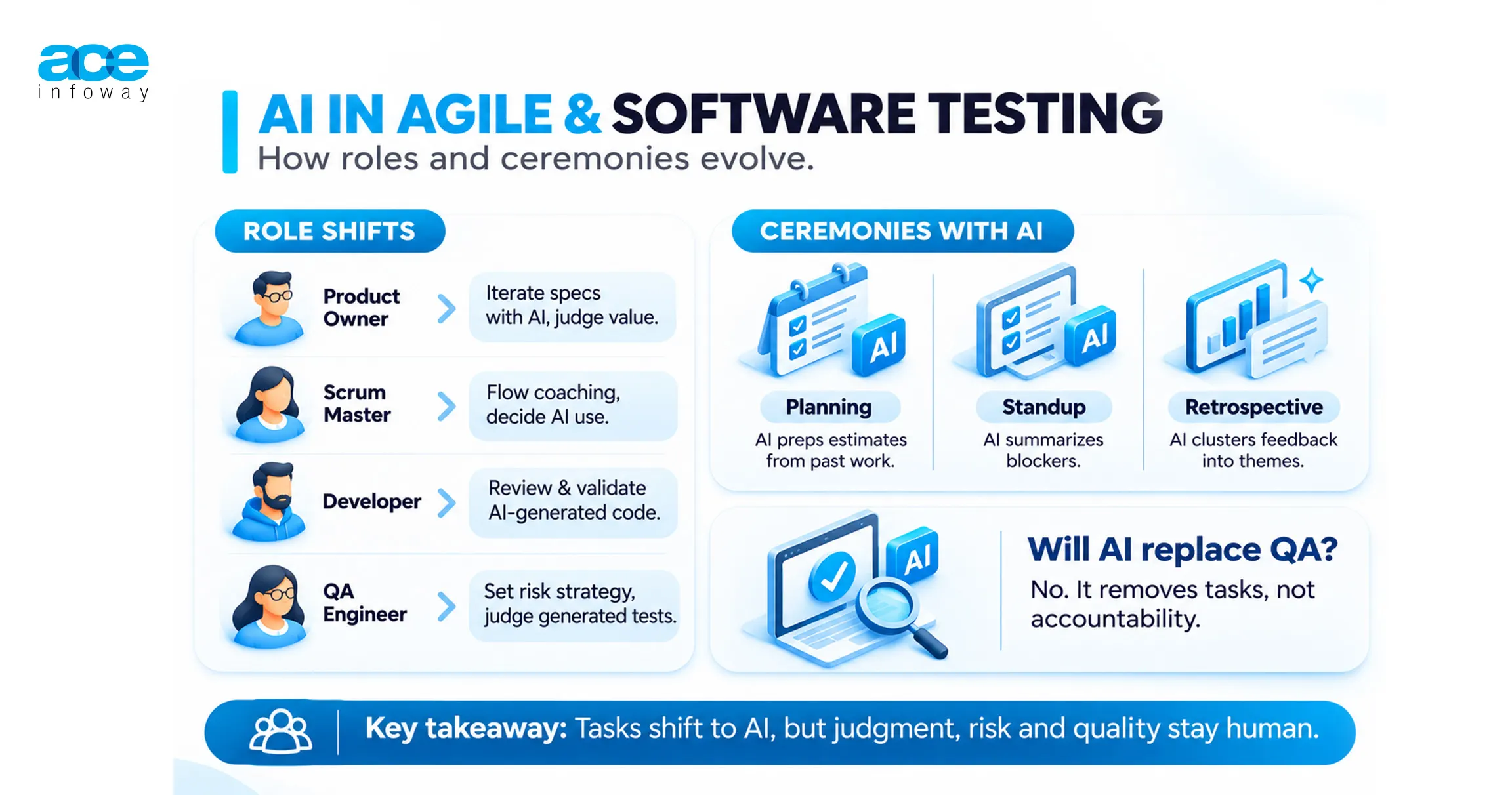
AI changes the work inside each ceremony more than the ceremonies themselves. Agents can draft estimates, flag dependencies, and forecast capacity before planning starts, and the humans keep the decisions.
Where Each Role Moves
Every role loses a task and gains a responsibility.
| How Each Role Changes | ||
|---|---|---|
| Role | Moves away from | Moves toward |
| Product owner | Writing long specs alone | Iterating specs with an agent, then judging which draft matches customer value |
| Scrum master | Pure facilitation | Flow coaching and deciding which tasks an agent may touch |
| Developer | Typing most of the code | Reviewing machine output, which makes code review a core quality gate |
| QA engineer | Maintaining scripts | Setting risk strategy, judging generated tests and testing exploratively |
Accountability does not shrink. It concentrates around judgment, prioritization, and risk. Teams also get smaller and more cross-functional, with AI embedded in how they work, which raises the load on review and verification.
What Happens in Planning, Standups, and Retrospectives?
In planning, an agent preps estimates from historical tickets. In standups, it summarizes blockers, and in retrospectives it clusters feedback into themes. The team still argues, decides, and commits.
Then again, an agent’s retrospective summary describes what happened, not why. Skip the human debate and the team inherits the model’s blind spots instead of fixing its own. If your fundamentals are shaky, fix them before adding agents.
Will AI Replace QA Testers?
No. AI removes tasks, not accountability. Script maintenance, boilerplate test writing, and first-pass triage move to machines. Judgment, risk assessment, and exploratory testing stay with people, and demand for verification grows as AI output grows.
The QA engineer shifts from script writer to quality strategist, the person who decides what to test and when a generated answer is almost right but unsafe to ship. Teams that treat this as a skills program, not a tool purchase, get further.
What Should Your Test Strategy Look Like When AI Writes the Code?
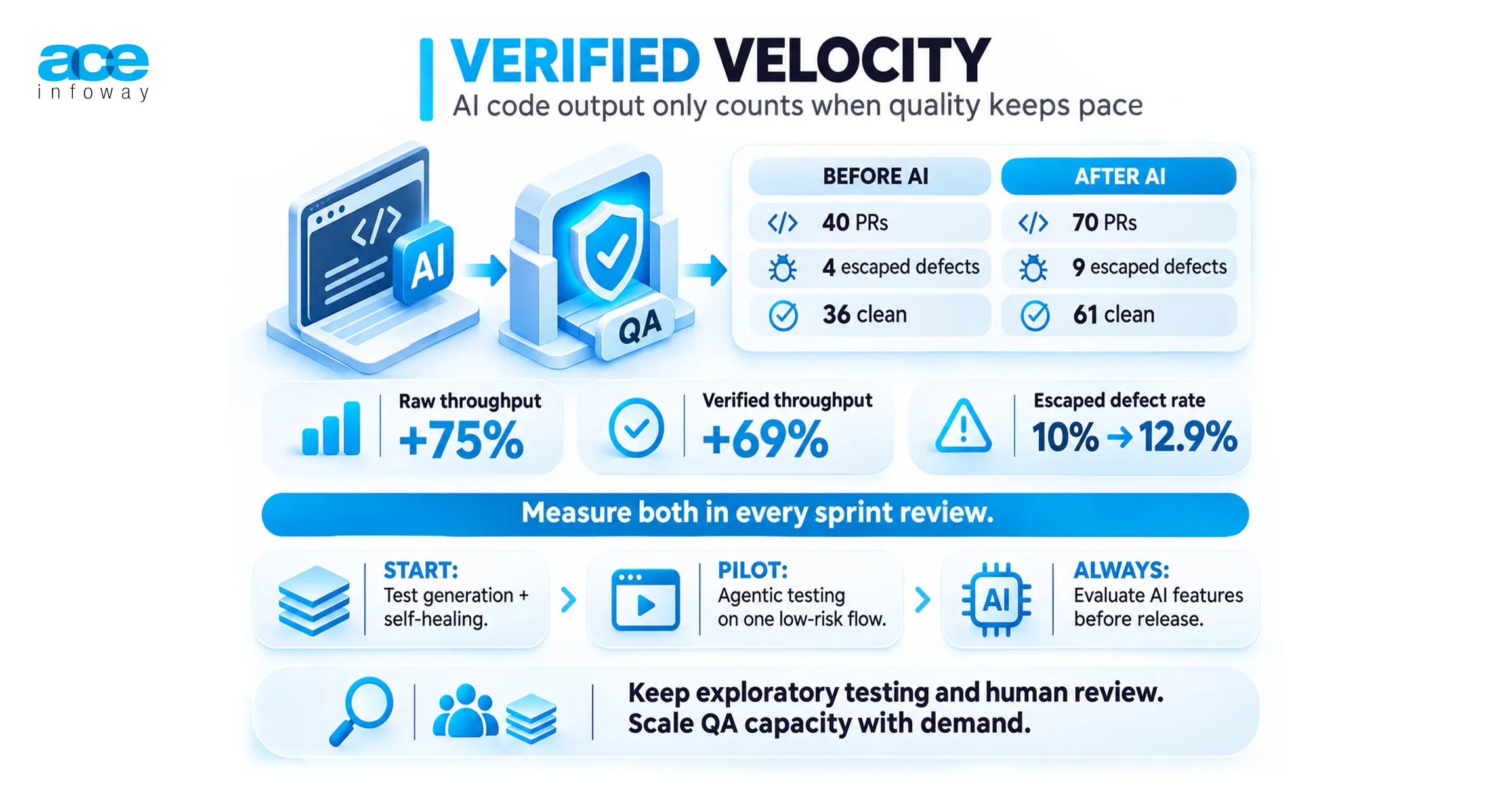
Start with a different number. A team celebrating 70 merged pull requests where 40 used to be has not gained 75% unless the extra work holds up in production.
Think of plumbing. A bigger pump raises output only until a joint fails, and a team that installs the pump without pressure-testing the pipes finds the weak fitting with water on the floor.
Why Verification is the Bottleneck Now
McKinsey’s 2026 research on AI-native product development describes the same shift: once agents produce more code, the constraint moves from generation to verification. Reviewers see a clean diff, approve code they did not fully read, and defects escape.
Review capacity did not grow at the pace of output, so quality gates have to be automated, not just staffed.
And this is why skipping software QA costs more in an AI-assisted workflow, not less. The blunt version: teams bought speed and forgot to buy the testing capacity to match it. Fix that imbalance before you buy another assistant.
A Worked Example of Verified Velocity
Say a squad merged 40 pull requests per sprint before assistants, and 4 of them were later tied to an escaped defect. After rollout, it merges 70, and 9 are tied to escaped defects.
Raw throughput rose 75% (70 ÷ 40 = 1.75). The escape rate moved from 10% to about 12.9% (9 ÷ 70). Clean throughput, meaning merged work with no escaped defect, went from 36 to 61, a gain of about 69% (61 ÷ 36 = 1.69).
The board sees 75%. The customer feels 69%, and the drifting escape rate will erode even that if the quality gate stays where it was. Report both numbers in the same sprint review.
Which AI Testing Capabilities Matter Most?
AI-augmented testing is moving from assisted to autonomous, and the five capabilities below sit at different points on that path.
| AI Testing Capabilities Compared | ||
|---|---|---|
| Capability | What it does | Best starting point |
| AI test case generation | Drafts tests from requirements, user stories, and code changes | Regression gaps and new features |
| Self-healing test automation | Repairs broken locators and scripts when the interface changes | Flaky UI suites |
| Agentic AI testing | Lets an agent plan, run, and triage tests using real tools | One stable, low-risk user flow |
| Autonomous testing platforms | Combine AI, generative models and agents for risk-based testing | Mature teams with clean pipelines |
| Testing the AI itself | Checks hallucinations, accuracy, and drift in AI-powered features | Any product shipping an LLM feature |
The verdict: start with test case generation and self-healing, hold agentic testing to one flow, and never skip the last row. A model that sounds confident and is wrong is a defect, even when every unit test passes.
Especially for products that ship an LLM feature, treating evaluation as a release gate, with its own data set and threshold, matters more than any script upgrade.
Then again, AI-generated tests carry their own risk. They often assert what the code does, not what the business intended, so a generated suite can pass a bug it just learned. Automation also never replaces the whole stack.
The sensible path is still balancing manual and automation testing, with AI absorbing the repetitive layer and people covering exploratory and judgment-heavy checks.
Which Risks Matter, and How Do You Get Ready Before 2027?
Teams will add the tool first and fix the process later, because adoption does not wait for governance. That order is the problem, and the risks below follow from it.
Three Risks to Watch
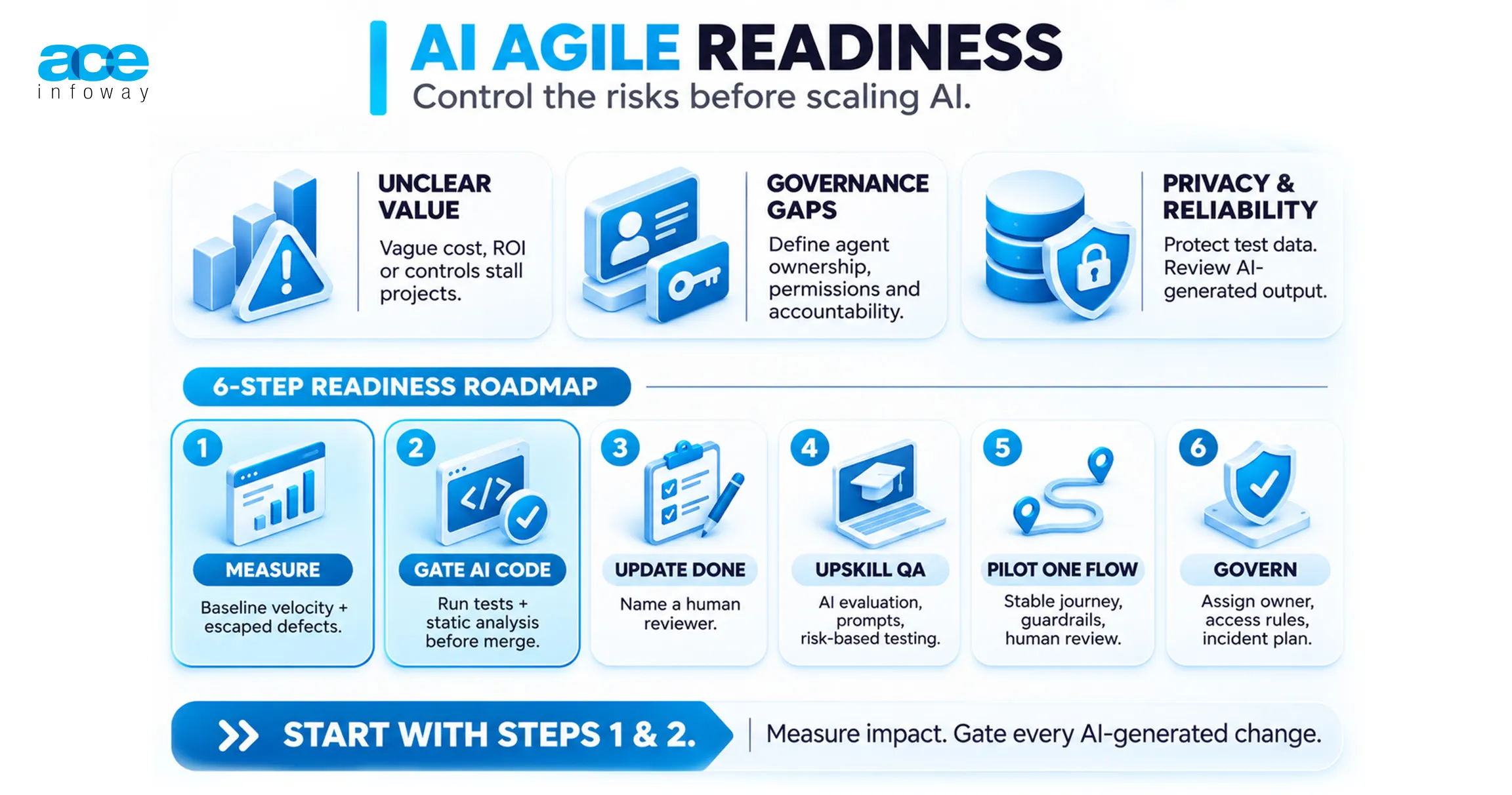
Projects stall first. Agentic initiatives lose funding when cost, value, or risk controls stay vague, so start with one narrow use case and a measurable outcome.
Governance lags next. Agents act faster than policies get written, which leaves open who owns an agent’s output and what it may change.
Privacy and reliability close the list. Test data can carry sensitive information, and generated tests can be wrong in ways that look right. Treat AI output as a draft that needs review.
A Six-Step Readiness Checklist
Use this checklist for a single squad or a whole release train. Each step has an owner.
- Measure before you scale. The delivery lead baselines velocity and escaped defects per merged pull request, so you can prove whether AI helped.
- Gate every AI-generated change. The tech lead runs automated tests and static analysis on machine-written code before merge.
- Redefine your Definition of Done. The Scrum master adds explicit criteria for AI-written code, including a named human reviewer.
- Upskill QA. The QA manager trains testers in AI evaluation, prompt literacy, and risk-based testing.
- Pilot agentic testing on one flow. The QA lead picks a stable journey, sets guardrails, and reviews every decision the agent makes.
- Govern from day one. The CTO assigns ownership, sets rules for agent access, and signs off on an incident-response plan.
Then again, six steps in one quarter is too many for a team that has never measured anything. Do steps one and two first. They cost almost nothing, and they tell you whether the rest is worth the effort.

Conclusion
Back in sprint 14 of 2027, the board still looks like a ski slope, but this team can say with a number how much of that speed survives the release. AI in agile and software testing will not replace agile teams or testers. It will punish the ones that treat verification as an afterthought.
Start small: baseline escaped defects per merged pull request, add one automated gate to your Definition of Done, and pick one stable flow for an agentic pilot.