





|
Getting your Trinity Audio player ready...
|
Table of Contents
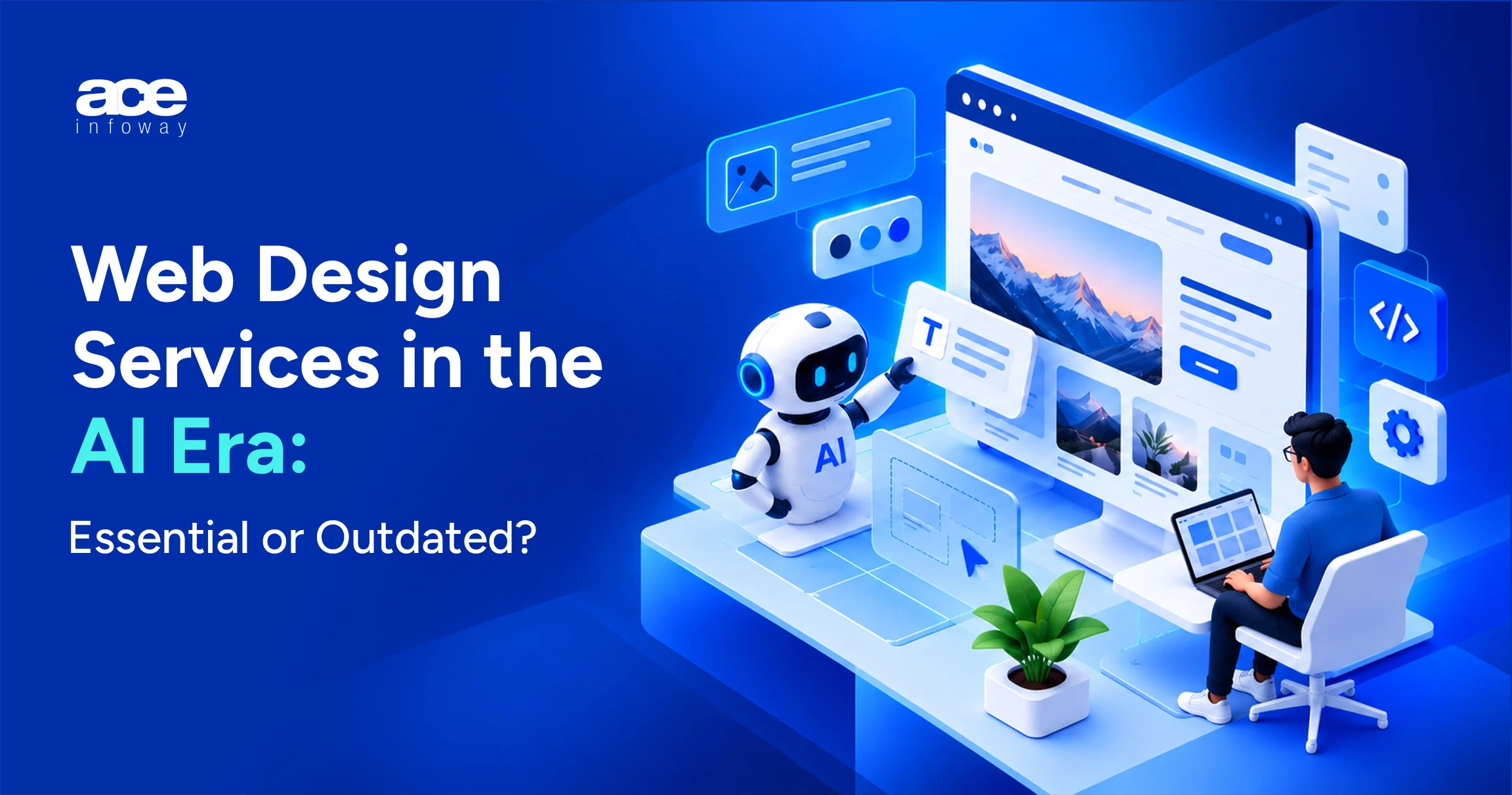
AI has made website development much easier, and this is an understatement. The vibe coding wave has taken the web development market by storm. But that’s again a thing of the past. If you look at the current market, the entire narrative has flipped. And web design services are now becoming more important, but why?
A study by NN Group shows that replicating human design output is a major concern for most narrow-scope AI tools. So, matching the client’s needs and delivering what a brand identity stands for is complex for most AI tools at their current capacity.
And this is where web design services come into play. With the right mix of AI-based tools and experienced web design services, businesses can ensure a better customer experience while delivering it at a rapid pace.
This piece goes beyond the question: are web design services required in the AI era? It includes what a web design service offers to your business, what strategy you should follow, and how to choose the right service.
What Do Web Design Services Include?
Web design services have evolved, going beyond manual visual drafting. With the rise of generative AI tools that handle the baseline layout generation, professional web design services offer a deeper insight into aspects like,
- Full-scale digital systems architecture
- Legal accessibility compliance
- Conversion engineering
- Research optimization
A comprehensive web design service offers,
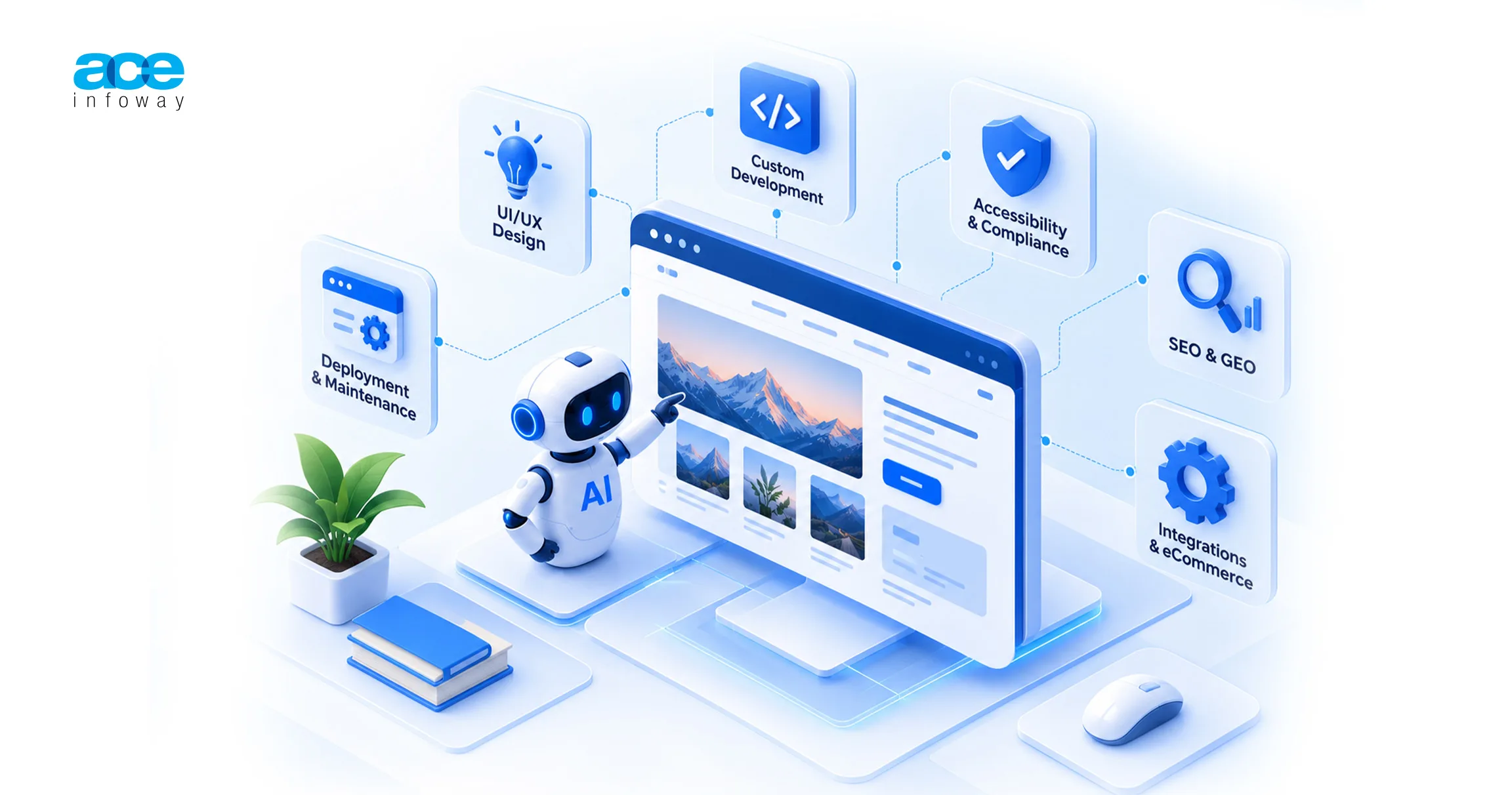
UI/UX Strategy and Visual Design
A polished site that confuses visitors still loses leads. So structure comes first and styling second. Sitemaps and wireframes set the layout, responsive designs sit on a component system, and CRO work places CTAs and trust signals where buyers decide.
Architecture and tailor-made development
Templates are for simple sites. If you want speed and control then custom code on react or next.js. Git-based delivery means you own your code and the server-side rendering means search engines and AI crawlers can read your pages. A CMS like WordPress or Webflow makes it easy for your team to keep updates.
Accessibility and Legal Compliance
Inaccessible sites can create legal exposure under the ADA. So WCAG 2.1 and 2.2 Level AA is built in from the start, then tested with keyboard navigation and screen readers like NVDA, VoiceOver, and JAWS.
SEO and GEO
Ranking on Google is no longer the only goal. Being cited by AI answer engines is the second. Clean technical SEO, JSON-LD schema, and content built around conversational queries help both.
Integrations and eCommerce
A site that cannot talk to your business systems creates manual work. Custom connections link it to your CRM, payment gateway, ERP, and accounting tools, while checkout, inventory, and shipping rules match how you sell.
Deployment and Maintenance
Launch is the start of the maintenance cycle, not the end. Hosting, security patches, uptime monitoring, and regular performance and accessibility checks keep the site healthy.
Traditional vs. Modern AI-Integrated Web Design Services
The table below shows how each area differs between a traditional agency and an AI-integrated one.
| Service Capability | Traditional Web Design Agency | Modern AI-Integrated Agency | Primary Business Impact |
| Development workflow | Manual HTML/CSS drafting and static mockups. | AI-assisted wireframing (Relume) and modular component scaffolding (v0). | Shorter production cycles, with billable time shifted to custom strategy. |
| Search strategy | Keyword density, meta tags, and backlink outreach. | Generative Engine Optimization (GEO) and JSON-LD schema markup. | Better odds of inclusion in conversational AI engines and AI Overviews. |
| Accessibility | Automated audit scans and basic alt text. | Manual screen reader audits, keyboard mapping, and WCAG 2.1/2.2 AA verification. | Lower legal exposure under ADA Title II and III. |
| Architecture | Monolithic templates and standard plugin add-ons. | Custom API middleware, headless CMS setups, and autonomous agent workflows. | Code ownership, faster pages, and real-time enterprise data sync. |
Web Design Scope: What You Get and What Costs Extra
Web design services cover everything from strategy to launch support, but copy, photography, hosting, and licenses are often billed separately.
| Phase | What you get | Usually extra |
| Strategy and discovery | Goals, content and SEO audit, sitemap, scope sign-off, and a written brief | Copywriting |
| UX and UI design | Wireframes, prototypes, responsive layouts, and agreed review rounds | Photography |
| Development | Build on the chosen platform, integrations, and CMS setup | Software licences, hosting, and domains |
| Content and QA | Content loading, plus performance, accessibility, and security testing | Ongoing SEO |
| Launch and support | Go-live checklist, redirects, monitoring, and a support window | Maintenance after the support window |
Service types follow the same phases. Custom design is built around your brand and workflows, and responsive design makes every layout work on every screen.
Ecommerce design adds catalogs, checkout, and payments, while a redesign improves an existing site and protects the rankings it already has.
The Web Design Process From Strategy to Launch
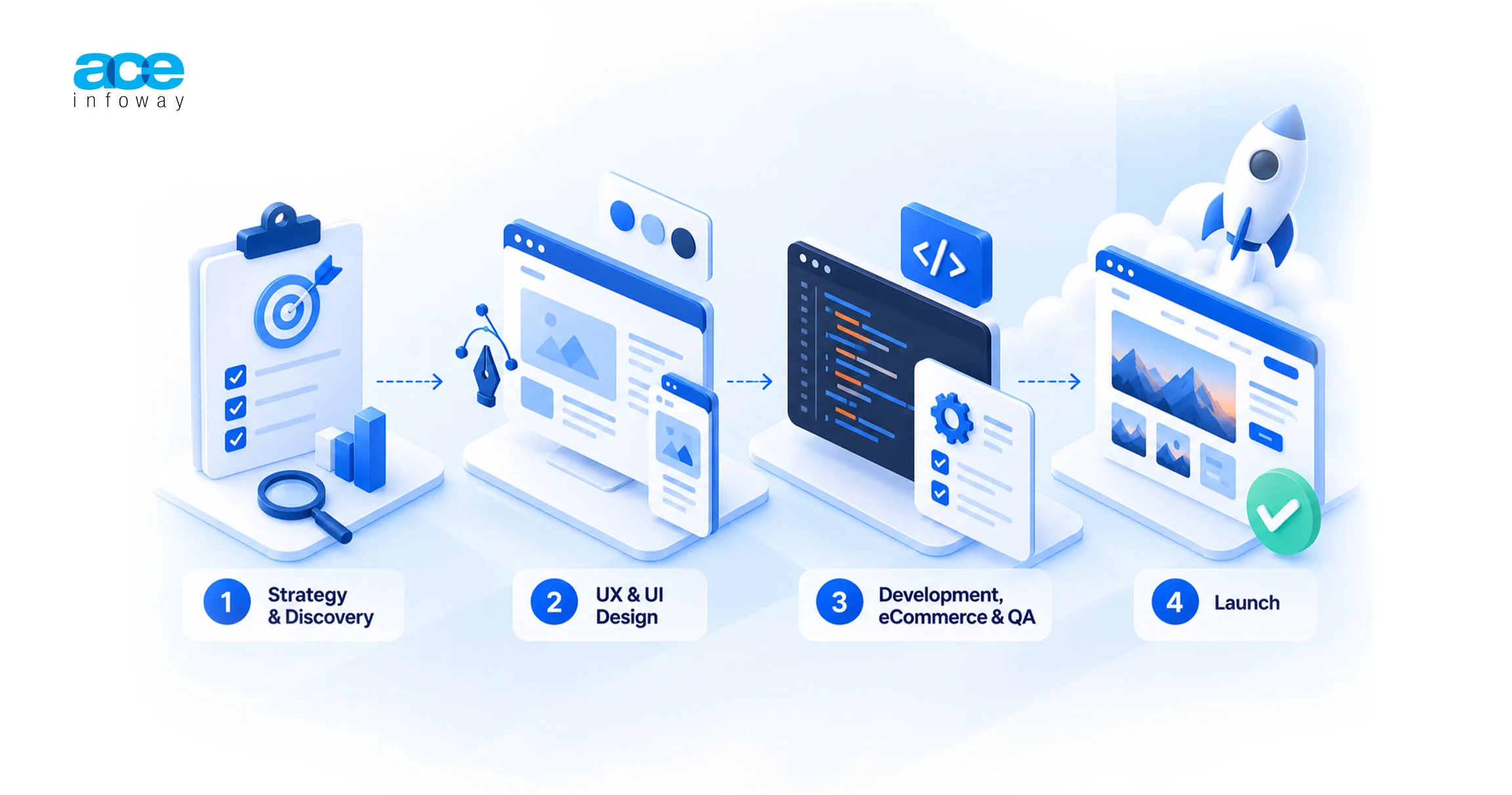
Strategy and Discovery
Discovery sets the scope before any design starts. It covers a content and SEO audit, a sitemap, and scope sign-off. It also checks how AI tools find and read your site, because 72% of consumers use gen AI tools regularly, and one in two gen AI users has informed a purchase decision with it. That is the search habit buyers bring to work.
End discovery with a copy-ready brief of eight fields: business goal, audience, success metric, sitemap and page count, content owner, integrations, launch date, and a single approver. This brief keeps every later phase tied to one goal and one owner.
UX and UI Design
Design turns the sitemap into wireframes and clickable prototypes, then into responsive layouts that work on every screen size. Agree the number of review rounds and the sign-off step in the contract, because open-ended revisions are a common cause of delay.
Decide upfront if you want custom design or templates. Templates are cheaper and faster for simple sites, and custom design is better for brands with complex journeys, integrations, or an identity to protect. Whichever route you choose, ask about the ownership of the design files and who will approve the final layouts before development begins.
Development, Ecommerce and QA
The development process starts with picking the platform and integrations your site needs, including CRM, payments and ERP. Now that shopping AIs read structured product data, it’s becoming more important for stores. By 2030, agentic commerce could be orchestrating $3 trillion to $5 trillion of goods globally.
QA covers performance, accessibility, and security testing, and it belongs inside the build, not after launch, when fixes cost more and the site is already live. The cost of skipping it is real: the global average cost of a data breach is $4.44 million, and the US average is $10.22 million.
Website Launch Checklist
Before go-live, confirm these eight items, each with a named owner:
- Redirects (developer): map every old URL to its new one.
- Metadata (SEO lead): check titles, descriptions, and schema.
- Analytics (marketing lead): confirm tracking and conversion goals.
- Forms (QA lead): test every form and confirmation email.
- Backups (developer): set automated backups and test a restore.
- Security (developer): check SSL, access roles, and patches.
- Monitoring (devops lead): set uptime and performance alerts.
- Post-launch support window (project manager): confirm its length and terms.
Web Design Timeline and Cost: What Drives Both
Scope, content readiness, and approvals move both the timeline and the price more than design does.
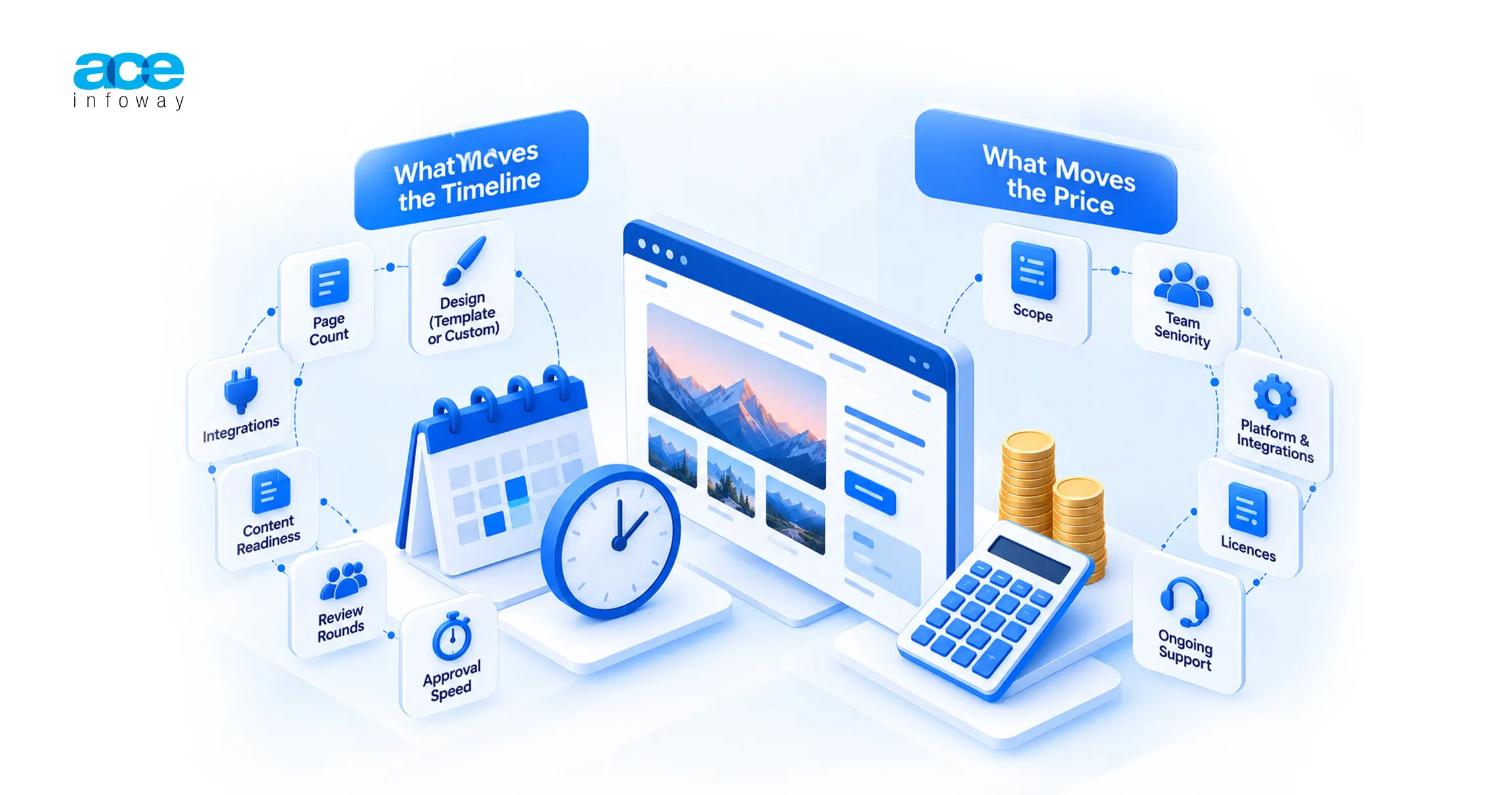
What Moves the Timeline
Six factors set the schedule: page count, custom design or a template, integrations, content readiness, review rounds, and approval speed. Late content and slow approvals cause more delay than design work.
To keep your launch date, freeze scope after sign-off, name one approver, and set a content delivery date in the contract. Integrations and ecommerce features add testing time, so list them in discovery, not mid-build.
A template site with few pages can launch in weeks, while a custom build with ERP or payment integrations needs a longer runway. Ask each agency to show the schedule phase by phase, with the dates on which your own input is due.
What Moves the Price
Five factors shape the price: scope, team seniority, platform and integrations, licences, and ongoing support. More pages, custom components, and third-party connections all add effort.
Senior teams cost more per hour but usually need fewer rounds. Licences for themes, plugins, and tools can sit outside the quote. Ask every agency for line items rather than a single total, so you can compare proposals on the same scope.
Check what the quote leaves out, such as copywriting, photography, hosting, and maintenance after the support window, because these gaps usually explain why two proposals for the same site differ in price. A lower quote with fewer inclusions is rarely the cheaper option.
How to Choose a Web Design Company
Questions Worth Asking Before Signing
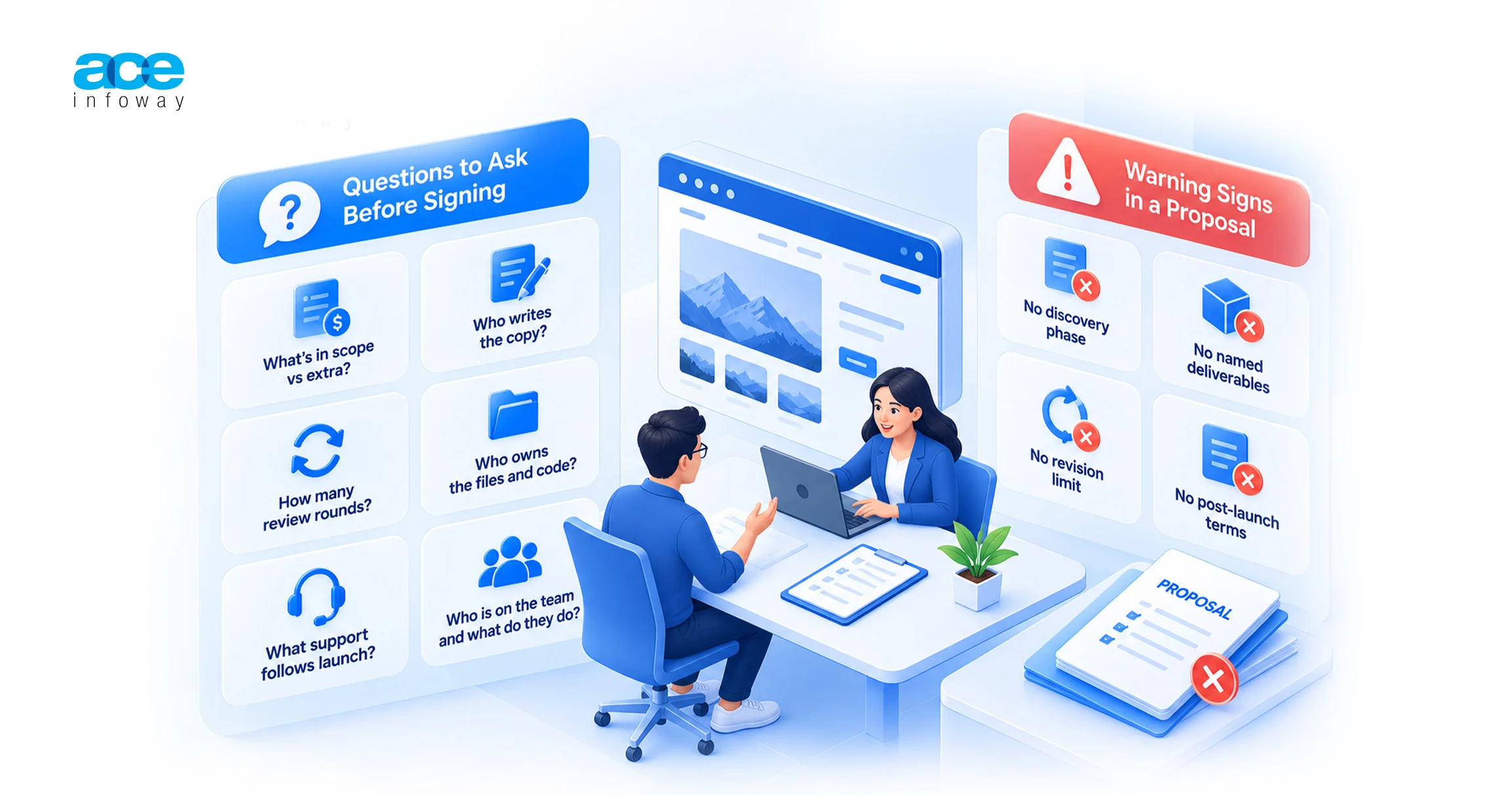
Six questions separate clear proposals from vague ones. Get every answer in writing, and compare the answers across agencies before you decide.
- What is in scope, and what is billed extra?
- Who writes the copy?
- How many review rounds are included?
- Who owns the files, code, and accounts?
- What support follows launch, and for how long?
- Who is on the team, and what does each person do?
Warning Signs in a Proposal
Be careful when a proposal shows any of these gaps, because each one tends to become an unplanned cost or delay:
- No discovery phase
- No named deliverables
- No revision limit
- No post-launch terms
Ask to see a project like yours and the result it produced, such as faster load times, more qualified leads, or higher conversion. A portfolio shows what an agency can design.
A result shows what its work did for the business. If an agency cannot name an outcome, treat its portfolio as a style gallery and keep asking. Request a reference you can call, and ask what the agency would change about that project.
Conclusion
Buying web design comes down to four decisions: scope, budget, timeline, and partner. Settle the scope first, because it sets the other three, then choose a partner that puts them in writing. The shift to rep-free buying raises the stakes. Gartner found that 61% of B2B buyers prefer a rep-free buying experience, so your website is now the first sales conversation for most of them.
FAQs
What Is Included in Web Design Services?
Web design services include strategy and discovery, UX and UI design, development, content and QA, and launch support. Copywriting, photography, hosting, software licences, and ongoing SEO are usually billed separately, so confirm them in the scope.
How Much Do Web Design Services Cost?
Cost depends on scope, team seniority, platform and integrations, licences, and ongoing support, not on design alone. Ask for line items so proposals can be compared, and see the timeline and cost section for the drivers.
How Long Does a Website Redesign Take?
A redesign takes as long as its scope, content readiness, and approvals allow. Page count, integrations, and review rounds add time, so freeze scope after sign-off and name one approver to protect your launch date.
What Are the Steps in the Web Design Process?
The process runs from strategy and discovery to UX and UI design, development and QA, and launch. Each stage ends with a sign-off, and QA, including accessibility and security testing, happens before go-live.
What Should Be in a Web Design Brief?
A web design brief should hold eight fields: business goal, audience, success metric, sitemap and page count, content owner, integrations, launch date, and a single approver. A clear brief prevents most scope disputes.